
Salvini puts the brakes on Meloni’s bid for the Quirinale: ‘I can see her as prime minister in autumn 2027’
And the League says no to the preferential voting system favoured by Fdi

Key points
The League is applying the double handbrake: on Giorgia Meloni’s candidacy for the Quirinale and on voting preferences. But on the electoral law, Fdi is not giving up and still has faith in mediation, all the more so following the one-week postponement of the vote in the Chamber of Deputies, from 7 to 14 July, decided by the Conference of Group Leaders alongside a cap on the duration of the debate, limited to 22 hours.
Salvini’s coldness
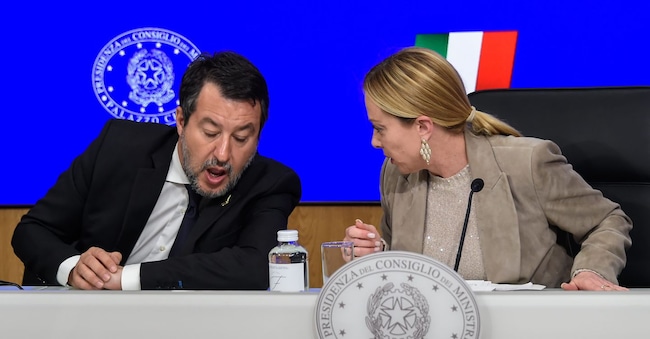
The centre-right’s key figures could meet again on 2 July, two days before the summit on Tuesday, where the League had already made its stance clear. On 1 July Matteo Salvini showed his indifference towards a proposal he felt was being imposed on him rather than one he supported (“‘I don’t have time to deal with it, I’m not keen on it; the important thing is to have a law that allows whoever wins to govern’) and, above all, made no secret of his coolness towards the idea of the Prime Minister moving to the Quirinale: ‘I can see Giorgia Meloni doing well anywhere, but I can see her doing well as the new Prime Minister in the autumn of next year. But we still have more than a year’s work ahead of us, so it’s too early to talk about any of this.’
Lega Nord member Molinari: ‘The reform is already a compromise’
Meanwhile, the Lega’s group leader in the Chamber of Deputies, Riccardo Molinari, pointed out that the Carroccio had already made far too many concessions on the new voting rules. “This electoral law,” said Molinari, speaking as a guest on Start on Sky Tg24, “stems from an agreement between the majority parties and was requested primarily by Fdi and Meloni, in the name of stability. We in the Lega, who are deeply rooted in the local communities, especially in the North, believe that the best model was the one we had before, with constituencies.” The reform was only accepted because of the agreement within the centre-right, Molinari added, “but it’s not as though other parts can now be called into question. This text is already the result of a compromise; constantly adding ‘one more’ creates difficulties.”
The Northern League leader on the Belgian model
Lega members are not keen on the hybrid proposal put forward by Meloni’s emissaries, Giovanni Donzelli in particular, which is inspired by the Belgian model: a closed list that also gives voters who so wish the option to cross out candidates they favour after the first two. With an eligibility threshold that remains very high and a complex system of vote transfer, this mechanism – as the Democrat Dario Parrini observes – ‘only very rarely allows the closed list to be unblocked. The proportion of those who manage to break through it ‘is historically very low: around 10 per cent of the total number of those elected in the last election, and even less in the past’.”
For the League, this would favour Fdi and the PD
For the League (and also for Forza Italia), this is not a welcome change. Molinari made this clear: ‘The system of two fixed lead candidates followed by preference votes does not convince us because, in effect, it would serve only one purpose: to strengthen the strongest parties, the PD and FDI. Preferential votes favour those with more money to spend and greater resources for campaigning. I would like to point out that the reason preferential votes no longer exist is because Italians voted in a referendum in the early 1990s to abolish them.”


