Towards the Budget Bill

Budget Bill, Salvini: ‘Banks? A 5 billion contribution is the bare minimum.’ The ABI: the measure was not agreed upon

The Deputy Prime Minister: huge profits derived mainly from interest and commissions paid by citizens, households and businesses. Torriero (ABI): as banks, we have increased revenue for the State, both through the 2025 Budget Act, contributing 4.5 billion, and then a further 10.2 billion through the 2026 Budget Act

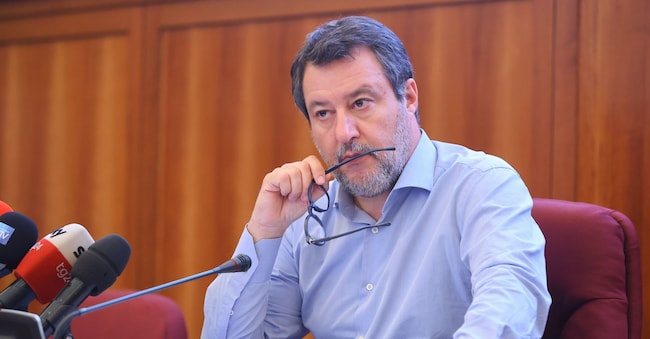
FOTO ARCHIVIO 7146

5' min read

Translated by AI
Versione italiana

5' min read

Translated by AI
Versione italiana

The back-and-forth and disagreement over the banks’ contribution to the 2027 budget continue. Adding fuel to the fire is Deputy Prime Minister and League secretary Matteo Salvini, who has been an advocate from the very beginning of banks contributing to the new revenue provisions of the Budget Law. ‘The remarks by ABI President Antonio Patuelli are surprising; he has even invoked the Constitution,’ comments Salvini, ‘complaining that bankers are being financially “beaten up”.’ But a response came swiftly from Gianfranco Torriero, Deputy Director-General of the ABI: “The provision in the budget has absolutely not been agreed upon, unlike what has happened over the past two years.”

The figures quoted by the Deputy Prime Minister

“The figures, to their credit,” continues Salvini, “tell a completely different story: 25.5 billion in profits in 2022, 40.6 in 2023, 46.5 in 2024 and 47.5 in 2025. And this year, profits of over 50 billion euros are forecast. Meanwhile, between 2022 and 2025, the banks have closed 2,510 branches and made 12,900 employees redundant.”

Loading...

The tax rate

‘Not to mention,’ Salvini adds, ‘that in 2025 their effective tax rate stood at 19.2 per cent – a tax burden well below that of other businesses. These colossal profits stem mainly from the interest and commissions paid by citizens, households and businesses. Asking for a contribution of at least 5 billion euros from one of Italia’s richest and most protected sectors will be a measure of absolute common sense.”

The banks’ response


“To echo President Patuelli’s remarks, the intervention in the budget is entirely uncoordinated, unlike what has happened over the last two years,” said ABI Deputy Director-General Gianfranco Torriero, referring to the contribution requested of the banking sector in the budget, during the conference call on the association’s monthly report.

Its role in increasing tax revenue

“Let us recall that, as banks, we have increased revenue for the State, both through the 2025 Budget Act, to the tune of 4.5 billion, and then by over 10.2 billion through the 2026 Budget Act ,” explained Torriero, “and, in particular, regarding the 2026 Budget Act, there had been a commitment agreed with the government and the parliamentary groups representing it for a period of three years.”

“This is simply the position we are taking,” he concluded, “when agreements are made, they should always be honoured; I stand firmly by the words formally expressed by our president.”

Tajani: Banks can be asked to contribute, but without aggression

Forza Italia is insisting on resuming dialogue with the banks. The party’s secretary and Deputy Prime Minister, Antonio Tajani, reiterated the party’s position on the matter on the sidelines of the Confindustria Young Entrepreneurs’ conference in Capri: ‘No one thinks anyone is going to die; it is a question of approach – the way in which we engage with the business community. The Government must not be aggressive; it must be inclusive. Therefore, a centre-right Government cannot be one that attacks part of our economic system, because the banking system is fundamental to supporting businesses.’ Furthermore, ‘we must be careful not to let the consequences fall on account holders. So we must be very cautious and also take into account the specific nature of our system, which is a two-tier system: large banks and local banks, namely the BCCs and cooperative banks. So we must always examine the issue in depth, not with demagoguery, not with aggression, because aggression never pays off’, added Tajani.

‘A moderate government, a centre-right government, must always seek to involve all parties, just as we have done in the past. We have a three-year agreement with the banking and insurance sectors, and we have also found a way to involve the energy sector without imposing taxes. So the fewer taxes we impose, the better. We will talk about this and discuss it calmly,” he clarified.

The banking sector, Tajani continued, “is part of our economic system; it must contribute, as everyone else does, to overcoming the problems we face, but without aggression, without threats, without verbal abuse, because these only make the situation worse. So I believe that problems are resolved through dialogue, and we hope that they can be resolved this time too, just as we did last year through dialogue and as we have done with the oil companies in recent weeks’.

With regard to the estimated figure of 5 billion euros in contributions from the banks, Tajani clarified that ‘we need to see what scope we are given; we’ll see who will have to contribute; we’ll need to discuss it and assess the situation. I have always believed that we need to have a serious and in-depth discussion; we will discuss this with the majority, and we will discuss it within the Government. The figure relating to the financial system as a whole is indicative; the financial system is not just banks – there are other entities too – and we will discuss this. I repeat, I am in favour of a contribution from the financial sector and the way in which that contribution is requested. Contributions are not demanded through threats, nor are they demanded through insults’.

Loading...

Craxi: returning to the path of constructive dialogue

Stefania Craxi, leader of the ‘Azzurri’ group in the Senate, echoed this sentiment: ‘I hope that, together with the banking sector, we can resume as soon as possible the path of fruitful and constructive dialogue which, in recent years, has enabled us to address sensitive issues without creating tensions or uncertainty. There are appropriate ways and times to engage in discussion and find mutually agreed solutions, by returning to a sensible approach and avoiding paths that risk harming the system as a whole. In this regard, the comments made by the ABI deserve to be listened to carefully. Not because the banking sector should be exempt from any form of contribution, but because the key issue concerns the approach. The path followed in recent years has delivered results and predictability, without causing disruptions or sending negative signals to the markets. Not to mention that an uncoordinated intervention risks setting a dangerous precedent. Investors assess a country’s soundness not only through the figures, but also through the stability of the rules. Any element of uncertainty inevitably translates into an increase in perceived risk, with possible consequences for the costs borne by households and businesses. A sound fiscal policy must also assess its effects over time, taking into account the impact on credit to the real economy, on investment capacity and on market participants’ confidence. For this reason, it is necessary to act with prudence, responsibility and foresight, both in decision-making and in public statements, whilst safeguarding a balance that serves the country’s general interest.’

Copyright reserved ©
Loading...

Brand connect

Loading...

Newsletter

Notizie e approfondimenti sugli avvenimenti politici, economici e finanziari.

Iscriviti