The interview

Samantha Cristoforetti talks about her new private space station project

At the 75th IAC 2024, the astronaut presents the ambitious project he is working on
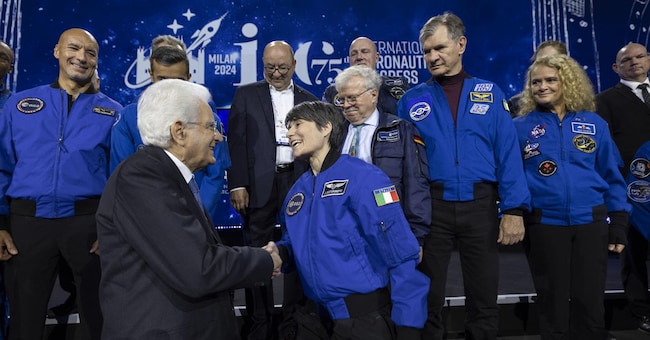
by Chiara Albicocco

 Samantha Cristoforetti incontra il presidente della Repubblica

3' min read

3' min read

She spent 369 days in space. Samantha Cristoforetti, an Italian astronaut of the European Space Agency, has participated in two important missions: Futura in 2014 and Minerva in 2022. During the latter she served as commander of the International Space Station and was the first European to conduct an extravehicular activity, the so-called spacewalk.

On the occasion of the seventy-fifth edition of the IAC 2024, the world congress of astronautics, held in Milan from 11 to 18 October 2024, Samantha Cristoforetti presents the ambitious project she is working on. It is a cargo shuttle service to future space stations that will orbit the Earth.

Loading...
Samantha Cristoforetti: “Europa verso l’autonomia spaziale”

What function will these cargo vehicles have and where will they be going?
The vehicles will be two because we have signed contracts with two European companies: Thales Alenia Space of Turin, a company with great space experience, and The Exploration Company, a Franco-German start-up. We would like them to complete the development of cargo refuelling vehicles in addition to the design.

The project is called LEO (Low Earth Orbit) Cargo Return Service and will be used to bring supplies to future private space stations that will take the place of the International Space Station (ISS). These platforms will undoubtedly be used by astronauts and astronautesses, but also by wealthy individuals who will be able to buy a ticket to take a ride in space. They will be the bases for all those people sent by companies, institutions and universities to carry out scientific research.

These stations will need food, water, clothing, technological equipment and spare parts. Our cargo vehicles will carry these supplies. Consider that at this moment, more or less 15 tonnes of supplies are sent to the ISS every year (not including the Russian part).

The real news for Europe is the ability these vehicles will have to return to Earth. We would like to make a first demonstration flight in 2028 on the ISS, before it is decommissioned for good in 2031. There is no time to lose, we must hurry, both on the part of the European Space Agency, promoter of the project, but above all on the part of the companies that finance these vehicles with direct investments of at least 40%. They really have to believe.

L’astronauta Cristoforetti al lavoro su nuovi veicoli cargo spaziali

Photogallery5 foto

Could these vehicles one day become a kind of taxi and carry human beings on board as well?
My dream in my (and many others') drawer is that this will become an opportunity for European industry to show that we are capable of building these vehicles cheaply, quickly, and that, once we have won the trust of our governments, we can take the next step: the development of a vehicle to transport astronauts.

We all have in mind the spectacular images of Space X's Starship rocket that a couple of days ago returned perfectly to the launch pad. Is the Moon today a little closer for human exploration?
Surely the Moon is the next concrete goal. We will continue to have astronauts in low orbit, but in that range it no longer makes sense to continue to call it 'exploration'. We could say that we have moved from exploration to exploitation, which means the exploitation of the opportunities that arise for research and private operators.

Regarding exploration, however, we want to return to the Moon with a robust and permanent presence, not as it was in the 1960s and 1970s. Starship is an important element in this goal because Space X has proposed to NASA a lander version of Starship, capable of reaching the lunar surface.

Every Starship flight that demonstrates new capabilities brings us one step closer to the realisation of these 'landing' missions on the Moon.

I have to say that the return of the Starship booster, filmed on the launch pad, was truly science fiction and I think it makes the heart race from a technical point of view. Of concern is the ever-widening gap between Space X's capabilities and those of everyone else.

Are large injections of private capital, such as Elon Musk's, a risk or an opportunity for the space economy?
Private investment has overall been a significant injection of resources and innovation. I don't think we need to worry about that, I would rather focus on how to narrow the gap for Europe compared to other realities. Here, access to high capital is much more difficult. In short, we have to try to systemise the available resources and we have to do it strategically so that we do not find ourselves in a situation that could become irretrievable.

Copyright reserved ©
Loading...

Brand connect

Loading...

Newsletter

Notizie e approfondimenti sugli avvenimenti politici, economici e finanziari.

Iscriviti