
Samsung's challenge: more revenue and production in memory chips
Tech. The South Korean giant leverages super-fast microprocessors linked to artificial intelligence. In smartphones there is competition from Apple and China

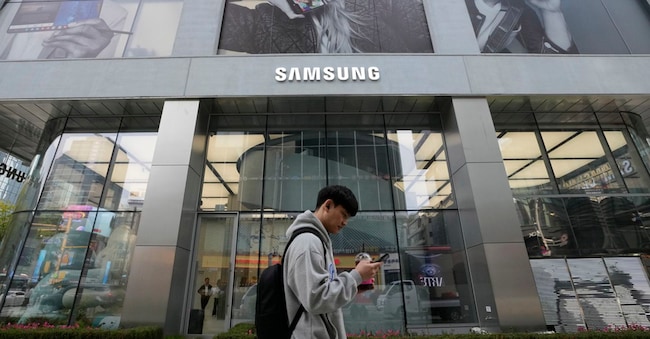
Artificial intelligence. Always her. Declined, in the specific case of Samsung Electronics, mainly in the form of the new super chips for computer memory. It is one of the building blocks of the development strategy on which the South Korean conglomerate is banking.
Social Object
A giant which, it is worth remembering, essentially divides its business into four major areas: Device eXperience (Dx), Device solutions (Ds), Samsung display corporations (Sdc) and Harman. The first segment (48.4 trillion won in revenue in Q3 2025, or approximately EUR 28 billion) represents the consumer front. This includes smartphones, tablets, wearables, TVs, home appliances and 5G and 6G network solutions. Device solutions (33.1oo billion won), on the other hand, constitutes the technological engine of the company. It includes memory chips for Ia such as Dram and Hbm, as well as processors designed in-house and chips made in the company's foundries (also for third parties). Then there is Sdc (8,100 billion). That is: the division that on the one hand supplies Oled screens for premium smartphones, laptops and monitors; and on the other hand, makes Qd-Oled panels for high-end TVs. Finally: Harman (4,000 billion in turnover). Belonging to this area are audio systems and technologies for the connected car.
The super chips for Ia
Well: emphasising the articulation of the business, which is one of Samsung's strengths, in the third quarter the Ds division was the one with the highest revenue growth (+13% year-on-year). In particular, the lion's share was accounted for by the Memory business - driven mainly by demand for artificial intelligence (Ai) - which rose by 20%. Not only that. Even at the operating profit level, Device solutions was characterised by the greatest increase in profitability (expansion of 3.1 trillion won). In short: the main driver of the South Korean giant's turnover and profitability has been the business of memories and advanced components required for Ai. Above all: the ultra-fast 'stacked' memories called Hbm (together with Ddr5) and the so-called eSsd exploited in data centres for enterprises.
The medium term
Up to this point, some suggestions regarding some of the most recent income statement dynamics. However - as always happens - in order to better grasp the group's performance, it is useful to broaden the time span of analysis. In 2020, Samsung closed the year with about 236.8oo billion won in revenue and 35.990 billion won in EBIT. The operating margin, for its part, was 15.2%. In 2021, at the height of the digital race, consolidated sales increased to around 279.6 trillion won and operating profit stood at 51.6 trillion won, with a double-digit margin of over 18%. In 2022, sales reached 302,230 billion won: a record for volume. And yet, the operating result slipped to 43.38o billion (margin at 14.4%). A trend that signalled that simply increasing volumes was not enough to guarantee high profits. Then came 2023, the most critical point. In that financial year, demand for semiconductors fell and - thanks to an oversupply that crushed prices - the company ended the year with revenues of 258,940 billion won and a meagre EBIT of around 6,570 billion won: minimal margins, loss of competitiveness in the memory segment, and strong doubts about the future. An environment that materialised several clouds on the horizon of the Asian conglomerate.In 2024, however, demand stabilised: there was the gradual recovery of the chip sector and a moderate recovery of the consumer segment. Thus Samsung was able to climb to 300.9 trillion won in total turnover, with EBIT of 32.7 trillion won and an operating margin of 10.9 per cent. 2025 marked the turnaround. In the third quarter - at an overall level - the group generated sales of 86.1 trillion won and an operating profit of 12.2 trillion won. Beyond past dynamics, however, the do-it-yourselfer asks: what are the future moves? With regard to semiconductors, the company's Ds division, in the current financial year it is mainly focusing on high-end memories: Hbm3E, i.e. ultra-wideband 'stacked' memory for GPUs and Ai, and 128GB Ddr5, used in next-generation servers. More generally, the group plans to leverage all the higher value-added memories. With regard to next year, however, Samsung - among other things - confirms the goal of starting production in the new Taylor (Texas) factory in the United States. From microchips to Device eXperience (Dx), which includes all consumer products. Here, the company wants to focus on smartphone sales in the fourth quarter (also in view of the Christmas season). In particular, the intention is to focus on the Galaxy S25 range and foldable mobile phones, to be integrated with artificial intelligence functions in order to differentiate products and push premium models.With regard to Sdc, on the other hand, the group expects - in the fourth quarter - a positive contribution thanks to the launch of new premium models of major customers and the increase in demand for gaming monitors based on Qd-Oled technology. Finally, the Harman business. The subsidiary focused on premium audio and automotive technologies, enters the fourth quarter with growth expectations in both consumer solutions - thanks to seasonality - and automotive infotainment systems. And what about 2026? The forecast is to expand its presence in the automotive sector through a more diversified portfolio of manufacturers and new audio brands.
The problems
All roses and flowers, then? The reality is more complicated. First of all, on the geopolitical side, we have to remember the trade tensions and US tariffs on imports from Vietnam. This is a relevant issue, as the country in question is a strategic hub for Samsung's mobile phones. So much so that the company is reviewing production chains and costs. Not only that. Another aspect highlighted by the operators concerns governance and internal structure. The company is 'moulded' on the basis of (also) the complex 'chaebol' structure typical of South Korea: an organisation that risks limiting efficiency and transparency in strategic decisions. Another element of potential vulnerability is the strong dependence on Dram and Nand memories, sectors that in the past have suffered strong price and demand fluctuations due to global overcapacity. More. Also on the semiconductor front, competition on several fronts - from Chinese rivals to other advanced chipmakers such as Qualcomm in mobile and Tsmc in foundry - is a further critical issue for growth and margins. Last but not least, there is strong competition in the smartphone segment, especially with brands such as Apple in the premium segment and Chinese manufacturers on the cheaper offerings. True, according to Idc Samsung at the end of the third quarter of 2025 has the first place as global market share (19%) on the total amount of mobile phones sold (Apple has the second position with 18.2%). Having said that, however, the underlying consideration does not change: the competition on this type of device is very strong and the company's results can be impacted (positively or negatively) by the revenue trend related to smartphones et similia.


