
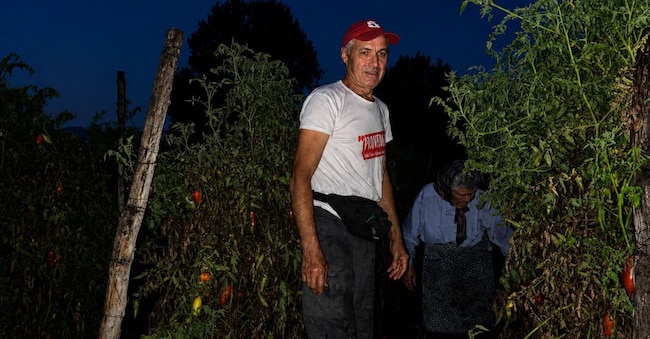
San Marzano by night: in the Agro Sarnese-Nocerino area, tomatoes are harvested at night
To shelter from the extreme heat, Danicoop’s farmers work in the fields from 3 am to 10 am. The result? One of the best harvests on record

Key points
‘Out in the fields at night, it’s harder to move about and find your way. The darkness doesn’t help, but at least it shields our farmers from this summer’s record-breaking heat.’ Indeed, not a breath of air moves amongst the rows of San Marzano tomatoes, and the perceived temperatures during the day make the fields of the Agro Sarnese-Nocerino region impossible to work in.
Night-time harvesting of San Marzano tomatoes
Tomatoes, traditionally grown on trellises, much like rows of grapes, have ripened far too quickly this year: harvesting had already begun before mid-July – more than 15 days ahead of schedule. Paolo Ruggiero, of Danicoop – a long-established cooperative, one of the largest in the area with its 40 members – which oversees the entire San Marzano supply chain, right through to the PDO peeled tomatoes in tins (Kiros variety), feared the worst: ‘But our farmers, who, incidentally, are not exactly in the prime of life, organised themselves independently, swapping their shifts from 3 am to 10 am and from sunset to 10 pm.’ Thus, by planning ahead and working through the night, the farmers of the Sarnese cooperative have produced what is perhaps one of the best harvests ever: 9,000 quintals of gleaming San Marzano tomatoes, for which the farmers were paid 75 centesimi per kg. This amounts to approximately 10 million euros.
Peeled and puréed tomatoes ready for export
All in all, the losses were limited: ‘Just under 20 per cent, particularly the tomatoes from the last row – the fourth – grown on land in San Valentino Torio. The rest of the harvest reached our factories, where we process the tomatoes into peeled tomatoes and tomato purée. Our shipments, excluding those for large-scale retailers, are then sent abroad. We export 60 per cent of our produce, which goes as far as Korea and is supplied to pizzerias and restaurants all over the world.”
Aunt Regina and Uncle Vincenzo, icons of the Sarnese tomato
Aunt Regina, aged 87, and Uncle Vincenzo, aged 82, also work under the moonlight; they have become the symbol of a family-run farming business that has gone from strength to strength over the years – Giuseppe, Regina’s son, is also out in the fields – and which attracts chefs, tourists and entrepreneurs. Every year, people come from every continent to discover the secrets of this fertile, volcanic soil, which yields produce of the highest quality. Welcoming them is Paolo Ruggiero, who represents the fourth generation at Danicoop. His father, Edoardo, is the chairman.
The intractable issue of ‘Italian-sounding’ names
But whilst the San Marzano has had to contend with climate change this year, the Sarno tomato – with its strong evocative power – has long been battling counterfeits, despite its PDO status: ‘I was at the Fancy Food Show in New York and realised that the problem cannot be solved. In America,’ concludes Ruggiero, ‘they’ve replaced the word “tomato” with “San Marzano”. And the products on display at the fair – even right in front of our own institutions – were mostly fakes, despite bearing our label. This does us a great disservice, given that in the United States, 95 per cent of ‘San Marzano’ products are simply ‘Italian-sounding’ imitations.”

