
São Paulo economic and industrial hub for global development
Opportunities for Italian companies. In Brazil the first leg of the international roadshow ahead of the 21st edition of the Trento Festival

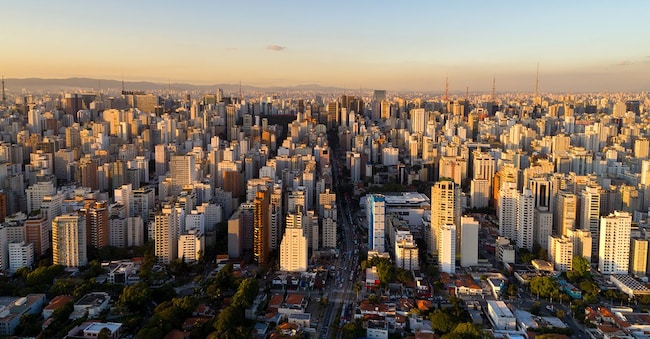
SAN PAOLO - It is South America's most vibrant metropolis, a pole of attraction and opportunity. But São Paulo is not just a big city, it is above all a Brazilian state of great economic importance. A region capable of attracting workers, investors, students. And offer extraordinary spaces for businesses at a time when other geographical contexts in Europe and the Middle East are characterised by wars, conflicts and instability.
An important city in the history of migration to Brazil, where there are still 15 million Italian descendants. This constitutes a connection point with the strong demand for Made in Italy, a driver for bilateral activities, both commercial and industrial. These are the driving factors that led to Brazil being chosen as the first stage of the 'Road to Trento', organised abroad by Il Sole 24 Ore in view of the 21st edition of the 'Trento Economics Festival' scheduled from 20 to 24 May 2026, promoted by Il Sole 24Ore with the Province of Trento.
At the centre of yesterday's debate was São Paulo's ability to establish itself as one of the main economic and industrial hubs globally. Describing its features, in watercolour, is Graziano Messana, president of the Italian Chamber of Commerce in São Paulo, a post renewed a few days ago for the next three years. 'Brazil is no longer just a cyclical promise of the global economy, a junction through which capital, energy and new geopolitical ambitions flow. It is not the periphery observing the centre, but a territory redrawing maps as the world changes coordinates. In this sense, São Paulo appears as an engine room: noisy, complex, but indispensable to fuel the engine of regional growth'. In this dynamic, Italia plays a far from marginal game. 'There are more than 1,100 Italian companies,' says Messana, 'rooted in the Brazilian productive fabric, they are like deep roots under fertile soil: not always visible, but essential to give stability and continuity to development'.
An analysis in line with the point of view of Paola Boromei, Chief Operating Officer of Il Sole 24Ore: 'In a global scenario that is growing but increasingly fragmented and unstable, companies can no longer act alone or read markets from a national perspective. The focus on Italia-Brazil opens a new phase of relations, where community, culture and operational tools become competitive levers'.
A significant testimony is that of Domenico Fornara, Consul General of Italy in Sao Paulo, according to whom 'the Brazilian market is rich in resources, open to innovation, with strong growth potential, and has a very complementary structure compared to the Italia market.

