
Sanchez challenges Trump: 'We will not be complicit, no to war'
The conflict in Iran serves to 'hide internal failure: this is how the great disasters of humanity begin'. Spanish PM reiterates condemnation of attacks after threat of US embargo for refusal to authorise use of joint bases

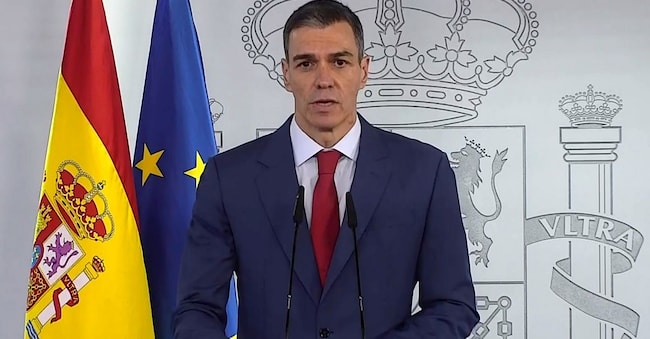
It is an open, bitter clash between Spanish Prime Minister Pedro Sanchez and US President Donald Trump. And which, however, between declarations by the White House and immediate denials by the government in Madrid, runs the risk of degenerating into the grotesque, even in such a dramatic context. On the morning of 4 March, Sanchez reiterated his condemnation of the attacks launched by the US and Israel on Iran. This is the position he has expressed since day one and is his response to Trump, who threatens to sever all commercial ties with Madrid: a sort of embargo, in retaliation for his refusal to make military bases available on Spanish territory, even if only for support operations.
"We will not be complicit"
Sanchez addressed the nation in a speech at the Moncloa Palace. And he raised the tone again, criticised leaders who 'use the fog of war to hide their failure. This is how humanity's great disasters begin. One cannot play Russian roulette with the fate of millions of people. We will not be accomplices only for fear of retaliation'. An unequivocal message, which provoked the stinging reaction of the US Treasury Secretary, Scott Bessent, who said that Spain's rejection of the use of the bases would endanger the lives of American citizens.
The White House Hoax
But it is in the evening, when the White House propaganda machine is set in motion, that the sensational revelation arrives, offered to the American public by spokeswoman Karoline Leavitt at a press conference. No stranger to gaffes and manipulations, in her enthusiastic devotion to her boss, Leavitt announced that Spain 'has understood the president's message loud and clear', and consequently 'has agreed to cooperate with the United States military, which is now coordinating activities with its counterparts in Spain'. Were this true, it would be an embarrassment without return for Sanchez.
Immediate denial
The denial came within minutes, relayed in large letters by the website of El Pais. It was taken on by the Foreign Minister, José Manuel Albares, who, in an interview with the country's main private radio station, denied it 'categorically'. Madrid's position 'on the war in the Middle East, the bombing of Iran and the use of our bases has not changed one iota', compared to what was reiterated in the morning. Albares expressed his astonishment: 'I have no idea' what Leavitt was referring to, 'she may be the White House spokeswoman, but I am the foreign minister of the Spanish government'.
He then returned to Sanchez's words: 'Our position can be summed up in three words: no to war'. Afterwards, the premier wished to reiterate that the condemnation of the attacks has nothing to do with defending the ayatollahs: 'The whole of Spanish society has always condemned and repudiated the Iranian regime, in particular its oppression of women'. With the same conviction, Sanchez added, "we condemn the destruction of schools and hospitals leaving hundreds of victims, many of them women and girls".


