
Sandwiches, clothes and TV series: global identity is back in vogue for brands
After years in which brands have focused on local strategies, the market is rediscovering the borderless dimension: according to McCann-Economist, three out of four consumers describe themselves as citizens of the world

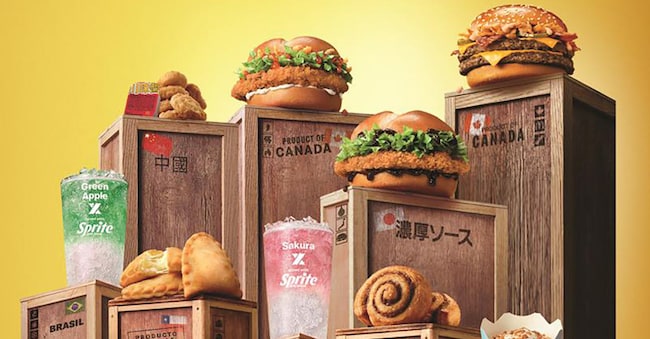
A Canadian sandwich, a German one, and yet another Australian one. Dishes you’d never find in Italia, drinks with surprising flavours, and traditional specialities available only in certain countries – all served and enjoyed at a typically Italian table. A hub of the world that would have been unthinkable until recently, but contemporary marketing has accustomed us to offerings and associated campaigns that capture the spirit of the times, anticipating future trends. A way of giving a nod at Generation Z – globetrotters on the hunt for unexpected flavours to try, who, after the pandemic, are making a comeback by travelling the world (even at the dinner table).
So it’s no surprise that the new campaign World Menu Heist – in which McDonald’s is bringing international dishes to Italia: ranging from Japanese teriyaki to hot honey from Canada, empanadas from Chile and Szechuan sauce from China. “More and more customers are enjoying discovering and trying the menus from our restaurants in other countries, which are often not available locally. It’s a real social media phenomenon: they’re the ones trying out recipes from around the world, sharing them and reviewing them online,” says Valeria Casani, Chief Marketing Officer at McDonald’s Italia.
The Diplomacy of Marketing
Who would have thought it? In a world that is creating more and more silos and erecting walls, marketing diplomacy is trying to make a difference by building bridges. A phenomenon that runs counter to the ‘glocalisation’ which, until just a few years ago, guided the strategies of multinational giants according to ‘glocal’ logic – how long has it been since Naomi Klein’s ‘No Logo’ manifesto – only to arrive now at a new global village , to paraphrase McLuhan and his idea of media interconnection. Thus, that very same ‘zero-kilometre’ brand is undertaking the opposite approach with recipes from international markets.
This marks a new phase of ‘glocalisation’ – a term coined by sociologist Roland Robertson – which for decades has described the ability of global brands to combine a widespread presence with adaptation to local cultures. Thus, ‘under-the-radar’ globalisation no longer conceals its broader scope. On the contrary, it places it at the heart of the narrative. These are the paradoxes of our times, in an era characterised by geopolitical tensions, tariffs and market fragmentation. More than just a commercial strategy, it is a cultural response. Whilst ‘glocalisation’ used to be about making a global brand local, today some campaigns suggest the opposite: making the global desirable in a world that is tending to close in on itself.
In short, marketing is trying to heal the wounds of a world in tatters. Netflix has transformed productions originating in local contexts, such as Squid Game and La casa de papel, into global phenomena. Starbucks promotes drinks and formats developed in Asian markets across Western markets. Ikea brings products and solutions to the world that were initially designed to meet the specific needs of individual geographical areas; Lego produces collections inspired by Japanese, Chinese or British culture that go on to become international successes, Airbnb transforms the desire to experience authentic neighbourhoods into experiences that can be booked anywhere in the world, whilst McDonald’s itself has opened a ‘lab restaurant’ in Chicago featuring menus inspired by international markets, turning geographical diversity into an experience.

