
Sannazaro, from the Fenice in Venice to the Petruzzelli in Bari the great theatres destroyed by fire
In the past, gas lights, candles, stage fires and even theatrical cannons turned festive moments into authentic hells, leaving deep scars in the collective imagination
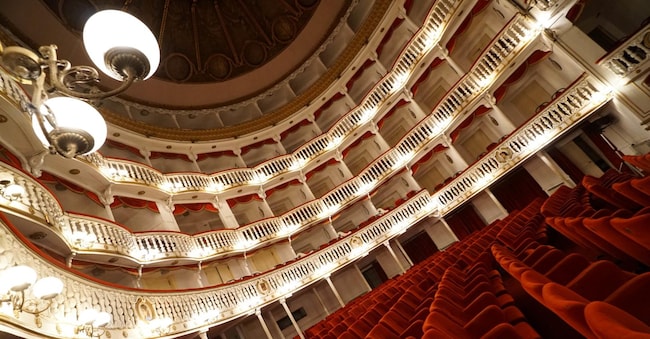
The fire at the Sannazaro theatre in Naples is just the latest in a long series of theatres that have gone up in flames in Italia and around the world. From London to Naples, from Venice to Chicago, passing through Bari, Barcelona and New York, places born to entertain, educate and make people dream, have often become death traps, prey to flames that have devoured wood, straw, fabric and every stage decoration. In the past, gaslights, candles, stage fires and even theatre cannons turned festive moments into authentic hells, leaving deep scars in the collective imagination. Here, the best-known precedent in recent times is that of the La Fenice Theatre in Venice on 26 January 1996. The fire, of an intentional nature, devoured the stalls, boxes and ceiling, leaving only the perimeter walls standing. Two electricians Enrico Carella and Massimiliano Marchetti set the flames to the theatre, which was closed for maintenance work, in order to avoid penalties due to delays in the restoration work. La Fenice reopened on 14 December 2003 with an inaugural concert conducted by maestro Riccardo Muti.
Petruzzelli di Bari
Five years earlier, it was the Petruzzelli di Bari that burned down. On the night between 26 and 27 October 1991, the Petruzzelli - which had staged Bellini's Norma the night before and ended with a tragic fire - was partially devoured by flames. Tragedy was avoided only because the collapse of the dome, embellished by Raffaele Armenise's frescoes, managed to prevent the furnace from affecting the surrounding buildings. The tangled judicial and political affair that followed attributed responsibility for the flames to some local criminal elements. The theatre reopened only 18 years later, on 4 October 2009.
Loading...
The Royal Theatre of Turin
On the night of 8 February 1936, the splendid Teatro Regio in Turin was also destroyed by fire. After the staging of Liolà, when the spectators had already left, due to an electrical contact, a fire broke out under the stage and the flames, in less than an hour, destroyed the 18th-century architectural masterpiece. The Teatro Regio reopened only 40 years later, on 10 April 1973, with a performance of I Vespri Siciliani. The opening night was also attended by Maria Callas and Giuseppe Di Stefano.
From London to Barcelona
More generally, the first great theatre fire of which we have any memory dates back to 29 June 1613, in the heart of London, at the Globe Theatre, the famous theatre where William Shakespeare staged his plays. During a performance of 'Henry VIII', a stage cannon, designed to amaze the audience, set fire to the thatched roof, reducing the entire building to ashes. Fortunately, no one was killed, but that episode left a clear warning: the wonder of theatre could turn into mortal danger in the blink of an eye. In the centuries that followed, the risk multiplied. Theatres, often built of wood and decorated with cloth and flammable materials, were lit by oil lamps, candles and gas lights. Every performance implicitly carried a fire risk. Yet, spectators continued to fill halls and stages, unaware of the precariousness of their safety, attracted by the allure of invented worlds and unforgettable stories. Barcelona, a city of great theatre traditions, has also experienced dramatic fires. The Gran Teatre del Liceu, inaugurated in 1847, has seen its splendour extinguished twice in flames. On 9 April 1861, just fourteen years after its opening, a fire destroyed a large part of the theatre, sparing only the entrance and the famous Hall of Mirrors. On 31 January 1994, a new fire devastated the auditorium and stage, and a lengthy reconstruction was necessary, which was completed in 1999, returning the city's cultural symbol to the city with a modern structure that is faithful to the original. Barcelona's Teatre Principal, the city's oldest, founded at the end of the 16th century, suffered repeated fires over the centuries, including those of 1787, 1915, 1924 and 1933, which progressively marked its decline as a theatrical centre of reference. Smaller theatres in the Catalan city, such as the Teatro Olímpia, also suffered minor fires, such as the one in 1906, during the screening of a film, which caused at least one fatality and numerous injuries.
Oltreoceano
In the 19th century, the danger of European theatres became dramatically evident. Structures were often made of wood, decorations of fabric and audiences crowded halls lit by gas lamps. The average life of a theatre rarely exceeded twenty years, and many buildings burned down within five years of opening. The German engineer August Foelsch estimated that 25% of European theatres would go up in smoke within a few years of opening. Among the most famous were: the Arena degli Acquedotti in Livorno, 1857, where a firework caused 40 deaths and over 200 injuries; the Ring Theater in Vienna, 1881, where a gas lamp during a performance of the 'Tales of Hoffmann' killed over 400 people; the Théâtre Municipal in Nice in 1881 with around 200 casualties; the Salle Favart in Paris, in 1887, with 84 deaths; and the Theatre Royal in Exeter, in 1887, which claimed 186 lives in what was the worst fire in English theatre history. In the United States, the situation was often more serious. At the Brooklyn Theatre in New York on 5 December 1876, a fire caused by a stage lamp during a performance of 'The Two Orphans' killed almost 300 people. On 30 December 1903, the Iroquois Theatre in Chicago, which had opened only a few months before, witnessed the deadliest theatre fire in American history. Advertised as totally fireproof, the theatre had a seating capacity of 1,600, but the audience in attendance exceeded 2,000. When sparks from an arc lamp ignited a curtain, the asbestos curtain designed to contain the flames caught. The exits, opening inwards, became blocked in the crush, while lacking telephones and alarms the arrival of rescue was delayed. The final death toll was around 600. The incident led to revolutionary safety reforms: outward-opening exits, panic bars, clear signage and strict regulations for the management of the public. From then on, safety in American theatres would never again be neglected.
Copyright reserved ©


Brand connect
Loading...
