Internationalisation

Intesa Sanpaolo takes aerospace SMEs to Silicon Valley

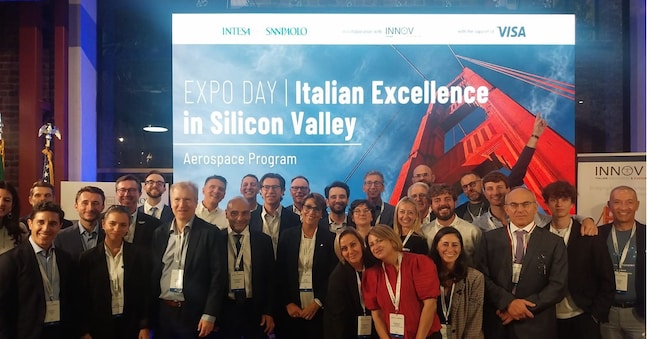
The group is leading a mission to San Francisco for 12 Italian SMEs in the sector, in collaboration with Innovit. New ‘Connecting Markets’ platform

9' min read

Translated by AI
Versione italiana

9' min read

Translated by AI
Versione italiana

Pocket-sized lasers capable, however, of powering sensors destined for the Moon; two-seater helicopters fitted with ballistic parachutes; aluminium sheets mounted on the world’s tallest antennas at NASA; and mechanical components from Emilia’s ‘Motor Valley’ that are ready to take off into space.

Italian excellence, even in the most technologically advanced sectors, is built on a myriad of small and micro-enterprises, which never cease to amaze with the quality of their workmanship and their ability to find and adapt ever-new solutions in line with market demand. Even the most demanding markets, such as the US market – the very epitome of innovation and big business.

Loading...

The mission to Silicon Valley

And it is precisely to raise awareness of this excellence – this ‘Made in Italy’ product with cutting-edge technology – and to support its growth and development in the US market that Intesa Sanpaolo’s mission in Silicon Valley, dedicated to Italian businesses, was launched. Now in its third year, the programme is run in collaboration with Innovit, a San Francisco-based company, and is supported by the Ministry of Foreign Affairs and International Cooperation through the ICE Agency (in collaboration with the Italian Embassy in Washington and the Italian Consulate-General in San Francisco), and which, since October 2022, has been managed by the Giacomo Brodolini Foundation and Harmonic Innovation Xcelerator (an incubator and accelerator of the Harmonic Innovation Group).

Dedicated to 12 start-ups in its first year (in 2024) and to 12 innovative SMEs last year, this year the programme has focused on 12 small and medium-sized enterprises in the aerospace and robotics sector, which are clients of the bank and were selected in collaboration with Innovit.

For a week in early September, these organisations took part in over 100 training and business sessions, including 85 one-to-one B2B meetings and 23 classroom-based sessions with 43 mentors from the Innovit network (which, over four years, has built up a network of over a thousand professionals).

Intesa Sanpaolo’s strategy for SMEs

This mission forms part of the Intesa Sanpaolo Group’s overall strategy to support the positioning of Italian industry abroad and, in particular, the activities of the Banca dei Territori division, led by Stefano Barrese, which are geared towards financing new initiatives and overseas branches of Italian SMEs, facilitating their engagement with foreign investors, and supporting the international development of high-tech sectors that are strategic for the growth of the Italian economy worldwide.

The Intesa Sanpaolo initiative was spearheaded by Stefano Barrese, head of Banca dei Territori, accompanied by Anna Roscio, executive director of corporate sales and marketing for the division, and Nicola Baiocchi di Silvestri, country manager for the US and the Americas within the IMI CIB division. Supported by Massimo Carnelos, Italia’s Consul-General in San Francisco, and Filippo Fusaro, Director of the ITA’s Houston office, the mission was organised through the Italian innovation centre Innovit, headed by Alberto Acito, of which the Italian Trade Agency (ITA) and the IIC (Italian Cultural Institute San Francisco).

The new US mission forms part of the strategy announced by Intesa Sanpaolo’s CEO, Carlo Messina, during the presentation of the 2026–2029 Business Plan, and is the result of synergy between the group’s divisions and its global network of institutions and business communities.

“This is not a one-off project, but a comprehensive programme designed to support the structured growth of Italian businesses,” explains Anna Roscio, Executive Director of Sales & Marketing for Corporate Clients at the Banca dei Territori division. “ To achieve this, we do not limit ourselves to the traditional role of a bank – that of a lender – although we have made a significant commitment in this regard too, having provided over 140 billion euros in loans to SMEs since 2020. But we also provide companies with what might be called ‘soft’ support, offering opportunities for networking, knowledge-sharing and dialogue, made possible by the network that an institution like ours can offer to small and medium-sized Italian businesses. The collaboration with Innovit forms part of this strategy.”

Why Silicon Valley

In fact, over the course of four years, Innovit has built up a network of over a thousand professionals – including mentors and speakers – across the Silicon Valley region, supporting nearly 500 companies through 48 programmes designed to promote start-ups and innovative SMEs. More than half of these have already embarked on development initiatives in the US market. One such programme is the one sponsored by Intesa Sanpaolo.

Loading...

“This is a strategic partnership, because we share many objectives, including the promotion of Italia as a ‘tech nation’,” explains Alberto Acito, director of Innovit. He also emphasises the crucial role of Silicon Valley for the aerospace sector at this historic juncture: “A profound transformation is underway in this sector, accelerated by artificial intelligence,” explains the director of Innovit. “Thanks precisely to Silicon Valley, the Space Economy is entering a phase of transformation, shifting from technology to strategic infrastructure. Whilst until a few years ago this sector was mainly about exploration, satellites and astronauts, today it is primarily about services. That is why companies are coming here to Silicon Valley no longer just to sell products, but above all to understand how to integrate into this new ecosystem.”

Italia has a great deal to offer the American market in this regard, as demonstrated by the stories of the 12 companies brought to San Francisco by Intesa Sanpaolo (see the article below) and as Anna Roscio emphasises, highlighting the strategic role of this sector – a ‘connecting’ role, so to speak: ‘Companies in this sector draw on inputs from many different product sectors, such as the automotive or electronics industries, and produce results that in turn find applications in many different fields, from agriculture to energy and logistics. This is what has prompted us to focus, this year, on the aerospace supply chain.”

The Age of the Space Economy

In addition to the fact that the space economy is now one of the production ecosystems with the highest growth potential worldwide, with a value which, according to estimates by the Space Foundation, is expected to reach 800 billion dollars by 2027 and exceed one trillion by 2032. In this arena, Italia can count on an industry employing over 50,000 people and covering every stage of the value chain, from software design to cyber security services, and from the manufacture of lasers to that of spacecraft and launch platforms.

And the United States remains an ‘indispensable’ market, in the words of Italia’s Consul-General in San Francisco, Massimo Carnelos, who emphasised the importance of this programme.

Connecting markets: the driving force of AI

However, Intesa Sanpaolo’s commitment to internationalisation does not stop at the US and in-person missions: the geopolitical context and uncertainty on global markets are forcing Italian businesses to constantly explore new regions. To support them in their search for foreign partners, the Banca dei Territori announced in San Francisco the launch of its new digital platform, ‘Connecting Markets’, powered by artificial intelligence, which will provide the bank’s clients with data on 560 million companies across 170 countries, operating in over 2,000 technology sectors. Through this tool, developed in collaboration with Matchplat, and with support from Intesa Sanpaolo in liaising with counterparties, client companies will be able to search for new industrial, commercial and supply chain partners, as well as target companies for acquisitions or collaborations, whilst also achieving greater diversification in the markets they enter and develop for their business. This provides further support for the growth of Italian SMEs, to which the banking group has already provided €12 billion since 2020 in the form of loans dedicated to internationalisation projects and export support.

The aerospace supply chain

A strategic sector due to its cross-cutting nature and its ability to draw on expertise from various manufacturing sectors and then channel it back into an equal number of industrial sectors, the aerospace sector has long been a focus of Intesa Sanpaolo’s initiatives; it is no coincidence that it was the first European commercial bank to join the ESA Investor Network. The group has, in fact, supported over 500 SMEs in the sector, providing them with financing totalling over 1 billion euros. Intesa Sanpaolo is also the only Italian bank – and the first in Europe – to have entered into a partnership with the European Investment Bank (EIB) and the European Space Agency (ESA): the agreement signed last July will mobilise €300 million in new funding for SME investments, thanks to European resources and dedicated guarantee schemes.

“We have always been the bank of choice for SMEs, and we are also the bank of choice for the aerospace sector, which originates in our local areas and industrial clusters to achieve ambitious goals, including in the United States and Silicon Valley – the cradle of innovation and numerous opportunities, as we have demonstrated over the years – says Stefano Barrese, head of the Banca dei Territori division. – Our role is to work with them to identify new opportunities for growth abroad and to devise new tools to support them in industrial projects, partnerships with new investors, and in achieving not only economic but also cultural outcomes. Thanks to our innovative platform, the result of insights gathered here during previous missions, we will be able to offer global potential for the growth and competitiveness of our SMEs, to which, since 2020, we have provided loans totalling over €141 billion, of which €12 billion was for internationalisation and exports and €14 billion for extraordinary financial transactions such as acquisitions, mergers and share capital increases.’

According to Consul Massimo Carnelos, ‘The ability to work collaboratively is essential for promoting Italian excellence in a strategic environment such as Silicon Valley. The collaboration between Intesa Sanpaolo and Innovit demonstrates the value of a shared commitment between organisations with complementary expertise, capable of supporting businesses as they navigate a highly competitive ecosystem and of fostering new connections with strategic partners overseas.”

“The Space Economy has always been one of the technology sectors in which Innovit has chosen to invest, building expertise and relationships within the Silicon Valley ecosystem. Over the past few years, we have developed 48 programmes for innovative start-ups and SMEs, supporting nearly 500 companies and 1,000 entrepreneurs, with over 1,750 sessions and more than a thousand mentors and speakers. We are now in our third year of collaboration with Intesa Sanpaolo: a continuity that allows us to put this wealth of experience at the service of 12 aerospace SMEs, in a sector where the convergence of space, artificial intelligence, software and data is opening up new opportunities,” adds Innovit’s director, Alberto Acito.

The companies in the spotlight

“My father’s dream was motorsport; my dream is aerospace.” Francesca Paoli is the CEO of Dino Paoli, a precision engineering firm founded by her father in Reggio Emilia, which has been designing and manufacturing high-performance mechanical and electronic components since 1968. She is part of the delegation of businesswomen and businessmen who took part last week in Intesa Sanpaolo’s mission to Silicon Valley, organised in collaboration with Innovit.

Twelve small and medium-sized enterprises in the aerospace sector, from across Italia and representing various parts of the sector, selected from among the more than 200,000 SME clients of the Banca dei Territori division: Ali (Naples), Apr (Turin), Bercella (Parma), Bisiach&Carrù (Turin), Bright Solutions (Pavia), Cospal Composites (Bergamo), Curti (Ravenna), Dino Paoli (Reggio Emilia), Leas (Padua), Netgroup (Naples), Novation Tech (Treviso), Sab Aerospace (Benevento).

“We are among the leaders in Formula 1 pit stops, thanks to our screwdrivers, and for the past few years we have also been working in the underwater sector,” says the entrepreneur. “Now we also want to expand into the aerospace sector, which we have only just entered, and that is why we are here in San Francisco,” she continues. The small Emilia-Romagna-based company (with a turnover of €10.3 million in 2025 and around fifty employees) already has a branch in the United States – in Charlotte, North Carolina – thanks to its motorsport-related activities, but it also wants to raise its profile and expand within the space economy.

Cospal Composites, a Bergamo-based company with 46 employees and a turnover of around 12 million euros, is also already operating in the US, where its clients include NASA. But the company – which specialises in the processing of aluminium and composite materials – is now also looking to the most innovative players in the so-called ‘new space economy’, which are concentrated in Silicon Valley, as explained by Luca Barello, business developer at the Lombardy-based SME. Founded in the 1980s, the company has been active in the aerospace sector from the outset, with a gradually increasing specialisation in high-precision products and services for the sector’s leading clients.

Among the largest companies present in San Francisco was Curti of Castel Bolognese (Ravenna), a company with around 400 employees and a turnover of 110 million euros which, founded in 1955 and specialising in mechanical welding processes for earth-moving machinery, embarked on a diversification strategy in the 1980s. “Today we have several active business units,” explains Filippo Curti, a third-generation representative at the helm of the family business. Among other things, Curti has developed, over 30 years, extensive expertise in the supply of components for the aerospace industry, and it is precisely this expertise that forms the basis of the Zefir, a two-seater carbon-fibre helicopter – the only one in the world equipped with a ballistic parachute. “We are here to seek industrial partners with whom to produce and market the Zefir on the American market, particularly in its drone version.”

Sab Aerospace, a company based in Benevento with a turnover of 15 million euros and 90 employees, counts among its flagship products the space platforms required for the multiple launch of satellites. “We now have a well-established and firmly rooted position in the European market; we are in Silicon Valley to also enter the commercial market, which is essentially non-existent in Europe,” explains Valentina Latini, the company’s technical director.

Copyright reserved ©
Loading...

Brand connect

Loading...

Newsletter

Notizie e approfondimenti sugli avvenimenti politici, economici e finanziari.

Iscriviti