
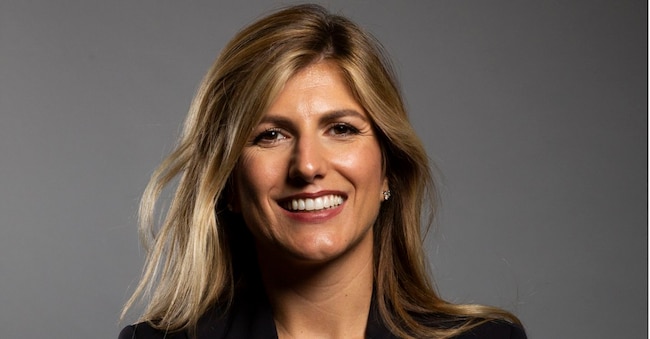
Sarah Catania (Jp Morgan private banking): 'Time to reorient investments geographically towards Europe'
The bank's managing director in Italy and Greece points out that in the uncertainty over the US markets, the shift in portfolios may be towards the Old Continent
4' min read
Key points
4' min read
"The moment is complex and articulated. We are experiencing a redefinition of many balances at the international level, not only geopolitically but also economically. The US is dealing very explicitly with the problems of the drop in its industrial production, the trade issue and the situation of its debt; the other countries are responding to the decisions of the US administration'. Sarah Catania, responsible for JPMorgan private bank for Italy from 2019 and for Greece from 2024, is experiencing, like everyone else, intense days that span from the trading in Asia to the close of the session in the United States. Not so much to monitor the day-by-day as to understand a situation that is not matched by market precedents.
"The way in which the negotiations on tariffs have been handled has resulted in days of panic on the markets: Wednesday 9 April saw the highest volumes traded ever on the US market, and throughout the week we have observed days with extraordinary volatility peaks. And volatility creates uncertainty about the choices of traders and investors,' Catania points out, continuing: "Last week's latest developments, with the suspension of US tariffs, have momentarily removed the most extreme economic risks: however, it remains to be understood what the possible solutions will be and the implications for inflation, consumption and, as a cascade, the investment strategies of companies and investors. Looking at the changes announced by Trump on the tariffs front, we are facing a scenario that cannot be compared to the one at the end of 2018, which mainly concerned China."
The composition of portfolios
.J.P Morgan Private Bank, which has been operating in Italy since 2000 and provides asset management and advisory services, 'at this juncture is focused on the long-term strategic composition of portfolios, putting purely speculative choices on the back burner. In addition to tariffs, there are other dynamics that we have yet to fully understand and assess how the market will evolve in the short and medium term,' says the manager, who points out: 'Distorting portfolios when volatility is so high is never advisable. At this stage we prefer to have strategic conversations with clients to make sure the portfolios are properly equipped to be resilient. When we set up household portfolios, we agree on the strategic objective in terms of return and long-term asset risk. A share of equities will always be there, but we should try to avoid sectoral concentrations and reorient portfolios geographically, preferably towards Europe'.
Between the US and Europe
.The movement of capital and investments away from the US is expected, but not yet particularly pronounced: 'We do not yet see a significant shift of capital. About 60% of global assets are denominated in dollars. Most likely there will be a currency reallocation, especially by institutional investors, bearing in mind that we are coming from a time of maximum allocation to US markets. The share allocated to US tresuries held by foreign investors has also been very high so far," comments Catania, who adds: "Analysing financial flows, we can see that institutional investors are the ones who have moved their portfolios the least. This could prove to be an indicator to watch carefully'.
The sectors
.From geography to sectors. "At the sector level," the manager observes, "the correction has affected the entire market. Those who are active in picking individual stocks are trying to identify those penalised by the context but less affected by the duties. The real question, however, is: how likely is an economic recession in this situation? Before the recent developments, a slowdown in the current economic cycle was possible, especially considering the trend of the past years. Now we will have to understand how companies' strategies will change, in terms of production chain and sourcing choices.


