
Sarkozy released from prison now prepares for appeal process
The former president is under 'judicial control' and cannot meet with other MPs and Justice Minister Gérald Darmanin

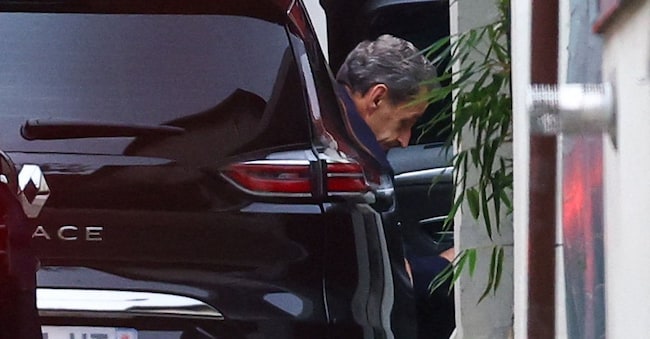
Nicolas Sarkozy was released from the Santé prison. The appeal of the former President of the French Republic, sentenced to five years in first instance with an enforceable sentence, after 20 days of detention, has been accepted. He will remain under 'judicial control', he will not be able to leave France, to enter into contact with the other defendants, the eight Libyan dignitaries and all the other people involved in the trial, but also with the cabinet of the Ministry of Justice and with Minister Gérald Darmanin himself, who had visited him in prison amid much controversy: according to the Paris Court of Appeal, Sarkozy, as a former president, has the 'capacity to activate various state services, despite no longer exercising official activities'. Minister Darmanin confirmed through his entourage - heard by Agence France Presse - that "the chancellor always respects the judges' decisions". Sarkozy has already been on probation since 14 May 2025, due to his age, after being convicted in the Bismuth affaire for bribery and influence peddling in order to obtain information on the Bettencourt trial, for which he obtained a non-suit, in which he was accused of illegally financing the 2007 election campaign.
A decision not taken for granted
Sarkozy was convicted, at first instance, of Association de malfaiteurs, an offence introduced in France in 1810 to punish the excesses of the Revolution and reinforced during the season of the anarchists in the late 19th century: it is different from the Bande organisée, which is an aggravating circumstance in France, because it punishes offences that are only attempted, through consequential acts, and punished with at least five years. In his case, Sarkozy allegedly allowed his chief of staff at the Interior Ministry Claude Guéant in 2005 to meet with the Libyan regime - including Muhammar Gaddafi's number two Abdallah Senoussi, sentenced in France to life imprisonment for the bombing of UTA flight 772 - to obtain funding for the 2007 presidential elections. The trial proved the negotiations and the arrival of the money in France, but not its use for Sarkozy's campaign, who was therefore cleared of all other charges. He was, however, taken to prison for the 'exceptional gravity of the facts'.
Presumption of innocence
The former president's lawyers appealed and, in doing so, succeeded in demonstrating that his eventual detention met the criteria for pre-trial detention. The Court of Appeal in Paris, accepting the proposals of the Prosecutor General (the Parquet général), recognised that 'there is no risk of evidence being polluted, nor of pressure or agreements' with witnesses or other defendants. The outcome was not a foregone conclusion: the court had released 81-year-old banker Wahib Nacer from prison on 15 September, but the detention was confirmed for broker Alexandre Djouhri, sentenced to six years and a fine of three million euro because his guarantees were judged 'particularly weak' and the risk of pressure on witnesses still real. Public prosecutor Damien Brunet repeated during the hearing for Sarkozy, as Olivier Géron had done in the two previous cases, that the decision to free the former president does not affect the next appeal trial, scheduled for March: 'This is not an analysis of the sentence of the correctional court of 25 September 2025. You will have to assess the request of a defendant in custody and presumed innocent."
Prison "exhausting"
'I know this is not the place to discuss the merits of my case,' Sarkozy said during the hearing, 'but I never had the idea or the crazy intention of asking Mr Gaddafi for money. And I will never confess to something I did not do. I have always responded to all calls for justice. I never imagined I would reach 70 years of age and know imprisonment. It is an imposed test. It is hard, very hard. It leaves marks on every prisoner because it is exhausting. I am aware of the seriousness of the facts I am accused of, but three weeks at the Santé will not change my attitude. I am French, Mr President, my family is in France. I will respect all the obligations imposed on me. I want to pay tribute to the prison staff who showed exceptional humanity and made this nightmare bearable'. "My energies," he added later in the evening on X, "are all directed towards one goal: to prove my innocence. The truth will triumph. It is an evidence that life teaches. The end of the story has yet to be written."
The ban on meeting Darmanin
The political world was shocked by Sarkozy's ban on meeting Minister Gérald Darmanin, who had visited the former president in prison on 29 October, triggering criticism from the prosecutor at the Court of Cassation Rémy Heitz, who had seen it as "an obstacle to the serenity" of the judgement and "an attack on the independence of magistrates" at the Court of Appeal. In addition to asking him about the origin of his income (€4,541,512 in 2023) and his real estate assets (9,923,874 wueo in 2024), the president of the Court of Appeal panel, Olivier Géron questioned Sarkozy's contacts in June 2013, when he was only a member of the Conseil Constitutionnel - the French version of our Constitutional Court - with Patrick Calvar, director general of the Dgsi, the Directorate General for Internal Security, the intelligence agency similar to the Italian Aisi:. "It is a bit surprising to be in contact with the Dgsi," he said. Sarkozy, according to Le Monde's reconstruction, explained that Moftah Missouri, Gaddafi's former interpreter, had told the press that Tripoli had indeed paid the Frenchman 20 million euros for his 2007 presidential campaign. "I was not afraid of manipulation, I was sure that it was manipulation," said former President Sarkozy, "and I called Calvar to tell him that, in that case, I would not hesitate to press charges. The extent of his contacts, and the weight he still has on the French right wing, prompted the court to circumscribe his permitted activities.


