Middle East

Saudi Arabia: attack on Dammam airport leaves one dead and eight injured

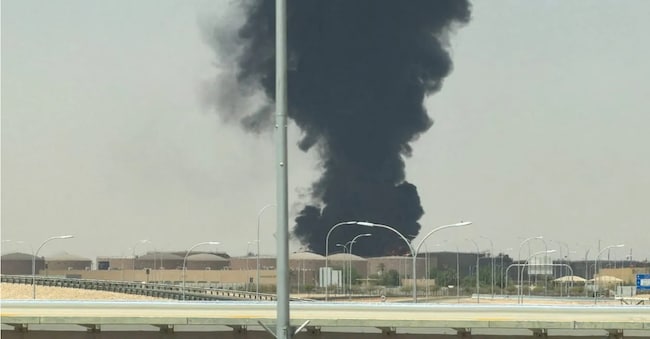
Attacco all’aeroporto internazionale King Fahd di Dammam. REUTERS

3' min read

Translated by AI
Versione italiana

3' min read

Translated by AI
Versione italiana

The Saudi Arabian Civil Aviation Authority has announced that a Saudi national was killed in an attack on King Fahd International Airport in Dammam, Saudi Arabia, on the Persian Gulf, near Bahrain and Qatar. The Authority also reported that eight people were injured in the attack. The airport also sustained some material damage.

The global flight-tracking service Flightradar24 reported during the night between Thursday and Friday that several flights had been diverted from the airport. King Fahd Airport had previously been attacked as part of a wider wave of missile and shelling attacks by the Houthis against Saudi Arabia’s main airports.

Loading...

Hormuz, London and Oman: keeping the strait open

Rome, 21 Oct. (askanews) – British Prime Minister Andy Burnham and the Sultan of Oman, Haitham bin Tariq, have agreed on the need to keep the Strait of Hormuz open in order to ease pressure on global supply chains and limit the economic consequences of the conflict in the Middle East. This was reported by the British Prime Minister’s office following a meeting held as part of the Omani sovereign’s state visit to the United Kingdom.

“The Prime Minister thanked Oman for its efforts to reopen the Strait of Hormuz. Both leaders agreed on the need to keep it open in order to ease the pressure on global supply chains and mitigate the impact on the population,” the statement read.

During the meeting, Burnham also highlighted the role played by Oman in maintaining regional stability. The two leaders agreed to strengthen bilateral cooperation in the fields of defence and security.

The military escalation in the Middle East, following the launch of the US and Israeli military campaign against Iran, has brought maritime traffic through the Strait of Hormuz to a near standstill, one of the world’s main routes for the transport of oil and liquefied natural gas, contributing to a sharp rise in international energy prices.

On 8 October, Iran and Oman had reached an agreement to identify safe shipping routes through the strait, in an attempt to gradually resume the passage of commercial vessels.

Iran, Trump: ‘something’ will happen very soon

US President Donald Trump has stated that no negotiations are currently taking place with Iran and that, in the context of the conflict with the Islamic Republic, “something” will happen very soon.

“We are not negotiating with” Iran, Trump told a NewsNation reporter at Andrews Air Force Base, where he had landed on Air Force One after returning from an election rally in South Carolina.

“One way or another, something will happen, quite soon,” Trump continued. “Most people seem to think it will happen after the election,” added the US president, who, when pressed on the possibility that the US might not strike Iran before the vote, remained vague and added: “We’ll see what happens.”

Loading...

Trump’s comments come following reports in *The New York Times* that the United States and Israel have drawn up plans for new military strikes against Iran, to be carried out after the mid-term elections scheduled for 3 November.

China and Djibouti call for the security of shipping routes in the Red Sea

Beijing and Djibouti have reaffirmed the need to ensure the safety of shipping in the Red Sea and the Gulf of Aden, in light of the growing tensions in the Middle East and their spread to the Horn of Africa. This is according to the joint statement issued following yesterday’s meeting in Beijing between Chinese Foreign Minister Wang Yi and his Djiboutian counterpart Abdoulkader Houssein Omar, as reported by the Chinese Foreign Ministry. Wang stated that the conflicts in the Middle East are spreading to the Horn of Africa and the Red Sea region, where the security of maritime routes and the Gulf of Aden is facing new threats. Beijing has stated its intention to strengthen cooperation with Djibouti and other countries to help ease tensions and safeguard regional peace and stability.

This is a strategic issue for China, which has its first permanent overseas military base in Djibouti, inaugurated in 2017. The country in the Horn of Africa is also situated at a crucial point at the southern entrance to the Red Sea, along one of the main trade routes linking Asia to Europe via the Suez Canal. The security of this passage is therefore vital for China’s trade flows and energy supplies. During the meeting, Wang also emphasised the importance of Djibouti’s geographical location for the development of regional transport links and logistics, citing the Addis Ababa–Djibouti railway as an opportunity to strengthen trade and investment. At the conclusion of the talks, the two ministers signed a memorandum of understanding on cooperation within the framework of the Global Security Initiative promoted by Beijing. (

Copyright reserved ©
Loading...

Brand connect

Loading...

Newsletter

Notizie e approfondimenti sugli avvenimenti politici, economici e finanziari.

Iscriviti