
Saying the pain and understanding how to listen to it
Subtracting the language of punishment from the domain of the inarticulate and of personal memory alone leads to better existences and societies. In the writer-artist's protean oeuvre, the first book to combine prose and paintings
by Lara Ricci
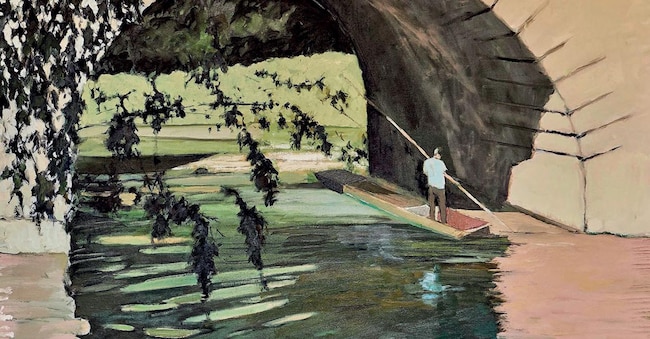
"Infandum, regina, iubes renovare dolorem": "Unspeakable sorrow, queen, you ask me to renew": this is how Aeneas speaks to Dido, who welcomed him in Carthage after the shipwreck. To recount the exploits of the Danaans at Troy and the painful return is to renew sorrow, but it is also to convey, and even acquire, knowledge. The adjective infandum, observes Nicola Gardini in his latest essay-narrative, Eco in una casa vuota, has the root of the verb fari, 'to speak', which resembles infans, the 'non-speaker' par excellence: 'Aeneas, here, in front of these people he has just met, finds himself in the condition of a newborn child. The story he is about to tell will be a linguistic learning, an appropriation of the words he needs, a coming into the world of language. And the end of a silence, of a gap'.
The silence that also surrounds pain, which we do not know and do not want to talk about: subtracting the language of punishment "from the domain of the inarticulate and of personal memory alone, or even of emotional censorship", telling pain, and understanding how to listen to it, is what Gardini wants to achieve with this book in which he reflects on the pain experienced by Nicolas, the beloved husband who died at dawn in 2020 (the protagonist of the memoir of the same name). A text that is also a way to continue the dialogue with him and that is among the most colloquial of the protean work of the professor of Italian and comparative literature at Oxford University who is a writer and also an artist. Indeed, his work constantly changes form, exploring man and the world through poetry or painting, novel or essay and, in Eco in una casa vuota, he sees prose juxtaposed with paintings for the first time. He uses his own intense paintings to broaden the spectrum of the communicable, to explicate certain thoughts in a different and richer way, further clarified by ecphrases that teach how to read the real, as well as the depicted image. Thoughts of which Gardini, who is also a Latinist and Greekist, seeks mirroring in the classics, generating an exciting dialogue between the millennia.
He is also moved by the observation that 'attitudes of revulsion similar to racism, misogyny and homophobia are observed towards the pain of others. It is no more and no less than a selfish rejection of the other, indeed of knowledge itself, which is always the bearer of difference'. And again - words that have urgent political significance in these years - the fact that 'by ignoring the difficult conditions of their neighbours, by pretending nothing is happening, by the repressive silence of cowardice and prejudice, people prevent everyone's life from improving, if it is true that all living people, not just writers, have a duty to improve it by making it more manifest and more familiar through language, that is, through the diversity of dialogue, the highest form, the only form - from Socrates onwards - of truth'.
"(...)/ The identical is the different. Nothing sleeps / in a painting: this one calls that one / and that one answers him, as words do / in verse, like bird / bird at dawn or days within the year. // And by painting you take away in abundance. / Gain is the void. And, since everything touches / everything and contains, a body will be distance / between distances, not presence: it overflows // in the self however a little of other people's blood, / in the brightest lights it has many darks" writes Gardini in his poetic collection Istruzioni per dipingere (Garzanti, 2018). Ideas that are found in prose in Eco in una casa vuota applied to listening to those in pain and that underpin his suggestion of a course in 'literary science' for medical students. A course that addresses the form of texts and analyses the tangle of messages in which meaning is generated, that learns them 'the art of interpretation', of finding that momentary truth that is also the patient's state of health: 'Nothing in literature is literal, just as nothing is literal in life. You say a thing and the thing you say is not just that certain thing, a datum, but enters into dialogue with a set of other things that extend its semantic resonances, creating deeper meanings and, through these, spaces for unforeseen responses. In literature, no information is just information. It always carries a symbolic 'more' and this 'more' must be discovered and understood in relation to the dynamic whole of discourse. A discourse is like a square full of people chatting in the light of the setting sun. There are individuals, but there are also their shadows'. Symptoms are just that: 'shadows of something else'.
A way of reading the real that becomes a paradigm of possible knowledge and is exemplified in a comparison between literature and painting: 'Both, understood as mental dispositions, pursue a hidden form through the provisional arrangements of the visible. Our gaze merely rests on something that will soon no longer be so. No scene is fixed. Yet we only delude ourselves that we are looking at things as they are. Instead, things are only the nodes of temporary relationships. And these relationships only change. And the knots only untie so that others can form. That is why, I think, I like to paint the waters. There is no moment when a river or a lake or a sea is the same river, the same lake, the same sea (...). It only takes one element to move for the overall configuration to change and become something else. Yet I pretend that the thing is the thing I see, as if my seeing were absolute and transitively absolutized the object of my seeing. For me, my seeing and the being of any supposed object inevitably overlap; they are reality. And there must be a truth in this momentary reality (...). I do not stop collecting snapshots of things and from the sum of these I draw a synthesis. Or only from some do I acquire the truest representations. Harmonies. Then that moment of my seeing (...) is an eternity. And on this unstable eternity I end up forming opinions, judgements, expectations. I form my knowledge of the world'.


