
AI: Scaleway brings a supercomputer to Sweden and completes its Milan region
The Iliad Group’s European cloud is expanding in the Nordic countries and in Italia, with two new Availability Zones in the Lombardy capital
from our correspondent in Paris, Biagio Simonetta
 Aggiungi Il Sole 24 Ore
ai preferiti su Google
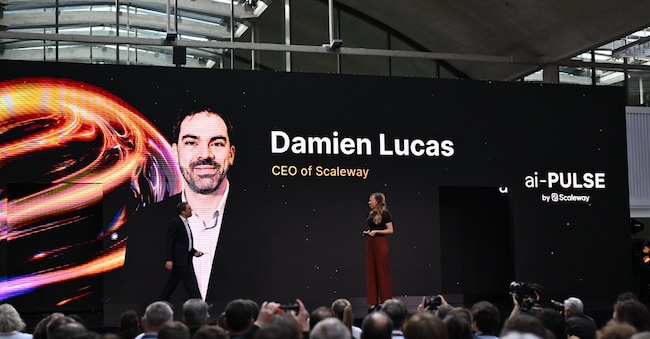
PARIS – The priority is immediately clear: greater computing power in Europe. This is the direction taken by the announcements from Scaleway, the iliad group’s cloud and artificial intelligence company, which unveiled its latest moves in Paris. The setting is Station F, a start-up campus located in Paris’s 13th arrondissement, near Austerlitz station. An incubator funded, some ten years ago, by Xavier Niel, the founder of Iliad himself. It is here that ai-Pulse has been held for several years now.
During the event, Scaleway unveiled its next steps. Starting with the most significant one, which concerns Sweden. There, the French company will deploy a new supercomputer for artificial intelligence, featuring AMD Instinct MI355X GPUs and the open-source AMD ROCm software. It is the first such supercomputer the company has built outside France, and it will be accessible to start-ups, specialist firms and large enterprises across Europe. AMD’s entry into the market is being presented as a way to give customers more architectures to choose from. It is worth noting that AMD chips already power supercomputers used for European research, including LUMI in Finland. US cloud companies, including Oracle and Vultr, also lease AMD chips to European customers.
Scaleway’s CEO, Damien Lucas, spoke of a strengthened partnership: “We are delighted to strengthen our partnership with AMD and to make the power of AMD Instinct technology available to businesses across Europe on this scale.”
Why Sweden? Probably because of its tech ecosystem and its largely low-emission energy mix. After all, Scaleway had already taken a step in that direction in May, when it signed a partnership agreement with Tele2.
The second announcement of the day also concerns the Nordic countries. In Copenhagen, in fact, a GPU Zone based on Nvidia HGX B300 technology is opening. GPU Zones are a new concept. They are infrastructures dedicated to large-scale GPU computing, for training and running models, which complement the cloud’s availability zones. When choosing locations, the company looks for proximity to customers, low-emission energy and a climate that minimises cooling requirements. They will all be located within the European Union. It is worth noting that in Denmark, Scaleway already has clients such as the City of Copenhagen and Corti, a company specialising in AI.


