United States

Nvidia scandal: CEO admits to relationship with Chinese spy. Company launches investigation, Trump defends him, share price plummets in pre-market trading

The powerful Jensen Huang is an ally of the president and the head of the chip giant, which has long been in the sights of Beijing’s intelligence services. However, Beijing denies any espionage activities in connection with this clandestine relationship with the manager

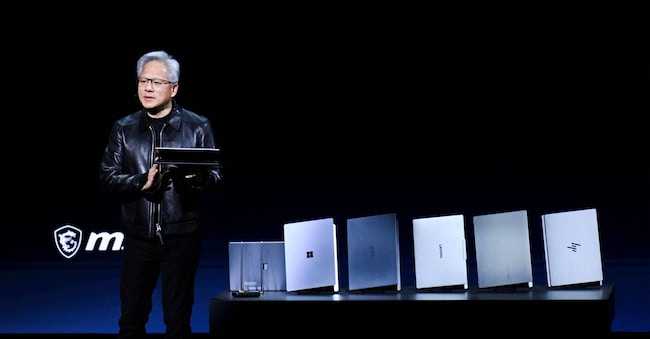
Il ceo di Nvidia Jensen Huang  REUTERS

4' min read

Translated by AI
Versione italiana

4' min read

Translated by AI
Versione italiana

Nvidia’s board of directors has launched an investigation into Jensen Huang, the company’s chief executive and co-founder, who has been at the helm for 30 years, after he admitted to the board that he had cheated on his wife and had an intimate relationship with a female executive identified by US intelligence as a Chinese spy. Huang’s relationship with the woman, named Alice Huang, has come under scrutiny by the US government, and the discovery has raised concerns, given that Huang is an ally of President Trump.

And indeed, Trump came to his ally’s defence. “I haven’t spoken” to Nvidia’s chief executive, Jensen Huang, “he’s a good person, he’s done a fantastic job for our country”. said the president, emphasising that he would take him along on his trip to Asia, “but he doesn’t know if he’ll come”. Trump also said that Jensen Huang should remain at the helm of Nvidia as chief executive.

Loading...

The Trump administration, however, was aware of the relationship between Jensen Huang and the Chinese manager-spy, and it could hardly have been otherwise given the focus in recent years on the issue of Chinese espionage against the American hi-tech sector, particularly regarding Nvidia’s chips, which are crucial for the development of artificial intelligence. The Secretary of State, Marco Rubio, in fact oversaw the drafting of the confidential document in which senior administration officials were warned of the close ties between the CEO and the Chinese spy. This is reported by the New York Times, citing several sources, according to whom Rubio’s involvement shows that concerns about the relationship were widespread amongst senior levels of the administration, given Huang’s closeness to Trump and the implications for national security.

In a letter sent on Sunday to Nvidia staff, Huang, 63, publicly apologised to his family and colleagues. “I have been unfaithful to my wife. My actions have hurt her and our children. There is no excuse for what I have done. I am deeply sorry,” wrote the executive, pledging his full cooperation with the internal investigation. Following this admission, Nvidia’s share price plummeted: the stock fell by around 6 per cent on the Tradegate platform compared with Friday’s close in the US; by contrast, the shares of Nvidia’s Asian suppliers were unaffected by the news, largely following the general rebound seen among their US counterparts on Friday.

For over a year, Nvidia Corp. has played down the links between its chief executive, Jensen Huang, and Megaspeed – a spin-off, initially little-known, of a Chinese company operating in the video games sector – as well as with a woman named Huang Le, who helped set it up.

Both Nvidia and Jensen Huang had described Megaspeed as a legitimate, albeit large-scale, purchaser of the artificial intelligence chips produced by Nvidia, despite the US government’s concerns that China might use this Singapore-based company to gain access to advanced semiconductors. Furthermore, they had described the relationship between Jensen Huang and Huang Le – also known as Alice Huang – as purely professional. As recently as the last two weeks, faced with rumours of a close link between the two, Jensen Huang defended himself, describing their interactions as ‘entirely normal’. Now, however, he has admitted to the relationship.

Jensen Huang’s admission that he had cheated on his wife – to whom he has been married for over forty years – seems all the more shocking, and stands in stark contrast to what he and the company had previously stated. On Sunday, Nvidia announced that the board of directors is investigating whether Huang has been ‘the target of a foreign intelligence operation’, following reports that US authorities suspect Alice Huang of having been recruited by a Chinese intelligence agency. These revelations now jeopardise the future of Jensen Huang, a figurehead of the artificial intelligence infrastructure boom and the head of one of the world’s most valuable companies.

Meanwhile, China has denied the existence of an espionage plot involving Nvidia’s chief executive, describing the allegations as baseless and part of a smear campaign against Beijing. According to reports in the New York Times, Huang admitted to Nvidia’s board of directors that he had had an intimate relationship with a female executive who, according to US intelligence, was gathering information on behalf of Beijing. “The so-called allegations of Chinese espionage are baseless. They are nothing more than slander against China,” said Guo Jiakun, a spokesperson for the Ministry of Foreign Affairs, today.

Jensen Huang is at the centre of a controversy concerning his alleged role in facilitating the sale of advanced chips to China, in breach of US technology restrictions designed precisely to limit Beijing’s access to such cutting-edge technologies. Huang had pushed to relax restrictions on chip sales to China, succeeding in persuading President Trump to allow his company to sell H200 chips. Although these are not Nvidia’s most cutting-edge models, they are nonetheless technologically advanced. It is not yet clear, however, whether Beijing will allow Chinese companies to purchase these chips in large quantities, as the Chinese government has repeatedly expressed its desire to achieve self-sufficiency and produce the components necessary for the development of artificial intelligence models itself. The issue of espionage, however, remains a concern amidst the fierce competition between the US and China in the race to develop increasingly advanced technologies.

The case has caught the attention of the US Congress: both Democratic and Republican lawmakers are seeking clarification on the links between Huang, Megaspeed and the Chinese executive. Three Republican chairmen of House committees, including John Moolenaar, chairman of the Special Committee on China, have asked the executive to attend a closed-door hearing on 18 November, the day after Nvidia’s quarterly results are due to be announced.

Copyright reserved ©

Brand connect

Loading...

Newsletter

Notizie e approfondimenti sugli avvenimenti politici, economici e finanziari.

Iscriviti