
Scandalous discovery of female pleasure
So far only well-made films, with many stars, but nothing exceptional. What is new is the reversal of the canons of sexuality, which wants powerful women as protagonists with young men
5' min read
5' min read
The first sensible fact is that in this first part of the 81st edition of the Venice Film Festival there are no films that can mark the history of the seventh art. A shower of stars, that is - from Monica Bellucci to Angelina Jolie, from Nicole Kidman to Antonio Banderas, with the addition of new stars such as Jenna Ortega -, starring in well-made films, mostly mainstream, with an excess of the phantasmagorical in terms of both haunting presences and shadows of the mind.
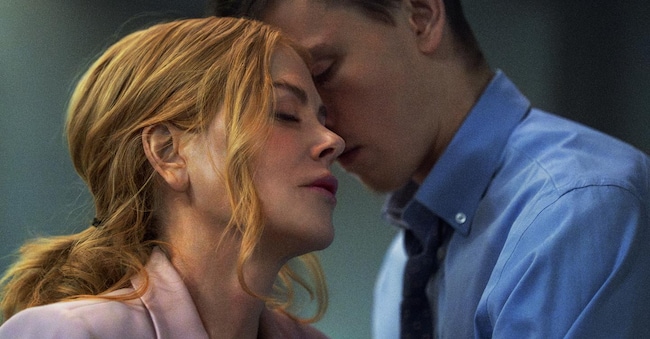
But at least there is a sociological novelty: there is a cinematic narrative about female erotic fantasies, not as excess, but as a legitimate search for sexual pleasure, the right to a female orgasm or the awareness of wanting to neglect it in order to save a relationship that is no longer passionate. The difference with respect to the past, in the latter case, is the active and not subjugated decision. This is the case of Babygirl by Halina Reijn starring Nicole Kidman as Romy, the managing director of a growing robotics company, who is bewitched by an intern who seems to have strange taming powers over animals and people. Happy with her family and husband (Antonio Banderas), Romy consciously runs the risk of a relationship that is unseemly in professional ethics. The most interesting part in this flatly directed psychological thriller is not the 9½ weeks version with interns (all already seen), but the reversal of perspective. No longer the man of power dominating the younger woman, but the other way around, following the dark plots of play, consent and liberation, without ending up like Madame Bovary.
Cate Blanchett, a successful investigative journalist in Alfonso Cuarón's Disclaimer TV series, also experiences the consequences of an extramarital affair with a young man. But here the implications are more complex. Again, Blanchett's is not a succumbing position: she has a husband who is also far from undesirable, Sacha Baron Cohen, but the affair in which she is protagonist, initially mysterious and inextricable, ends up having an almost moralistic connotation under the embers (not new) of digital vulnerability. Unfortunately, the 'Cuaronian' stretching of time here does not have the same harmony as in the splendid Rome. In Emmanuel Moret's Three Friends, a sense of female affirmation prevails. These women in the prime of life choose to stay in a couple or to date while remaining true to themselves, without being subject to social logic. A well-written, very French comedy that would have done well out of competition. Among the protagonists was Camille Cottin of Call my agent, who at the opening ceremony gave the laudation of Sigourney Weaver, for the Golden Lion for Lifetime Achievement, in which she emphasised how the 'Alien' par excellence had travelled acting paths previously unheard of for a woman.
Of course, one cannot speak of psychological independence for Pablo Larraín's Maria Callas. She is a defeated figure, especially by herself. The Chilean director observes her in her last days in her Paris home in 1977, while she is overwhelmed by the ghosts of the past, in which Aristotle Onassis is the great sinker of her talent. Angelina Jolie is a very good Callas, in spite of the initial estrangement at the physical difference: Jolie's perfect face certainly does not match the Divina's splendid irregularities. But this is soon forgotten, because Jolie knows how to get into iconic poses, sings with her voice, and interprets acrobatics, hysterics and follies very close to those to which, in her own words, she is addicted. A likely candidate for the coppa Volpi for a very classic biopic, though done well, better than Spencer on Lady D. and Jackie on Jackie Kennedy. Larraín works best when he corrodes his Latin America, from Tony Manero to Post Mortem, to the psychedelic Ema. So far, however, it has seemed more like a séance than a festival (by the way, the talking dead also appear in Three Friends!). It started with the most justified and coherent gothic fantasy of the king of cadaveric comedy, Tim Burton and his Beetlejuice Beetlejuice, with the old glories Michael Keaton - less of a swine, but still a spirit -, Winona Ryder, rediscovered as an occult TV star, and Catherine O'Hara. Added is Burton's new life partner Monica Bellucci, who here is a stapled-up, vengeful bimbo. Burton follows his loving dark chords with an extra vein of cheerfulness compared toEdward Scissorhands or The Corpse Bride and makes a funny, chaotic, but also very enjoyable story with a strong solidarity between three generations of women.
The incorporeal vein also struck Valerio Mastandrea in Nonostante, which opened the Orizzonti section. Who would have expected his easygoing and sweetly pragmatic nature to make a film about the no man's land that is coma? As Burton deals with it in an ironic and light-hearted manner, putting himself, Lino Musella and Laura Morante toiling around the hospital, waiting to wake up and resisting death as much as possible. Until a very peculiar in-patient (Dolores María Fonzi) arrives, upsetting habits and feelings. At his second directing, Mastandrea sows too many trails without knowing how to master them, 'despite', to be precise, some nice gimmicks about the passage into the afterlife.


