Supporting the country system

Scannapieco: 'Cdp plan to 2027 includes 81 billion to support the economy'

The CEO of Cassa Depositi e Prestiti, Dario Scannapieco, charts the course: 'We are not a power centre, but we operate on the ground'

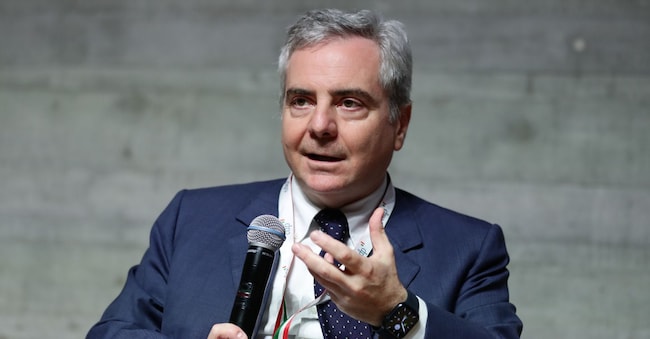
by Fabio Carducci and Celestina Dominelli

L’amministratore delegato di Cassa Depositi e Prestiti, Dario Scannapieco

7' min read

Translated by AI
Versione italiana

7' min read

Translated by AI
Versione italiana

"Many definitions gravitate around Cassa Depositi e Prestiti: the one I wanted to counter most strongly is that it is the state's safe. Because Cdp is anything but an inert, stationary, heavy object. It is not a power centre, but a service centre, a public promotional bank that operates proactively and on the ground'. Dario Scannapieco, a past civil servant first at the Treasury where, called upon by former Prime Minister Mario Draghi, he worked for a long time on securitisation and privatisation, and immediately afterwards at the EIB (the European Investment Bank) as vice-president from 2007 to 2021, arrived in 2021 at the helm of the Cassa, which celebrates its 175th anniversary this year. And, in the first strategic plan he signed and presented in November of that year, he summarised his strategy for the group's transformation with a pierced funnel in which only the best projects reach the bottom: 'It was a clear way of representing what we do and do not do,' he explains. 'And we gave substance to that funnel with a series of sectoral policies, later approved by the board of directors, which served to set the course.

Cdp e Confindustria insieme per la crescita delle imprese

The Cdp is often reproached for being too static. What do you reply?

Loading...

In recent years we have tried to overturn this view. Proof of this is, most recently, the roadshow we started with Confindustria. Three stops have been made so far: the first, the kick-off in Rome with the president of industrialists, Emanuele Orsini, then Cagliari and the last in Bologna last week. We plan to complete the tour of Italy in the next two months so that Cassa is not seen as a distant grey building in Rome. And this is precisely what the new industrial plan envisages: a Cassa that is much more proactive and close to the territories.

Last week you signed an agreement with Anci. Is this also instrumental in bringing the Cassa closer to the territory?

Absolutely. Thanks to that agreement, we are committed to working much more closely with the municipalities, as we have done with the regions, because there are often shortages of staff or specific skills there. This is a serious issue because public administrations often have ample financial resources, primarily EU funds, but lack the in-house expertise needed for quality programming of projects that can be implemented and financed, and on which resources can be spent. On this, Cdp intervenes with its advisory activities, on which municipalities rely heavily, and its capacity building activities.

Cdp rafforza il sostegno ai Comuni tra Pnrr e consulenza tecnica

There is an ever-present strong theme of non-grounding of European funds in Italy. 

We are also working hard in this area. Cdp is an implementing partner of InvestEu, the European programme called to boost competitiveness and growth in Europe, and we are among the promotional banks that have had the greatest access to European resources, with 1.3 billion in guarantees. Not to mention that my position as president of Elti, the network of long-term investors in the Old Continent, gives me the opportunity to amplify the voice of these promotional institutions: from KfW in Germany to Cdc in France, there are now 33 of us and the European Commission identifies these entities, which have a strong knowledge of the needs of the economy and society, as crucial grounding tools for the EU budget. The regulation of the new European multiannual financial framework should maintain the open architecture, which allows promotional banks direct access to the EU budget and this is a great recognition of our role.

The Old Continent still cannot overcome certain fences. Is there, on the other hand, a Europe of CoEs that cooperates and shares strategies or do we struggle with this too?

There is great cooperation between the European public promotional banks. A few months ago we had Stefan Wintels, the CEO of KfW, as a guest at one of our board meetings in Brussels, and we also set up several working groups within Elti to speak the same language and define a single metric on common topics. We did this, for example, when the war broke out in Ukraine, with an ad hoc working group between our chief technology officers to define shared strategies to defend against cyber attacks, but there are different fronts for collaboration, starting with the European taxonomy, on which there are aspects that can be improved. It is a very collaborative approach, a desire to build Europe in the spirit of the declaration made in 1950 by the then French Foreign Minister, Robert Schuman: 'Europe cannot be built all at once, nor will it be built all at once; it will arise from concrete achievements that first create de facto solidarity'.

Cdp has guaranteed more than EUR 200 billion to support the country over 10 years, of which more than EUR 70 billion between 2022 and 2024. Where did these funds go?

Taking away the resources that Cdp has put in place as a bank for cooperation and development, our activities have led us to have a credit portfolio that is essentially split 50-50 between what is Cdp's historical mission, support for the public administration, and support for businesses. And the new plan, which envisages committing resources of EUR 81 billion, activating investments of around EUR 170 billion, brings with it a qualitative leap because it also incorporates Simest. This means that we will be able to follow the entire life cycle of companies, from the incubation phase through Cdp Venture Capital to the subsequent development and internationalisation through Simest, which accompanies them in opening up new markets.

In the last few months you have intervened alongside a number of your strategic holdings, from the Saipem and Subsea7 wedding to Italgas' acquisition of 2i Rete Gas. Are there any other transactions on the horizon?

Here too we have given ourselves a 'discipline of rules' because everything we do is preceded by a market gap analysis of Italy. And, therefore, for each operation we have a sustainable development assessment model that defines the impact generated by our intervention. This is a path we also follow for equity, where our goal is to enrich the Italian financial ecosystem with new asset classes. For example, in venture capital we are still far behind countries like Germany and France. Even in direct equity, our design is to invest in companies that have strong technological competences in strategic sectors and that have the possibility of aggregating and creating critical mass. We do not have the pressure of private equity and, therefore, we do not have a date by which to exit, we are patient investors. We do it as soon as we see that the company has become solid, has made a market consolidation and is able to compete.

On the subject of equity investments, which sectors do you see the greatest potential for aggregation?

Today we have identified a number of key sectors for Italy, ranging from agriculture and food, robotics to energy via construction & real estate, and It & Tech. These are among the sectors in which we believe there are players with a possible consolidation activity for our direct investments. We assessed this on the basis of three macro-parameters: technological innovativeness of the sectors, economic and market potential of the Italian supply chain, and the social and industrial relevance of the sector. And all this is possible thanks to a quality staff. At Cdp, the average age is 41, with recruitment that also uses artificial intelligence programmes. We continue to believe that diversity, equity and inclusion are fundamental values: it is no coincidence that today women in managerial positions account for 33%, while when I arrived the bar was set at 21%.

The government is looking for a solution for the former Ilva. The trade unions are calling for public rescue. Will you intervene?

We have granted credit in the past, we are following the matter, but our rules do not allow us to invest in loss-making companies or companies without clear prospects of profitability.

In spite of several attempts, the project for a single network between Open Fiber and Fibre Cop is at the pole. Do you still believe in integration?

Before I answer, let me first point out that we are seeing an improving operational performance on Open Fiber. Open Fiber is a new network and has a good architecture. We know, of course, that there is still a lot to be done, but in short it seems to me that we are on the right track. As for the single network, I still think it is a good project because I see the duplications that exist and I think it is in everyone's interest to overcome them. So, first of all, we need to have a discussion at company level to try to understand how to overcome these duplications, and we as shareholders are always ready to sit down and discuss the dossier.

There has been talk of Cassa's possible involvement in the government's drive to reduce the cost of energy by securitising system charges in bills. Will you play a role?

To date there is nothing on the table. What we do, however, is invest in a strategic sector and finance everything related to the resilience of the electricity system, batteries and grids. In addition to being shareholders in Terna and Snam, we are also present in the energy efficiency sector, with Renovit together with Snam, and in the renewables sector through GreenIT, the joint venture with Plenitude.

The US fund Tpg has put up a billion for Nexi's Digital Banking Solutions division. Are you opposed to the divestment?

As an asset related to Nexi, any decision must be validated in the board of the group in which we are shareholders. Undoubtedly, there are interesting assets inside Nexi, but let's see what evaluation the board will give.

Mattarella: Cdp e Poste sono agenti della Costituzione

The agreement with the Post Office will expire in 2026 and you have already started work on the new agreement. What do you expect from the renewal?

In the meantime, I would like to point out that postal funding is currently worth around EUR 320 billion and is a stable base because bonds are a very popular product and we continue to assess the attractiveness of this instrument by also conducting blind tests. There is, at this moment, a great appreciation for the country and we have also seen it from the boom in demand that accompanied our first Yankee bond: 20 billion in demand for a 1.5 billion issue. That said, I am extremely satisfied with the relationship with Poste because we work very well together, we have innovated products, and so far the agreement has proven to work. It is an extremely collaborative approach: the instruments have been very innovative and modernised, and we are making maximum use of the digital channel to bring young people in as well.

Copyright reserved ©
Loading...

Brand connect

Loading...

Newsletter

Notizie e approfondimenti sugli avvenimenti politici, economici e finanziari.

Iscriviti