
School Tech Awards 2026: the best school projects recognised by Siemens
Over 80 innovative projects in industrial automation and digitalisation, presented by technical and vocational colleges, with a focus on robotics and AI integration
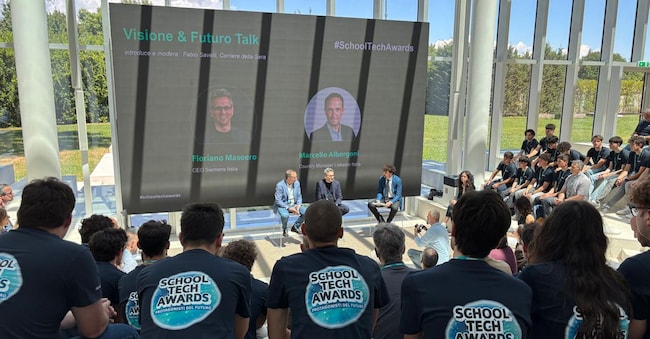
“We are in the midst of a new industrial revolution: that of artificial intelligence, and you hold the tools to shape the future in your hands,” said Floriano Masoero, CEO of Siemens Italia, addressing students at the School Tech Awards 2026 awards ceremony, held on 3 June at the Fondazione Dalmine. The international competition, sponsored by Siemens, builds on the legacy of the “Automation Championships”, which since 2009 have involved over 17,000 students, 700 projects and 300 schools. An event that aims to recognise the best school projects in the fields of industrial automation, digitalisation and technologies for the future of industry.
The award-winning institutions
This year’s edition saw the participation of over 80 projects and 36 finalists from Italian and international technical colleges, vocational schools, vocational training centres (CFP) and ITS Academies, including the Don Bosco Salesian Institute in Cairo, winner of the “International Award”. Among the projects presented, the key themes were AI, robotics and energy efficiency, with a high level of technological integration and industrial applicability. In the “Professionals” category, first prize went to the CNOS FAP Rebaudengo in Turin, which developed a revamping plan for a pallet handling system featuring automated cleaning and intelligent control. Also from Turin are the students of the Istituto Agnelli, winners of the “Technicians” category with the “Autopack” project, a compact packaging machine that integrates advanced automation and Industry 4.0 technologies. Finally, taking first place in the “ITS Academy” category is the ITS Academy Udine with “MoveDeX”, a cyber-physical platform integrating AI, computer vision, robotics and virtual reality.
Italia’s strengths
The event opened with a discussion between Floriano Masoero and Marcello Albergoni, Country Manager for LinkedIn Italia, on the role of businesses at a time of major technological change. One of the revolutions already underway, according to Albergoni, is the shift from a labour market based on job titles to a skill-based one: in the age of automation, companies are increasingly seeking human qualities such as curiosity, courage and creativity. ‘People will not cease to be important; on the contrary, they will be more central than ever,’ adds Masoero. ‘There will always be a need for creativity and for people who coordinate creativity.’ As for the global race for artificial intelligence, the CEO of Siemens Italia maintains that opportunities still exist for our country: “There are some areas, such as large language models, where we are lagging behind, but there are others where the game is still wide open. Italia is the second-largest manufacturing power in Europe and has a rich network of SMEs and significant industrial expertise. We have the opportunity to train specialised AI models for industrial applications like few others in the world”.
The skills of the future
“We truly believe that schools are one of the fundamental ecosystems for a country’s growth,” continues Masoero, recalling the spirit in which the School Tech Awards were created. “For us, it is an investment in the future. Never before in history has there been such a need for skills that are not only technological but also interpersonal, as we have seen in the student working groups that developed the projects. What we are trying to tell the students is this: innovate because we have the skills and abilities to continue to be leaders". Furthermore, according to Masoero, the skills demanded by the market today far exceed those currently offered by school curricula, so we must continue to emphasise the need to bridge the gap between education and business. ‘The modern leader must be a connector: between technologies, between people, between different sectors. We Italians have been accustomed for centuries to connecting ideas, so with this new industrial revolution we can only grow.’
The School Tech Awards initiative is one of the highlights of Siemens’ Education programme, which for over twenty years has been promoting dialogue between education and industry through teacher training courses, certifications and workshops. This is also one of the objectives of the recent 4+2 reform by the Ministry of Education and Merit, which provides for four years of secondary education, followed by two years at ITS Academies. ‘The Education programme is a crucial part of our strategy; management is investing more and more in it,’ says Raffaella Menconi, programme manager for Italia. Regarding the possibility, suggested by Minister Valditara, of placing technical and vocational schools on a par with sixth-form colleges, Menconi explains: “We aim to promote the various profiles: professional roles, for example, will become increasingly important and will need to understand how to interact with constantly evolving technologies.”


