
Schools: 30 per cent cap on non-Italian pupils in the classroom: 14 million to schools in difficulty
The measure is limited to a specific group: students from abroad who are struggling with Italian and have completed fewer than three years of schooling.

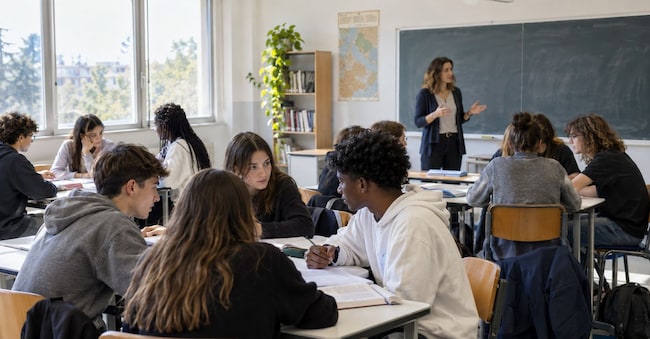
With every passing hour, the ‘education package’ due to be discussed by the Council of Ministers tomorrow is taking shape.
The first key point is that it should be a single decree, rather than a decree-law and a draft bill as circulated on Monday afternoon; a series of technical meetings regarding its contents were also held yesterday between the Ministry of the Interior, Palazzo Chigi and the Quirinale.
Audience and rules
On this point, there remains support for the idea of enshrining in law the 30 per cent cap on the proportion of foreign pupils in classes – a measure already set out in a 2010 circular and reiterated on Sunday by Prime Minister Giorgia Meloni following the summer announcements by the Minister for Education, Giuseppe Valditara. The target group also appears to be clearly defined: all pupils from abroad who have difficulty with Italian and have not yet completed three full years of schooling. For primary school pupils, this is reduced to two years for those who have attended nursery school in this country. Furthermore, it should be specified that if the school, in the first instance, or the Regional School Office (USR), in the second, is unable to find a local school (as is already the case for oversubscribed enrolments) or to find organisational solutions compatible with the right to education, an exemption from the new rules will apply.
Additional funds
To support these schools, Minister Valditara has announced 14 million, once fully implemented, ‘to strengthen Italian language provision for those pupils who find themselves in difficult circumstances and who do not know our language within mixed-ability classes’. This refers to the measure already in force from the 2025/26 academic year, which provides for the deployment of around a thousand teachers (of whom over 750 will be in the first cycle) dedicated to improving Italian for foreign nationals in classes where new arrivals in Italia make up 20 per cent or more (or who do not possess basic language skills equivalent to at least level A2).
The two measures, in fact, overlap. If the existing 20 per cent threshold for newly arrived foreign nationals is exceeded, an additional teacher is allocated straight away; if, on the other hand, the additional threshold of 30 per cent of non-Italian pupils with limited knowledge of our language is exceeded (and it is not feasible to transfer them to other classes or schools, ed.), language support programmes funded by the incoming resources will be implemented.

Brand connect


Newsletter Scuola+
La newsletter premium dedicata al mondo della scuola con approfondimenti normativi, analisi e guide operative
Abbonati