
Schools caught between budget cuts and new appointments
Speaking in the Chamber of Deputies, Minister Valditara highlighted the 206,000 appointments already made and the 40,000 still to be made.

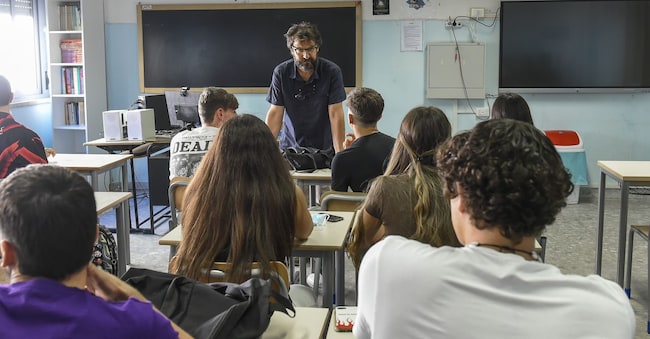
Whether viewed from the perspective of families or from that of politics and trade unions, teachers are one of the key pillars of the Italian school system. Very often, and particularly in the case of support teaching, the quality of teaching is a decisive factor in pupils’ success. And never before has education been so precariously balanced between staff cuts and new appointments as it is this year, the final year of the Meloni government. As, indeed, the Minister for Education and Merit, Giuseppe Valditara, himself hinted at when he announced last week during Question Time in the Chamber of Deputies that he had already estimated ‘a further 40,000 or so teacher appointments for the coming academic year’.
Between the old and new governments
Valditara began by looking back to the Draghi government, to highlight how, unfortunately, the falling birth rate (there are 110,000–120,000 fewer pupils in classrooms every year) has now become a national emergency. It was under that government that the process – which the Ministry of Economy and Finance (MEF) has consistently pushed for – of reducing staff numbers began: a total of 10,157 fewer posts.
Added to this slashing is now the cut provided for in the 2027 Budget Bill, which stipulates, with effect from the 2027/2028 school year, a reduction of 4,925 posts within the autonomous teaching staff and 2,049 ATA posts, resulting in savings of approximately 250 million euros.
Mim’s figures
The Minister for Education has pledged to eliminate, or at the very least reduce, these new cuts, pointing out that the current government has so far taken on around 206,000 workers in the sector, including teachers and technical and administrative staff. Furthermore, to begin bringing increasingly qualified special needs teachers into the classroom (which is the most critical aspect), a specific training programme has been introduced through Indire, which has already resulted in over 30,000 new specialists.
According to Valditara, these pathways – which offer an alternative to traditional university courses – have proved successful in the competitive selection rounds: candidates holding the new specialisation qualification in special educational needs have, on average, achieved better results than those recorded by candidates holding a university-based TFA qualification.


Brand connect


Newsletter Scuola+
La newsletter premium dedicata al mondo della scuola con approfondimenti normativi, analisi e guide operative
Abbonati