Middle East

Iran - Israel - US crisis, the impact of the Strait of Hormuz

The conflict risks unleashing a high crude oil price with direct consequences also on Italian consumption, starting with the cost of fuel. In these hours, in fact, voices of concern about the fate of this Strait (so dear to China in particular) are multiplying. This is why it is so central

by Andrea Carli and online editorial staff

Aggiornato il 23 giugno 2025 alle ore 12:01

(REUTERS/Dado Ruvic/Illustration)

5' min read

5' min read

In these hours the escalation of the Middle East crisis between Israel and Iran (and the United States of America) could have an impact on the Strait of Hormuz.

An Iranian closure of the Strait "would be extremely dangerous," warned the EU's High Representative for Foreign Policy Kaja Kallas, reiterating that the EU calls for a diplomatic solution and de-escalation. Meeting in Brussels, the European foreign ministers focus on a "diplomatic solution". "The fears of retaliation and war escalation are enormous, in particular the closure of the Strait of Hormuz by Iran, which would be extremely dangerous and would not benefit anyone," Kallas insisted.

Loading...

To the Iranian foreign minister Abbas Araghchi "I expressed concern, the request not to intervene with the closure of Hormuz, which could cause enormous damage to the economy primarily of Iran, but also to all other countries, including China," said the Italian foreign minister, Antonio Tajani, on the sidelines of the EU Foreign Council in Brussels.

European natural gas markets meanwhile are expected to face an increased risk of significant supply disruptions due to the latest geopolitical developments in the Middle East, according to Goldman Sachs. The US bank's analysts estimate that the Dutch benchmark TTF contract could rise to as much as EUR 74 per megawatt-hour - from around EUR 42 today - and over EUR 100 in the event of prolonged supply disruptions across the Strait of Hormuz. Brent could rise to $120 per barrel in the short term in the event of a successful blockade of the Strait of Hormuz, according to ING's Warren Patterson. "A successful blockade of Hormuz would lead to a dramatic change in the outlook for oil, pushing the market into a deep deficit," according to the head of commodity strategy.

The Chinese warning

.

China urges the international community to do more to prevent the fighting between Iran and Israel from impacting the global economy, stressing the importance of the Persian Gulf and surrounding waters for international trade. "China calls on the international community to redouble its efforts to promote de-escalation of the conflict and prevent regional instability from having a greater impact on global economic development," Foreign Ministry spokesman Guo Jiakun said. Beijing is particularly attentive to the Strait of Hormuz because about 90 per cent of oil supplies passing through this sea route are directed to China.

What is the Strait of Hormuz

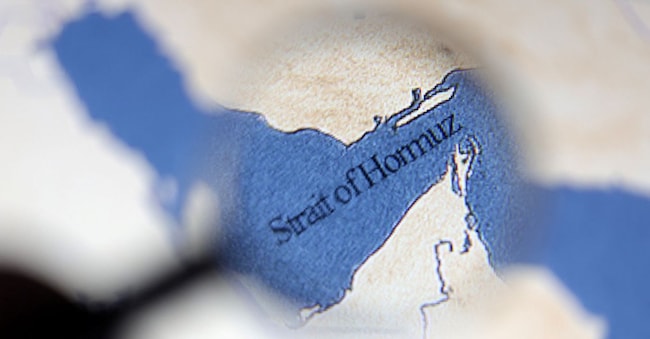
The Strait is an arm of the sea that connects the Gulf of Oman, i.e. the stretch of the Arabian Sea between the coast of Oman and the southernmost coast of Iran through which approximately 30% of the world's oil passes, to the Persian Gulf.

It stretches for 560 kilometres, reaching a maximum width of 320 kilometres.

Several states overlook the Persian Gulf: Iran, which makes up its entire northern coast (about 2,400 km), but also Iraq, Kuwait, Saudi Arabia, Bahrain, Qatar and Oman.

"The Strait of Hormuz will be one of the critical points in the coming weeks, but also in the medium to long term the situation may have important consequences, including an increased risk of terrorist attacks," Defence Minister Guido Crosetto confirmed in an interview with Il Corriere della Sera.

The effects of an escalation of the military confrontation between Israel and Iran could be in two areas: the global trade in hydrocarbons and, more generally, the traffic of goods.

The risk of high crude oil prices

.

Let us start with the first aspect. The conflict threatens to unleash a new high price rise with direct consequences on the consumption of Italians, starting with the cost of fuel. So far, Minister for the Environment and Energy Security Pichetto Fratin has assured, the price increase is contained at around 8% for oil and 5% for gas, but if the conflict, as it seems, does not diminish in intensity in the coming days, the price rise could accentuate.

From Monday 16 June, with the start of the new week, the picture should become clearer. The real fear of the markets, more than the possible involvement of Iranian oil facilities, whose exports are mainly directed to China and affected by the sanctions against the regime, is Iran's possible retaliation on the Strait of Hormuz. Through the channel transits all oil from the Persian Gulf to importers worldwide including LNG exports from Qatar and Oman: it is the main oil artery, 40% of the market volume. Approximately 15 million barrels a day transit through Hormuz, 'a total blockade would cause oil to skyrocket above 200 dollars', experts predicted last year as tensions between the two countries escalated.

An average of more than 3,000 ships transit the Strait of Hormuz each month

.

More generally, the Strait of Hormuz is important from the point of view of trade. According to early Lloyd's List estimates, an average of more than 3,000 ships pass through those waters every month. At its narrowest point, this crucial passage has a width of just 21 nautical miles. Whenever tensions in the Middle East threaten to escalate, many fear that this oil artery could effectively close to shipping. If this were to happen, the more than 500 million barrels of crude oil travelling eastwards from the oil-producing states would have to find another way to reach the market. Analysing transits in the first quarter of 2025 by country of actual ownership, Greek, Japanese and Chinese ships dominate and would be the most affected by a possible blockade.

EU Operation Aspides

.

Aspides ('shield', in Greek) is the EU's maritime security operation, in which Italy also participates, whose aim is to safeguard freedom of navigation in connection with the crisis in the Red Sea. Established in February 2024 as a maritime security operation of a defensive nature, it has been extended until 28 February 2026. The operation intervenes along the main maritime lines of communication in an area encompassing the Baab al-Mandab Strait and the Strait of Hormuz, as well as the international waters of the Red Sea, the Gulf of Aden, the Arabian Sea, the Gulf of Oman and the Persian Gulf, and ensures an EU naval presence in the area where, since October 2023, numerous Houthi attacks have targeted international commercial vessels. Italian ships (Caio Duilio, Virginio Fasan, Federico Martinengo, Andrea Doria) performed flagship and defence roles during the year. Rear Admiral Vasileios Gryparis heads the operation, whose command is based in Larissa (Greece). Aspides operates in close coordination with EUNAVFOR ATALANTA, another EU military operation aimed at contributing to maritime security in the western Indian Ocean and the Red Sea, and with other initiatives in the area.

The EMASOH (European-led Maritime Awareness Strait of Hormuz)

initiative

In June last year, Italy's participation in Kuwait as part of the naval surveillance mission in the Strait of Hormuz (EMASoH, an acronym for 'European-led Maritime Awareness Strait of Hormuz') ended. Active since 2020 and based in the Emirates, EMASoH is joined by European countries such as Belgium, Denmark, Greece, the Netherlands, Portugal and Germany. Italy continues to be part of the initiative, contributing through diplomatic representatives and staff, though without deploying ships or aircraft. The objective of the mission is to safeguard freedom of navigation and the safety of ships in transit in the Strait area.

Brand connect

Loading...

Newsletter

Notizie e approfondimenti sugli avvenimenti politici, economici e finanziari.

Iscriviti