The text passed by the Council of Ministers

Security Decree, here are all the rules: from protections for agents and military to new crimes

In 39 articles, the measure follows the old bill. Gone is the obligation for administrations and universities to cooperate with 007s

Manuela Perrone

10' min read

10' min read

From the crime of 'possession of material for the purposes of terrorism' to strengthened protections for agents and military personnel, to measures to support the work of detainees, the decree law on security approved yesterday by the Council of Ministers is broad and complex, replacing and superseding the Senate's bill, with its 38 articles in full but incorporating the six remarks made by the Quirinal Palace.

Prevention and Counter-Terrorism

The first article introduces the offence of possession of material for terrorist purposes. It punishes with imprisonment from two to six years anyone who procures or possesses material containing instructions on the preparation and use of deadly war devices, weapons, chemical or bacteriological substances, and any other technique or method for the perpetration of acts for the purpose of terrorism. The threshold of punishability is also raised for anyone who distributes, disseminates or publicises by any means material containing instructions for the preparation and use of explosive materials essential for the commission of serious offences.

Loading...

In the same vein is the introduction of a sanction against operators of rental of vehicles without drivers, in the event of failure to communicate the customer's and vehicle's identification data, for subsequent comparison by the Data Processing Centre-CED, extending the purpose of preventing terrorism also to organised crime, drug trafficking, immigration, and counterfeiting.

Anti-mafia checks also on network contract

Other provisions strengthen the fight against crime. The figure of the 'network contract' is introduced in the list of entities subject to anti-mafia verification under the Anti-Mafia Code. The power attributed to the prefect to limit certain effects of the anti-mafia interdiction order in the event that the person concerned and his family members lack the means of subsistence has been redefined: it is envisaged that it can only be exercised upon the documented request of the owner of the sole proprietorship, and therefore not ex officio, and after preliminary investigation activities carried out by the inter-force group. The benefits for the survivors of mafia victims are also granted to the spouse, cohabiting partner, relative or kin up to the fourth degree of kinship of the recipient of a prevention measure provided for by the Anti-Mafia Code, or of persons subject to criminal proceedings for one of the offences referred to in Article 51, paragraph 3-bis, of the Code of Criminal Procedure, when it appears that, at the time of the event, the applicant had definitively broken off personal and property relations.

News for assets seized and confiscated from the mafias

Collaborators and witnesses of justice are allowed to set up 'fictitious' companies to carry out activities that require a higher level of security. For seized and confiscated properties, the immediate involvement of local authorities for the management of unauthorised properties and the competence of the judge who, with the confiscation order, orders the demolition to be carried out, as well as a simplification of the procedure for the cancellation of inactive companies is established; the prohibition of employment in a company, after the final confiscation, by persons close to the addressee of the confiscation itself or to those who have been convicted, even at first instance, of 416-bis; the free registration in the company register, by the court or the Agency, of changes concerning the seized and confiscated companies; the satisfaction of the companies' predeductible creditors by withdrawing the sums available in the company's assets. During the examination in the Chamber of Deputies, the deadline for appealing against personal prevention measures adopted by the judicial authority was extended from ten days to thirty, and it was provided that economic contributions to local authorities for making school buildings safe and energy efficient can also be used for confiscated assets destined to the local authority.

Citizenship, revocation possible up to ten years after conviction

In addition to transposing the new definition of a pyrotechnic article contained in the EU legislation, the decree also intervenes on the matter of revocation of citizenship: it extends from three to ten years the period during which it can be exercised against a foreigner, starting from the conviction for serious offences already provided for in the law, provided that he possesses or can acquire another citizenship.

The crime of squatting

.

The decree, like the bill, introduces a new type of offence aimed at combating the phenomenon of illegal occupation of property intended as someone else's domicile or its appurtenances, or the appropriation of property intended as someone else's domicile, or its appurtenances, with artifice and deception. The offence is punishable by imprisonment from two to seven years. Ex officio prosecution is provided for if the offence is committed against a person who is incapacitated by age or infirmity, and also if it is committed on public property or property intended for public use. In addition, a procedure is introduced to speed up the reinstatement of possession of the occupied property if it is the only actual dwelling of the complainant.

Hacking and scamming the elderly

A new common aggravating circumstance is provided for in non-culpable offences against life and public and individual safety, against personal liberty and against property, or which in any case offend property: that of having committed the offence inside or in the immediate vicinity of railway and underground stations or inside passenger transport convoys. In the new wording, the scope of the offences in respect of which the new aggravating circumstance expresses a degree of greater offensiveness such as to justify the increase in penalty has been redefined. The instruments for deterring and repressing fraud against the elderly are also strengthened, through the introduction of a specific hypothesis of aggravated fraud (from two to six years and a fine of €700 to €3,000) with arrest in flagrante delicto. In the Chamber of Deputies, an increase in the penalty by up to one third was introduced for the crime of damaging public events, committed with violence to the person or with a threat, punishable by imprisonment of one year and six months to five years and a fine of up to 15 thousand euro.

The extension of the Urban Daspo

.

The Urban Daspo, i.e. the ban on frequenting certain areas of the city, is extended to those who have been reported or convicted, even with a non-definitive sentence, during the previous five years, of crimes against the person or against property committed in the internal areas and in the appurtenances of railway, airport, maritime and local, urban and suburban public transport infrastructures. The deferred arrest in flagrante delicto is also extended to the offence of serious or very serious bodily harm to a public official on duty of public order, committed during demonstrations in a public place or open to the public.

Road blockade becomes a crime

The current administrative offence of road blocking becomes a crime, punishable by imprisonment of up to one month and a fine of up to EUR 300. If the offence is committed by several persons, the imprisonment ranges from six months to two years.

Mothers, how the squeeze changes

Article 15 deals with the execution of sentences for pregnant women and women with children, with the repeal of the provision providing for mandatory postponement and the introduction of optional postponement of sentences and the provision that optional postponement is not possible if this results in a situation of danger, of exceptional importance, of the commission of further offences. In the case of pregnant women or mothers with children under one year of age, the judge is obliged to enforce the measure of pre-trial detention in attenuated custody institutions. By 31 October each year, the Government has to submit a report to Parliament.

Begging, punishment for using children up to the age of 16

Again in order to combat urban crimes considered to be more harassing, the decree increases the punishment for inducing begging to use minors up to the age of 16 (no longer up to 14) and introduces an aggravating circumstance if the act is committed with violence or threats or against a person under the age of 16 or in any case not chargeable. The Dl-ex-Dl also authorises the hiring of one hundred non-managerial staff members of the local police force for an indefinite period of time for the needs of the city of Palermo.

From the alt to light cannabis excluding seed production

The amendments to Law 242/2016 are confirmed with the express prohibition of importing, transferring, processing, distributing, trading, transporting, sending and delivering the inflorescences of cultivated hemp. But included in the decree, within the scope of lawful cultivation, is the agricultural production of seeds for uses permitted by law within the contamination limits established by the Minister of Health by decree. The controls are entrusted to the Carabinieri's Forestry, Environmental and Agri-Food Units Command.

Police and military protections

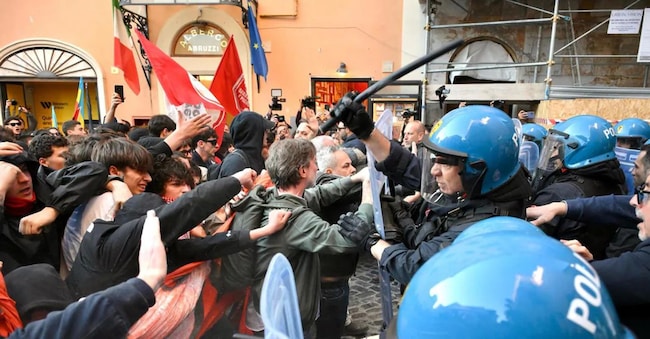
There is a substantial package of regulations for the police and armed forces. An aggravating circumstance is introduced for the crime of violence or threatening and resistance to a public official if the act is committed against an officer or agent of the judicial police or public security, with an increase in the penalty by up to half (instead of one third, as provided for in the Bill). On the other hand, the prohibition on the prevalence of extenuating circumstances over aggravating circumstances has been expunged, after the discussion with the Quirinal. There is also a further aggravating circumstance in the case of violent acts committed in order to prevent the construction of an infrastructure (the so-called 'no Bridge or no Tav' rule), but it is specified in the text of the Bill that the infrastructures are those 'intended for the provision of energy, transport services, telecommunications or other public services'. It also introduces the new offence of personal injury to an officer or agent of the judicial police or public security in the act or due to the performance of their duties.

Bodycam on uniforms and unlicensed private weapons

.


Police forces will be allowed to wear bodycams on their uniforms, i.e. video surveillance devices suitable for recording operational activity in public order maintenance services, territorial control, surveillance of sensitive sites, as well as on trains and on board trains. The same power is provided in places and environments where persons subject to restriction of personal freedom are detained. Officers are also authorised to carry private weapons without a licence when not on duty.

Legal protection

.

For members of the police force, the National Fire Brigade and the Armed Forces investigated or accused for facts related to service activities, the State may pay up to EUR 10,000 for legal costs at each stage of the proceedings. Recourse is envisaged if it is established that the employee is responsible for wilful misconduct. Recourse is excluded, on the other hand, in the event of a decision not to prosecute, for lapse of the statute of limitations, for archiving, and in other cases of acquittal (unless, for the facts contested in the criminal proceedings, the employee has been found liable for gross negligence in disciplinary proceedings). In addition, the defence of movable and immovable property used in the exercise of public functions is strengthened: in the case of defacement and defacement, there is a risk of imprisonment from six months to one and a half years and a fine from one thousand to three thousand euro, with an increase in the maximum term of imprisonment (three years) and in the fine (up to 12 thousand euro), in the case of recidivism.

Tougher penalties for those who do not stop at traffic police stop

In the decree there is also the tightening of sanctions for violating the prescriptions and obligations issued by traffic police personnel, with the accessory sanction of the suspension of the driving licence from 15 to 30 days in the event of a repeat offence.

The prison crackdown

.

The measure increases the punishment for inciting disobedience of the laws if the act is committed within a penal institution or through writings or communications directed at prisoners. The offence of "riot within a penal institution" is created, which punishes the conduct of promoting, organising or directing and participating in a riot carried out within a penal institution by three or more persons united, by means of acts of violence or threats, attempts to escape or acts of resistance, including passive resistance, that prevent the performance of acts of office or service necessary for the management of order and security. Again thanks to the interlocution with the Colle, the core of criminal relevance of the conduct of resistance (also passive) has been better defined, circumscribing it to those relating to the execution of orders given 'for the maintenance of order and security'. The penalty is increased if the offence is committed with weapons or if the riot results in personal injury or death. A similar offence is also provided for in detention centres for irregular migrants. In this case, for resistance, reference is made to orders issued 'for the maintenance of order and security' against groups of irregular foreigners present in the CPRs only, expunging any reference to reception centres.

Secret services, collaboration obligation for the public administration and universities is off

One of the most controversial provisions of the draft law, the one that imposed an obligation on public administrations, universities and research centres to respond to requests for cooperation from the secret services, as an exception to privacy legislation, has been deleted. Nel decree remains, instead, the protections for 007s in relation to counter activities against conduct referable to terrorist and subversive threats, and the attribution of the qualification of public security agent to the personnel of the armed forces assigned to the protection of the structures of the intelligence agencies, where they do not already have it.

Sim to migrants, ID sufficient

In order to sell Sim cards to non-EU migrants, it will be sufficient for foreigners to show a simple identification document: the decree law does not provide, as did the bill, for the obligation to show a valid residence permit. Per those who do not observe the duties of identification, the accessory administrative sanction of the closure of the business or activity from 5 to 30 days is provided for. Moreover, the accessory penalty of the inability to contract with operators for a period to be fixed between six months and two years is introduced for those convicted of the crime of substitution of person, committed with the purpose of signing a contract for the supply of mobile telephony. Compared to the text introduced in the Chamber, the type of documents that the owner of the exercise or activity can acquire when selling Sims has been extended. In addition to the residence permit, it will be possible to acquire 'either a passport or an equivalent travel document or a valid identification document'.

Support for victims of usury is strengthened

For economic operators who are victims of usury, the decree provides for the creation of the figure of the tutor, with advisory and assistance functions in the management of the loan. The objective: to mitigate the high delinquency observed in the repayment of loans by beneficiaries and to facilitate their reintegration into the legal economic circuit. Legal auditors, accountants, lawyers and chartered accountants registered with their respective professional Associations, as well as persons with specific skills in the economic activity carried out by the victim of the crime of usury and in business management, may apply for registration in the register, set up at the Office of the Extraordinary Commissioner for the coordination of anti-racket and anti-usury initiatives.

Jails and Work

Lastly, the decree intervenes to encourage the employment of prisoners, including outside, using non-profit organisations (third sector entities) in implementation of principles of social solidarity and horizontal subsidiarity, with the extension of the definition of 'disadvantaged persons' also to prisoners or internees in penitentiary institutions and former in-patients of psychiatric hospitals, including judicial ones.

Copyright reserved ©
Loading...

Brand connect

Loading...

Newsletter

Notizie e approfondimenti sugli avvenimenti politici, economici e finanziari.

Iscriviti