The measure

Security Decree, yes to preventive detention and extended criminal shield. Knives to minors: fines to parents

Tightening up on weapons and minors New tools for the police: detention at public events but the public prosecutor can order release if he considers that the conditions are not met

by Ivan Cimmarusti

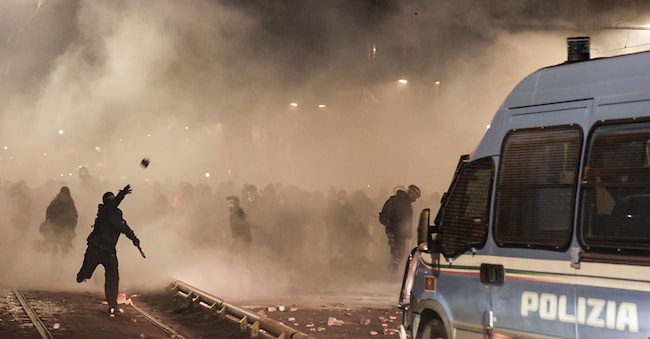
Scontri a corteo Nazionale in solidarietà al Centro Sociale Askatasuna di sabato 31 gennaio 2026. (Marco Alpozzi/Lapresse)

6' min read

Translated by AI
Versione italiana

6' min read

Translated by AI
Versione italiana

In the Decree-Law on Security passed today by the Council of Ministers, after the filing requested by the Quirinal, there is a squeeze that points straight at an explosive node: weapons and minors. The idea is simple and hard: it is not enough to punish those who go around armed, access upstream must be cut - in shops, between private individuals and above all online.

The port outside the house

On the take-away front, the text raises the criminal risk level: anyone who, without justified reason, carries tools with sharp or pointed blades over 8 centimetres risks imprisonment from six months to three years. The same penalty is also triggered for a series of 'typified' blades: folding blades from 5 centimetres upwards, 'single-edged and sharp', lockable, snap-on or one-handed, including 'butterfly' blades and those camouflaged or concealed in other objects. And it doesn't end there: the acts go to the prefect, who can add measures such as suspension of the driving licence or suspension/prohibition of obtaining a gun licence for up to one year.

Loading...

The chapter that makes the most noise is the one on minors: if one of the offences mentioned is committed by an under-18, an administrative penalty is also triggered for those exercising parental responsibility, from 200 to 1,000 euro, decided by the prefect.

Selling to minors

Then there is the barrier to purchase: it is forbidden to sell or give to minors under the age of 18 'offensive' pointing or cutting instruments. In shops it is compulsory to ask for identification, unless the age of majority is evident. But the ban also applies between private individuals: it is not just a matter of trade.

The most modern step concerns e-commerce: sites and platforms must adopt effective verification of age of majority before closing the sale. If they do not do so, Agcom intervenes: first a warning with 30 days to comply, then - if they do not comply - the blocking of the site or platform may arrive until everything falls into place.

Fines for violators of the ban on selling to minors start from 500 to 3,000 euros; if the violation is repeated, they rise to 1,000-6,000 euros with a 15-45 day closure, and in the event of a further repeat offence, they rise to 2,000-12,000 euros with revocation of the licence.

Youth Violence

In Palazzo Chigi's Dl Sicurezza comes a clampdown on youth violence that revolves around one point: the warning. If the juvenile relapses after that first 'yellow card', consequences are also triggered for those who have to supervise.

In fact, the rule inserts a sanction: if one of the offences already provided for is committed after the warning, the person exercising parental responsibility over the child may be fined between 200 and 1,000 euro. The prefect decides, applying the rules of Law 689/1981.

In addition, the warning procedure is also extended to injuries, brawls, private violence and threats when the act is committed with the use of weapons or offensive instruments, the carrying of which is prohibited absolutely or without justification.

The same mechanism is also pegged to law 71/2017: after the warning, if the offence is repeated, a fine of 200-1,000 euro can be triggered again for those with parental responsibility, again under the jurisdiction of the prefect.

Fermo

The rule that was most controversial, the detention, has been amended on the basis of the Quirinale's clarifications. The operational tools of the police during public demonstrations are broadened: under certain conditions, officers can accompany a person to the office and detain him or her for up to 12 hours for investigations.

The perimeter is linked to specific public order and safety operations ordered at events in a public place or open to the public. Accompaniment may be triggered when, on the basis of concrete circumstances of time and place and factual elements, there is a well-founded reason to believe that the person may engage in conduct that poses a concrete danger to the peaceful conduct of the event.

Factual elements' may also include:

1. the possession of certain instruments, objects or materials referred to in existing legislation (Articles 4 and 4-bis of Law 110/1975 and Articles 5 and 5-bis of Law 152/1975) useful to offend;

2. the presence of previous criminal records or police reports for offences involving violence against persons or property committed at events in the last five years.

Detention must last only as long as strictly necessary for the checks, with a maximum limit: no more than twelve hours. And immediate control is triggered: the accompaniment and the time are immediately notified to the public prosecutor, who can order the release if he considers that the conditions are not met. The release, with its timetable, is also immediately communicated to the public prosecutor.

Public events

In Palazzo Chigi's Security Decree, the management of public demonstrations changes with a clear-cut approach: fewer 'paper' arrests, more administrative maxi-sanctions and more power to the prefect. The target is mainly unannounced promoters, diversions that create risk and conduct that disturbs or obstructs.

Promoters without prior notice: fines of up to 10,000 euros (even if you organise online)The old penal formula is replaced by an administrative sanction of 1,000 to 10,000 euros. And the text says it explicitly: it also applies to anyone who promotes a meeting in a public place via electronic communication networks, platforms and services, even with closed groups, without notifying the Authority.

Stop the old penalties: other violations go up to 12,000 euro
Another offence changes to an administrative penalty from 1,000 to 12,000 euro, replacing arrest and fine

Trails, blockades and 'disturbances': new fines and aggravating circumstances
The decree adds a package of new penalties:

1. if traffic restrictions or prescribed routes are not observed and a danger to public safety or security may result from this: EUR 1,000-10,000;

2. if, during the meeting, you obstruct or hinder the proper functioning of the emergency public assistance services (unless it is a crime): the same sanction is triggered as provided for;

3. whoever disrupts the peaceful conduct of the meeting or the regular performance of the order and security service (unless a criminal offence is committed): EUR 500-3,000;

4. but the fine rises to EUR 2,000-10,000 if the disruption is made by a person who makes recognition difficult by the means provided for in Law 152/1975 or if he/she is in possession of the instruments/objects referred to in Article 5-bis of the same law.

There is also a clampdown on recidivism: if a violation is repeated within a two-year period, or if three violations (even different ones) are contested within five years, the penalties increase from one third to one half.

Not to be entered in the register of suspects

A technical but weighty novelty for those who end up involved in a fact that, from the outset, appears to be covered by a justification: the Public Prosecutor's Office can open a 'separate' track and close it quickly, but still guarantee rights and protections.

The text amends Article 335: when it is clear that the fact was committed in the presence of a justification, the public prosecutor does not proceed with the normal registration, but makes a preliminary entry in a separate form, indicating the name of the person to whom the fact is attributed. In this case the rules laid down in paragraph 1-bis, i.e. entry in the register of suspects, do not apply.

Immediately afterwards, a new article, 335-quinquies, is introduced, which clarifies two things. The first: even if it is a 'separate' record, the rights and guarantees typical of a person undergoing preliminary investigations, and any other related provisions, apply to the person indicated.

The second is timing, with a timed track:

1. If no further investigations are needed, the public prosecutor must decide on the request for archiving 'without delay' and in any case within 30 days of the preliminary notice;

2. if, on the other hand, it deems further investigations necessary (including those in the form of Article 360), it must do so "without delay" and in any case within 120 days of the preliminary note; then, if it does not enter the special cases provided for in the following paragraphs, it must decide on archiving within a further 30 days.

There is, however, a threshold that triggers the 'full' procedure: when moving towards acts that require the presence or the power of assistance of the defence counsel (other than technical examinations pursuant to Article 360) or when proceeding with an evidentiary incident, the public prosecutor must move on to the entry in the register provided for in Article 335 (paragraph 1-bis).

Copyright reserved ©
  • Ivan Cimmarustigiornalista

    Luogo: Roma

    Lingue parlate: Italiano, inglese

    Argomenti: Sicurezza, giudiziaria, inchieste, giustizia tributaria

    Premi: Nel 2011 tra i vincitori del Premio Internazionale Antimafia Livatino-Saetta

Loading...

Brand connect

Loading...

Newsletter

Notizie e approfondimenti sugli avvenimenti politici, economici e finanziari.

Iscriviti