
Europe accelerates on drones and air shields
From the war in Ukraine to attacks in the Red Sea, unmanned systems are reshaping military strategies and budgets. Italia invests 3.2 billion in unmanned platforms and strengthens air defence
by Andrea Carli (Il Sole 24 Ore), Janine Louloudi (EfSyn, Greece), Lola García-Ajofrín (El Confidencial, Spain), Lukas Kapeller (Der Standard, Austria) and Nikola Lalov (Mediapool, Bulgaria)
 Aggiungi Il Sole 24 Ore
ai preferiti su Google
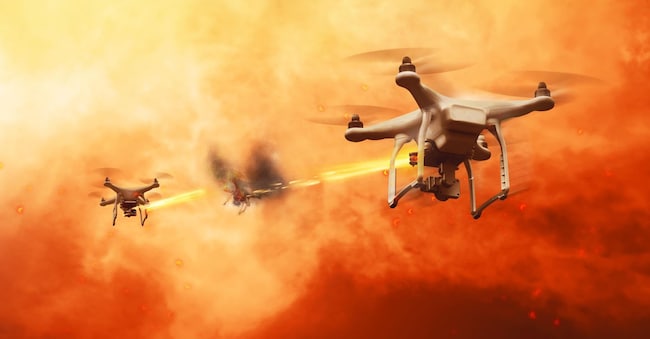
The conflict between Russia and Ukraine and the attacks in the Red Sea show how unmanned systems are profoundly changing the way military operations are conducted. The use of drones to strike sensitive targets such as airports, as happened in September in Copenhagen and Oslo, has also raised the alert in Italia on remotely piloted aircraft. The Italian Defence has moved on a dual track. On the one hand, the definition of a counter strategy, and on the other, the acquisition of instruments to provide cover against attacks from the sky.
In the first case, the occasion was provided by the 'non-paper' that Minister Guido Crosetto published in November. 'In recent months,' the paper highlights, 'there has been an increase in drone overflights - often unidentifiable - over civil and military infrastructure in numerous European countries'. Even earlier, in the Defence Planning Document 2025-2027, the document that plans defence spending for the coming years, the minister had emphasised that 'emerging and disruptive technologies (EDT) also lower the barriers to entry: advanced low-cost tools, such as drones and mini-drones that can also be deployed in swarms, are difficult to identify and counter'. Hence the conclusion: 'The military instrument must evolve towards a modern, flexible and credible model capable of guaranteeing state security and protecting national interests'.
The way forward is the 'widespread adoption of dronic technologies in all Army components, with operational integration extended down to the lowest orderly levels'. 'Looking ahead,' it goes on, 'we must also continue the process of evolution of air defence systems, including advanced radar and surface-to-air missiles, to counter the growing variety of threats, from missiles to drones. Ultimately, Italia is enhancing a highly integrated air system that ensures a high operational capability and rapid response to threats. Robust aerospace defence and a dynamic industrial ecosystem are key to maintaining a leading position in the sector'.
Unmanned systems, or unmanned vehicles, are becoming fundamental to the future of defence. These technologies are developing rapidly, and today there are different types of drones: aerial drones (UAVs - Unmanned Aerial Veichle), sea surface drones (USVs - Unmanned Surface Vehicles), underwater drones (AUVs - Autonomous Underwater Vehicles), and land-based drones (UGVs - Unmanned Ground Vehicles), as well as highly specialised robotic and cybernetic systems. With regard to the funds Italy has allocated in the Budget Law 2025, EUR 3.2 billion have been earmarked for the development and procurement of unmanned systems. Several programmes have been activated to develop and purchase these types of systems. Defence has explained that, as far as aerial drones (UAVs) are concerned, it is targeting very different models, from large, autonomous, long-range drones to highly versatile micro-drones. All branches of the Armed Forces will be equipped with them. As for marine systems (USVs and AUVs), there is growing investment in naval and underwater drones, to enhance underwater surveillance and protection, with a wide range of platforms. Finally, land vehicles (UGVs): unmanned vehicles are being developed for reconnaissance, support and logistics in risky environments, reducing personnel exposure and improving data collection and dissemination in the field. On 22 January, the first Grifo Air Defence System equipment was delivered to the Italian Army. Developed and produced by MBDA in Italia as part of a programme launched in 2019, which integrates the new CAMM-ER missile, this system will provide protection in the short-range segment (Short Range Air Defence), thanks to its capabilities to engage and neutralise a plurality of threats, including fixed-wing and rotary-wing aircraft (including drones), cruise missiles and anti-radar missiles. As part of a package of 14 Defence Ministerial Decrees under parliamentary consideration, amounting to EUR 5.5 billion, almost EUR 600 million are earmarked for upgrading the Air Force's MQ-9A remotely piloted aircraft.
With regard to the production of drones, in June, Italy's Leonardo announced the formation of a joint venture with Turkey's Baykar Technologies dedicated to the development of technologies for remotely piloted systems. Beyond this collaboration, there is the idea of involving other countries that have become leaders in this sector, such as Ukraine and Poland (especially for mini-drones). The game is also being played on the budget field. The European Commission has given the green light to the plan presented by Italia with the aim of obtaining around 15 billion from the Safe fund. It is not known how these resources will be used, as the plan has not yet been made public, but it is easy to predict that drones will be part of the package.


