Art

Seduced by colour by Andrea Solario

The Milan exhibition reveals a complex artist with the grace of Bellini, the attention to detail of the Flemish and the culture of Bramantino
by Marina Mojana

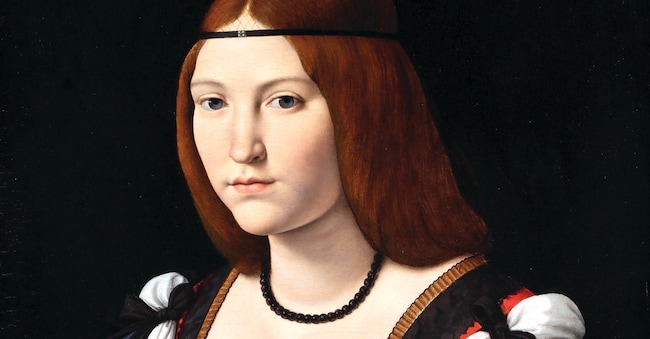
Andrea Solario. «Ritratto di dama», 1505-1507 circa, Milano, Castello Sforzesco. (Courtesy Castello Sforzesco di Milano)

4' min read

4' min read

At the Poldi Pezzoli Museum in Milan, a splendid exhibition is currently underway that I would call boutique because it is small in size, with a unique and intelligent style, of the highest aesthetic and scientific level and above all at the service of the visitor who will finally have the opportunity to get to know who Andrea Solario was: among the great painters born in Milan, second only to Caravaggio and quoted in the mid 19th century at twice the price of Botticelli.

Curated by Lavinia Galli and Antonio Mazzotta "La seduzione del colore. Andrea Solario e il Rinascimento tra Italia e Francia", open until 30 June 2025, is the first exhibition dedicated to this protagonist of Sforza art, much loved by scholars; the first to dedicate a monograph to him was Lisa De Schlegel in 1913, the last David Alan Brown in 1987.

Loading...

The exhibition design, by the Milanese studio Migliore+Servetto, lightly intervenes in the rooms on the ground floor of the house-museum, defining a fluid itinerary in three different environments, respectively dedicated to the Venetian, French and Milanese periods of the artist.

His human and artistic career began around 1470 in Milan, where he trained in the famous family workshop (the Solari family were architects and sculptors of Ticino origin) and ended here, cut short by the Black Death, in 1524. In between there is a stay in Venice (circa 1494-1499), a return to the capital of the Sforza duchy (circa 1500-1507), a prestigious assignment in France at the court of Cardinal Georges d'Amboise (1507-1510) and the definitive return to his hometown, where Solario painted uninterruptedly until his death, with the exception of a stop in Rome (1513 - 1514) and perhaps a passage to Ferrara.

He was still a young boy at the time when Leonardo da Vinci appeared at the court of Ludovico il Moro in 1482. He arrived in Venice in the company of his sculptor brother, Cristoforo known as the Gobbo, who was older and more famous than him, and studied the works of Giovanni Bellini, the absolute protagonist of the Venetian Renaissance, producing his first masterpiece in oil on panel, the Madonna dei garofani now in the Brera, alongside some penetrating portraits that were influenced by the lesson of Antonello da Messina, who had passed through Venice twenty years earlier. In the cosmopolitan lagoon, Andrea probably met the young Albrecht Dürer and Perugino, whose painting had a key influence on him, while he was confronted with the Leonardesque painters who had recently left French-occupied Milan. When Leonardo also arrived in Venice with the Salai in 1500, Andrea had already left.

He returned to Milan and established himself independently. To these years date works of extraordinary material quality - almost enamel - and impeccable execution such as the Ritratto di donna at the Castello Sforzesco in Milan (the more chaste sister of Leonardo's Belle ferronière); the Ecce Homo from the Poldi Pezzoli (to be calmly observed in every detail, including the tears), executed - through a magnifying glass - with a brush of the finest marten hair; and the numerous versions of the Head of St John the Baptist. In the one from the Louvre (1507), Solario paints his face reflected on the foot of the cup, in a play of anamorphosis, a tribute to Leonardo's optical research. The encounter with the genius da Vinci, which would give him a new freedom of expression, did not take place until 1511 in Milan, when Solario, in his early 40s, was by then a mature artist, having just returned from Normandy. Here, between 1507 and 1510, he had had an exhilarating experience as a painter at the court of Cardinal d'Amboise, lord of Gaillon, and here, opening himself up to the influence of the Flemish, he had worked on the frescoes in the chapel of the Castle, destroyed by the Jacobins in 1799.

In France, he produced some of his most famous and copied works, such as the stunning Madonna of the Green Pillow from the Louvre. 'It is one of the most copied paintings in the history of art,' Mazzotta notes, 'and although Solario is not an orthodox follower of Leonardo, in this work he comes close to him through Giovanni Antonio Boltraffio, the artist who often acted as mediator between him and Leonardo, allowing him not to get too close to the master's light,' Mazzotta continues.

Towards the end of his life he portrayed the ducal grand chancellor Gerolamo Morone (1522) and a monumental multi-compartment altarpiece for the Certosa di Pavia, which was never completed due to his sudden death.

With 24 works, seven from the Poldi Pezzoli (the richest nucleus in Italy) and six from the Louvre, the exhibition has the merit of making us fall in love with a complex artist, who has the grace of Bellini, the attention to detail of the Flemish, the culture of Bramantino and the harmony of Leonardo.

The author of portraits and room paintings, he used to sign himself Andreas Mediolanensis when working outside the Sforza duchy and Andrea de Solario when working in the city. This habit contributed to the confusion of art historians and weakened his identity between the 17th and 19th centuries. Vasari himself increased the confusion by calling it 'Andra del Gobbo'. It was only in 1857 that the connoisseur Otto Mündler discovered that the three Andrea's were the same person, encouraging the rediscovery of a fascinating artist who introduced the Italian Renaissance to France. From then on, Solario's collecting fortunes would dominate the entire second half of the 19th century. 'At the time of Count Gian Giacomo,' writes Galli in the catalogue, 'Andrea was very famous and commanded very high prices on the market. In the inventory of Gian Giacomo Poldi Pezzoli's works, his Riposo nella fuga in Egitto was valued at 45,000 lire, while Botticelli's Madonna del Libro was valued at 20,000 and Pollaiolo's Dama, then attributed to Piero della Francesca, at seven thousand lire'.

The Seduction of Colour. Andrea Solario and the Renaissance between Italy and France

Edited by Lavinia Galli and Antonio Mazzotta

Milan. Poldi Pezzoli Museum

Until 30 June 2025

Catalogue Dario Cimorelli, pp. 328, euro 36

Copyright reserved ©
Loading...

Brand connect

Loading...

Newsletter

Notizie e approfondimenti sugli avvenimenti politici, economici e finanziari.

Iscriviti