See under red: destination China, on the trail of an unparalleled stone
A colour, hóng zhû chì, dyes the thread that traces the itinerary from Florence to Beijing. Chronicle of a journey along the Great Wall ribbon.
7' min read
7' min read
There are three words for red: hóng is a silk cloth so pale as to fade into peach and dust, almost pink; zhû is a tree with a heart of blood, the pith of a cypress, pure cinnabar; chì is the naked body, the barren soil of the South. If one were to concentrate Beijing's meticulous, dissonant, boundless complexity inside a 'petite boîte rouge', the shade would not be that of the most regal French jewellery box, nor the orange-chamois of millenary lacquer, carved and encrusted with gold. Nor would it have the flickering transparency of the red lanterns of the few, surviving hutong. It would resemble, without ever definitively resembling, a rubellite anemone, now scarlet, now amber, now purple, a stone unique in nature and the deposit of hundreds of hours of handwork, a masterpiece of glyptics that engraves the tiny extracting light from it, a flower to be worn around the neck, a pendant unrepeatable in the repetition of gestures handed down from the age of the Minotaur. If the journey through Cartier's haute joaillerie begins again in Beijing, celebrating the most scenic stage of that Le Voyage Recommencé, which from Florence has moved and renewed between the splendours of the Forbidden City and the stone ribbon of the Great Wall, red, or rather hóng zhû chì, are the key word.
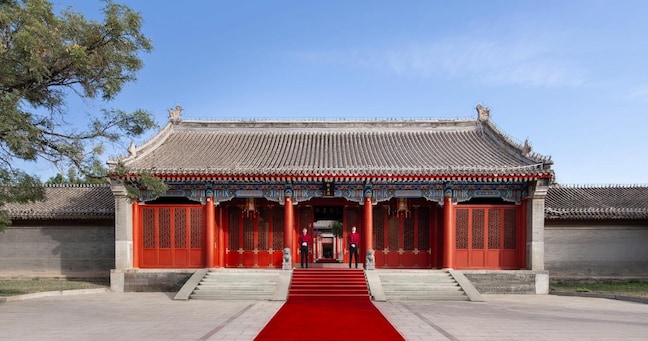
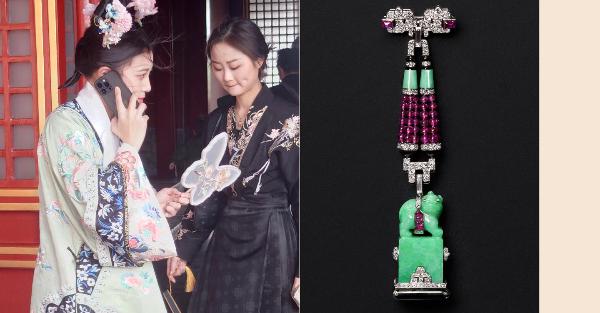
Every language is made up of terms that are sounds and, in China, are tones. Style is also a language before being an aesthetic line. One can practise its phonology, morphology, lexicon, syntax. This is the challenge thrown down to me by Pierre Rainero, Cartier's image, style and heritage director for forty years, a precious companion of discoveries in the capital's Palace Museum as well as inside Prince Jun's Mansion, where the collection is on display, a curious, omnivorous master of rare stones and antique watches, a storyteller and traveller. "I often ask myself what creativity is. There is a quantitative aspect which is the number of ideas (for me it doesn't count and I don't count them). There is a subjective aspect which is originality, but, mind you, the new is rarely original. Then there is a third level, which I consider the most important, relevance, that kind of resonance, both logical and functional, with the sender, with the receiver and with the object created. If we were not in front of a jade watch-brooch, in the shape of a Buddhist lion - one of the 3,500 pieces of the Cartier Collection, placed at the opening of the exhibition to recall its ancient connection with Chinese culture - the conversation might call into question semiology. "Creativity in itself is nothing. I am interested in pure instinct applied to a code. It's like when you learn a foreign language: only if you reach a certain level of knowledge can you speak with freedom without constantly consulting the vocabulary. That's it: brand culture, the one whose transmission I safeguard, is a language. When there is mastery of vocabulary and grammar, there are no longer any brakes on the possibilities of expression'. Rainero, incidentally, naturally speaks four languages, five if we include Cartier-style, and moves from French to English, from Spanish to Italian with the punctuality of one who searches for the most appropriate echo for each semantic area.
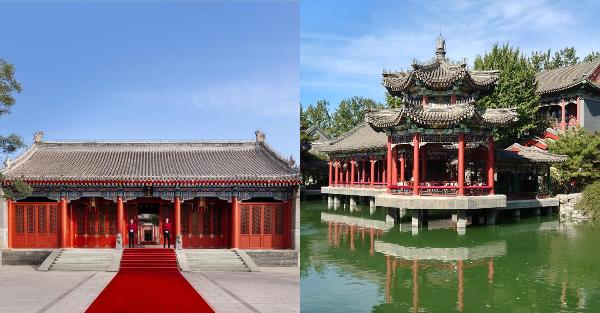
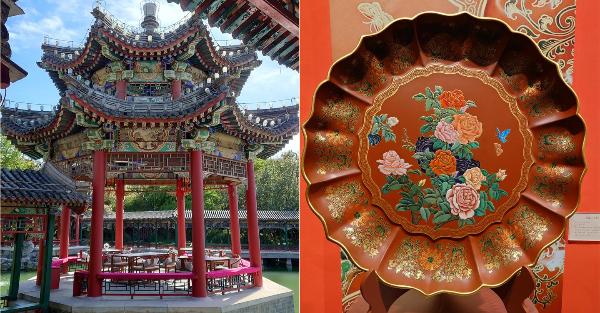
His reflection takes us a long way: we are guests in a 'house' that is more than 400 years old, the gardens, the painted wood of the pagoda roofs, the pools of water, the red-lacquered columns, all dating back to the Qing dynasty. Here, where every aesthetic expression has the dimension of ritual, a critique of spontaneism is amplified and reverberates in thousands of details. I think of this as I visit the small workshop for traditional kites, which the palace houses in an annex surrounded by trees. It is not part of the visitor's itinerary, but curiosity always moves on untrodden ground. I enter alone, a theft of time and silence, and find everything I need to 'create': markers, scissors, rice paper, tissue paper, paint, glue, flexible bamboo skeletons. A paradise for children, a merry-go-round of symbols for adults. On an outdoor rack are already hanging vibrant creatures, monsters, gods, fantastic animals, mobile for the wind, colourful, stacked one on top of the other, ready to be untied and fly. Never completely free, tied by a thread.
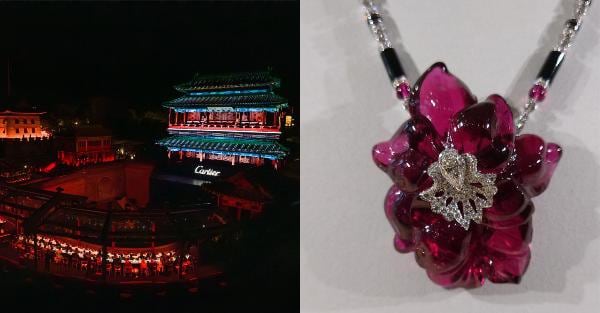
This place that cultivates the fantasy of lightness is identical to the architectural structure - this one part of the exhibition route - that houses the master Philippe Nicolas, the man who turns stone into flowers. It is he who guides the training of young people in the technique of glyptics, a centuries-old art of carving and engraving gems, an intangible heritage recognised by Unesco. The tools are drills, burin, diamond powder, rotating, steady hands and eyes that see shapes and extract them. In this room, the magic ingredient is not air, but earth, blocks of coloured rock. Each one a label, a name, a journey.
I pick up a dark purple stone, half a kilo of sugilite from South Africa. It is about to become a pansy, a mobile necklace of pansies. The heavy section of a magnetite fossil - a very rare find from the Palaeozoic - will have the snap of a panther's snout, a pendant holding a drop of morganite in its mouth. "It is the stone that drives, not the idea," explains Philippe. "In the atelier, we work with several hands on the same project." The most exclusive of crafts is the most choral in workmanship and is drawn over time. "There is a piece I started in Beijing four years ago, continued the work in Tokyo and then finished it in Venice, during Homo Faber. It is a classical carving, a technique that already existed in Greco-Roman times, where the stone is carved from the inside and the design is deep and three-dimensional'. The measurement of time can include boundless perspectives. Beijing reinforces the language of the handmade on this aspect as well.