
Sense, history and taste in the Andes of Peru
From Arequipa to Machu Picchu on board the Belmond Andean Explorer and Hiram Bingham trains, with stops at Lake Titicaca and Sacred Valley

Key points
The early morning light illuminates the majestic Plaza de Armas, the heart of Arequipa, a parade of low colonial-style houses with thick sillar (light volcanic tuff) walls. The whiteness of the cathedral contrasts with the red, yellow and orange of the traditional dresses of the women who stand there in the company of their baby alpacas. From the terrace of Cirqa, a delightful boutique hotel built on the site of a 16th-century monastery, the snow-capped peak of the El Misti volcano appears majestically (5821m). He reminds us that we are in Peru at the foot of the volcanic Cordillera of the Andes. That place, skilfully restored by Andean, a family-run brand created to celebrate the most authentic heritage and soul of Andean culture, in an oasis of tranquillity, pays homage to the architectural heritage of a city proud of its culture and beauty (a Unesco World Heritage Site since 2000). The adaptive reuse of the original structure minimises environmental impact: materials and labour come from local sources wherever possible, including stone, wood, plaster, textiles and decorative finishes. The structure actively collaborates with farmers, winegrowers and artisans in the region, promoting a circular approach to sourcing and celebrating Arequipa's creative and agricultural communities.
But to fully understand this corner of the world, it is to the foundations that one must go: the former monastery stands on an Inca settlement, who wanted it there to observe the volcano that, like the nearby Chachani and Pichu Pichu, protected them. In 1532, the arrival of the conquistadors changed the destiny of these lands, but Inca customs, traditions and beliefs still pervade them, creating a caledoscope of sacred and profane in which the spirituality of the Andean civilisations merges with the Catholic faith.
Towards Cuzco
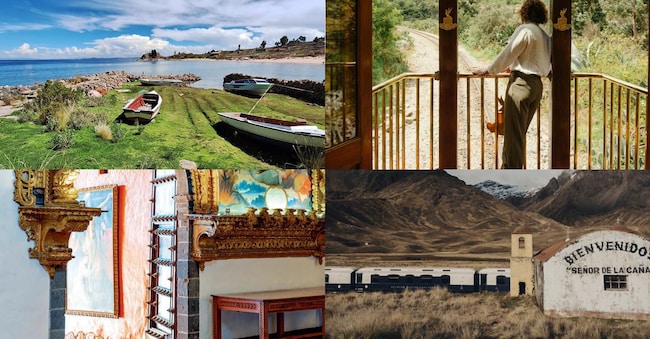
The true meaning of a journey from Arequipa to Cuzco, the ancient Inca capital, to Macchiu Picciu, a mystical citadel at an altitude of 2,492 metres, where nature takes possession of one of the world's most powerful archaeological sites, can only be grasped if one actively explores it: immersing oneself in the landscape, savouring food, experiencing things along the way to learn local stories such as those one learns at the edge of Lake Titikaka or in the Sacred Valley, and then returning home transformed. One would say sariri in Aymara, the Andean language. All at a leisurely pace like that on Belmond's Andean Explorer, a train of wonders (20 carriages and 35 private cabins, each with its own bathroom) that travels 700 kilometres on the world's highest altitude stretch, crossing huge and otherwise inaccessible parts of the country in three days and two nights. On board the sariri is firmly in Peru. With his eyes out of the window, in one glance he embraces the incredible expanse of volcanoes, while the guides tell him about life in the immense spaces of the Salinas y Aguada Blanca National Reserve at 4,000 metres, where among expanses of pampas is the kingdom of the wild vicuña, a protected animal prized for its fine wool, sheared only on its back once every two years by skilled hands. The Incas considered textiles more than just decoration. They used alpaca, llama and vicuña wool to create textiles as precious as gold. Each thread, colour and shape had a meaning. For example, red could symbolise power. A chessboard could indicate the rank of a warrior.
Trip to Lake Titicaca
Passing by the archaeological site Sumbay Caves reminds us that man arrived here more than 6,000 years ago. It is one of the country's 5,000 archaeological sites such as Raqchi that offers a real journey through history. The senses remain at the centre of the journey: in the Picaflor spa carriage (named after the local hummingbird), expert hands celebrate Andean rituals while in the restaurant carriage, at Muña (named after a soothing herb), dishes are served where the scents of primordial herbs, of the land on the edge of the Andes, dissolve. Like the delicious Cevice with Mais Blanco del Cuzco, one of more than 50 different varieties of maize, an incredible biodiversity resulting from more than 7 thousand years of history and cultivation in a country that boasts other records: 4 thousand varieties of potatoes, 500 types of chilli, and then tubers and Amazonian herbs. Sunrise in Puno offers a view of the Lake Titicaca, the largest navigable lake on the planet, and where communities on the islands of the Uros tell us of a primordial life still possible on floating platforms built with marsh reeds. The real jewel, however, is Taquile, an island of rocks and terraced fields, inhabited for 10,000 years and cultivated with potatoes, corn, beans and quinoa. Belmond guides help you discover its secret: a beautiful beach where you can bathe and where it is said that it was here that Viracocha, the bearded deity of the Tiwanaco and the Inca, the 'Master of the World' God of the empire of the sun, in short, where everything began, rose. The truth is that here were the largest gold mines that made the Incas masters of South America but also decreed their end. The train ride from Puno to Custo is a fluid fusion of landscapes, culture and tranquillity. It is not just travelling between two cities, it is a whole day to immerse yourself again in the spirit of those highlands with live music and delicious dishes that once again tell of a country that is, thanks to its traditions and its great variety of agricultural raw materials, a gourmet destination par excellence.
Sacred and profane
In Cuzco, a necessary stop before leaving again by train for Machu Piccu, the Incas built a city in the shape of a puma (which, together with the condor and the serpent, form the sacred trilogy of the Incas, representing respectively the upper world, the world of the dead and the earthly world), nestled in a valley at an altitude of 3400 metres. They terraced the mountains and calculated the stars, conquered kingdoms from Colombia to Chile and became the sovereign civilisation of the Andes. The city centre stands on the site of the ancient Inca square and is surrounded by spectacular churches and elegant boutiques where you can buy fine jumpers. Along Calle Siete Culebras, the walls are carved with images of snakes said to evoke one of the sacred creatures of the Incas, the Amaru. The street runs between two Belmond hotels also housed in places where Quechua palaces once stood, where sacred and profane in unison tell the story of the country: Monasterio stands where the palace, Amaru Cancha, of the Inca chief Huayna Capac once stood. In the 16th century, the Spaniards built the San Antonio Abad Seminary on its foundations, where future priests were trained for almost three centuries. Later, the monastery became a university. Today it houses one of the most important collections of 17th and 18th century artists known as the Escuela Cusqueña. The second hotel, Palacio Nazarenas, where meticulous restorations of beautiful frescoes show scenes of 18th century daily life, became a Jesuit seminary and in the 18th century a convent of the Nazarenas for indigenous women who could not take vows due to their social status, but lived as nuns. Traces of that era can be found in the revolving wooden door in the wall, where women, prevented from having contact with the outside world, sold their sweets. Widespread seclusion in colonial Spanish society was at the time a symbol of social prestige. This is why the area is dotted with monasteries: the beautiful Santa Catalina in Arequipa where cloistered Dominican nuns still live. Inside there are gardens and fountains in the Spanish style, among brightly coloured cloisters and cells with a piano and ovens where the novices once lived.


