
Sex life of the Greenlandic (and Africanə) people
Niviaq Korneliussen recounts the life of a queer community in asphyxiated Nuuk, while Nana Darkoa Sekyiamah interviews 31 African women who agree to speak freely about their sexual experiences

3' min read
3' min read
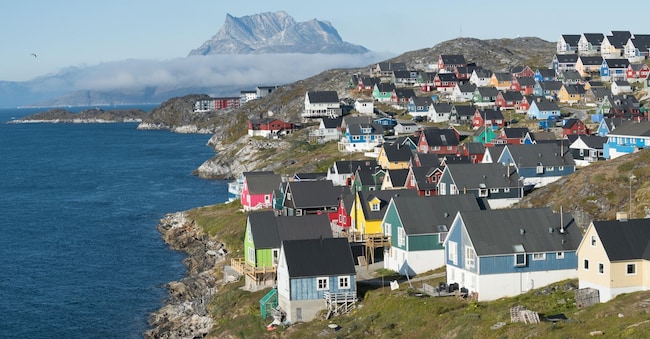
An island surrounded by nothingness, a prison island: the island of rage. The Greenland that can barely be seen in the background of A Night in Nuuk is a claustrophobic place where five queer teensə flounder in nights filled with alcohol and sex, searching for themselvesə, even before a person to fall in love with. In the novel written in 2014 in Greenlandic and Danish by the then 24-year-old activist and writer Niviaq Korneliussen, and now translated into Italian, there is no trace of the boundless 'white desert' described by anthropologist Knud Rasmussen during the Thule expeditions, nor of the immense mine brought to the open sky by the melting ice for which Donald Trump is eager.
They are monotonous interior scenes, or nocturnal scenes, where the outside world is perceived solely through descriptions of changing light intensities. Solitudes in which one can only hear the echo of the procession of spirits that, according to Rasmussen's accounts, the Inuit thought walked behind every human being. The ghosts of all their dead namesakes who support and help them as long as they respect the rules of life, but turn against them if they violate them.
They do not appear in the book, where all that remains of that culture are the names of people and places, the meaning of which the protagonists do not know. Nevertheless, their legacy seems to weigh on the conscience ofə five twenty-somethings looking for their own space on the outskirts of an empire guilty of having wiped out the ancient civilisation that had built meaning around those extreme places, and that still colonises them, economically and culturally. A generation caught between a legacy of ancestors destroyed by toil and alcohol - replaced by the emptiness of an acquired, rigid and patriarchal mentality, where there is no place for those who feel outside the canon - and the prison of self-pity.
"Enough of that post-colonial piece of shit," writes Arnaq to his friend Inuk, whose trust he has betrayed, contrasting the abuse he suffered as a child with unbridled cynicism, and seems to echo the Congolese writer Alain Mabanckou in his provocative pamphlet Le Sanglot de l'homme noir - the cry of the black man (2012) - where he invites Africans and their descendants not to base their identity on colonisation and trafficking, on a past of humiliation and suffering that prevents them from projecting into the future.
The pain of living of the victims. "Karma is a bitch," adds Arnaq, in a globish that feeds on hashtags and song phrases. "Where is my home? I don't have one," Inuk, who left the hated island but still rejects his homosexuality, replies to himself. "Life has triumphed over me. (...) Life has killed me'. Even elsewhere he does not feel at home, home seems to be only death.


