
Shots on canvas with embroidery: the story of 3D images with pearls and microcrystals
A tale in three stages. Protagonists: a camera, colour printing on cotton fibre, the hands of the most skilled brodeuse in Paris. Instead of working on the fashion of the season, they embroider the photograph.

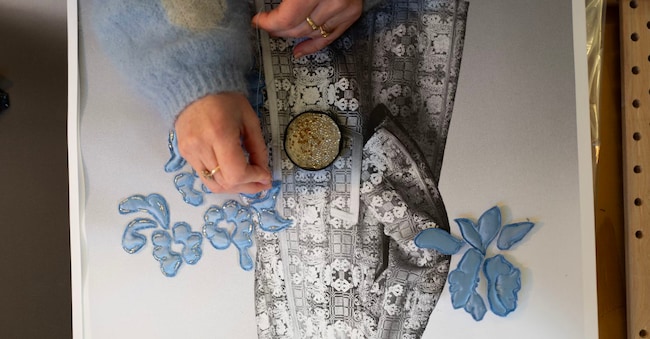
The first to add light and beauty to her wardrobe had been Catherine of Aragon, bride of Henry VIII, who had seduced and driven to envious emulation the English court of the 16th century, embellishing the collars, sleeves and cuffs of her sumptuous gowns with gold and silver threads. But the change of pace, in a twinning that would flourish in more than five centuries of fashion, occurred in France where Catherine de' Medici brought the Florentine art of embroidery, she a queen and embroiderer of such extraordinary skill that she baptised a stitch, the Madama Caterina de' Medici stitch.
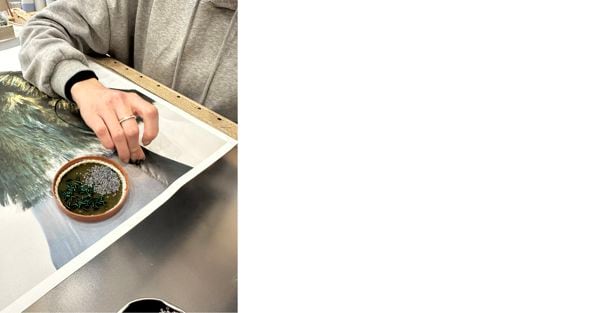
Now that French broderie is synonymous with luxury and savoir-faire, HTSI goes a step further and proposes to two of the most virtuoso Parisian brodeuses, Alexandra Latour and Héloïse Guérin, to embellish not the creations of the latest fashion shows, but the very concept of fashion, taste, elegance, by embroidering on the very images of this service. A preciously conceptual operation that goes back to the philology of the Latin texere, a double verb giving rise to text and textile, texte and textile in French. If we then wanted to explore the origin of the word embroidery, we would find ourselves in the Arab world, raqama, and again we would be faced with an identical marvellous duplicity: to punctuate and to write.
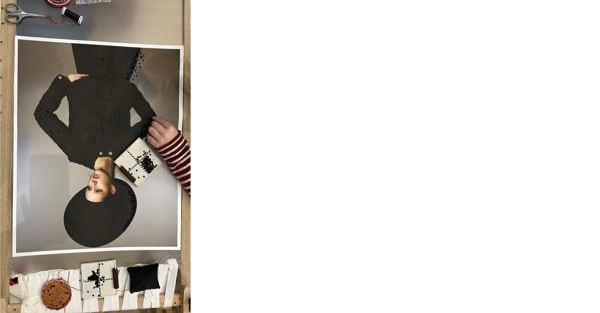
HTSI has therefore imagined punctuating and writing the history of these dresses, making visible, through embroidery, the secret energy of the materials, shapes, colours, even coded messages that make each creation unique. In her atelier in rue de Charenton, in a Parisian neighbourhood that still retains the memory of craftsmanship, Alexandra Latour has paid homage to the long summers spent in Italia, between Pompeii and Herculaneum, and at the Louvre in front of Giotto and Mantegna, starting with the Fendi coat, "because it is a painting, and our pearls, sequins and crystal tubes are brushstrokes that enhance the energy of the palette," she explains. Here and there, to give material depth, a solitary pearl and a game of raised 'knots' emerge. More Italian haute couture, and Alexandra, a long-standing collaborator with Chanel, Dior, Lesage and Saint Laurent, has transformed the backdrop enveloping Valentino's peacoat and given it the preciousness of an antique wallpaper or a map so that the rivulets of beads and jewels become rivulets of water.
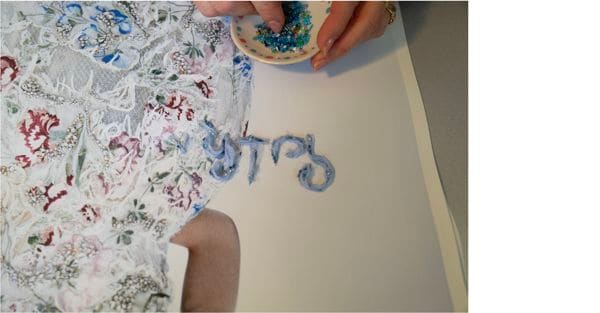
In the week of intense work that involved every embroiderer at Atelier Latour, the photographs of the Bottega Veneta, Prada and Loro Piana dresses also took on a new light. And for the latter, Alexandra, who in recent months has embroidered Dracula's red heart in Luc Besson's film and the sacred vestments for the Easter mass in the newly reopened Notre-Dame, wanted to infuse the sacredness of an icon, using cabochons, black pearls and small sequins, the paillons, which illuminate and dematerialise the profile of a tweed jacket and continue to reinvent the halo of the large hat.
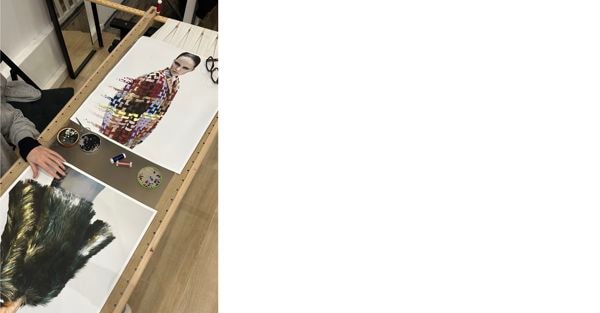
On the other side of Paris, at the DOC, the former Jean Quarré vocational high school at 26 rue du Docteur Potain, now an artist's residence, Héloïse Guérin, an embroidery virtuoso for Schiaparelli and Louis Vuitton, among others, has rewritten the creations of Chanel, Tod's, Erdem and Ermanno Scervino. Perhaps because as a child she had been struck by the mysterious allure of The Lady and the Unicorn, so much so that she pinned up in her atelier the postcards of the tapestry that her parents had given her, Héloïse was able to decipher the secret language of the muse that animates Erdem Moralıoğlu's collection, the extraordinary Hélène Smith, a French psychic from the early 20th century who had invented a Martian and mysterious language with which to translate the voice of other creatures in the universe. Héloïse is also a peculiar creature, highly sensitive, able to dematerialise fabric thanks to the aiguilletage technique, as told by her embroidered paintings, on display until 13 April in the La Venelle solidarity recycling village in Montreuil. Title of the exhibition, Le temps dans la paume, time in the palm of the hand. Well, perhaps the art of embroidering fabrics and sheets of paper is just that, holding time in the light of infinite sequins, perhaps tricking it into distracting itself from its race and making each of our moments precious.

