
Drought, native breeds at risk in Sicily Slow Food presidia
The alarm raised by the association concerns the Girgentana goat and the Modicana cow. The stories of two breeders
by Nino Amadore
3' min read
Key points
3' min read
It has rained in Sicily over the past few days. We will see if it has helped to alleviate the water crisis. Meanwhile, data updated on 12 August tells us that the situation in the reservoirs continues to worsen: there has been a further 22% drop in almost four weeks. And so concern is growing, especially in the countryside. In this case, it is Slow Food that is the spokesman, sounding the alarm about the risk to Sicily's precious native breeds, and in particular the Girgentana goat and the Modicana cow. Animals at risk due to lack of water and very serious problems for the Slow Food Presidia created precisely to protect the two breeds.
Girgentan goat: breeding in great difficulty
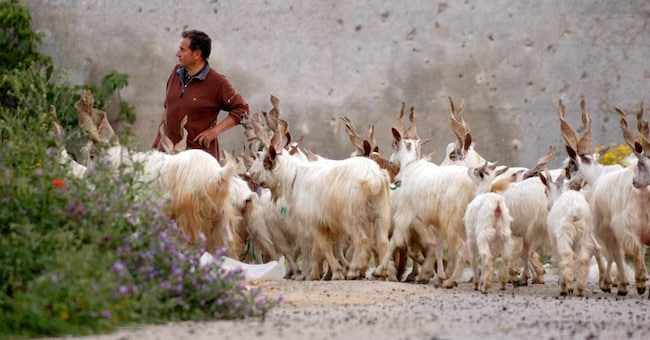
Let's start with the Girgentana breed of goats: medium size, long, thick, white hair and very long spiral horns make it unmistakable. The Girgentana breed is protected by a Slow Food Presidium created when there were only a few hundred surviving examples. Luca Cammarata, on his farm in San Cataldo in the province of Caltanissetta, owns around three hundred of them. Many are pregnant. They are all suffering from the temperatures, which for weeks now have frequently exceeded 40 degrees, from the scarcity of water, from months of drought that have dried up the pond where the animals used to drink and transformed an oasis of biodiversity into a kind of desert. 'It's a summer of torment,' says Cammarata, 'it's been like this since May. This year's production? We will be at 50 per cent of what we are used to, but the truth is that there is no accounting. In this situation, we are no longer doing business: what interests us is keeping the livestock heritage alive, the fruit of the sacrifices of generations of shepherds before us'.
Loading...
Tough situation for cattle
.About thirty kilometres further west lives Liborio Mangiapane: he is sixty years old and has been a livestock farmer for forty years: on his farm he raises one hundred and fifty sheep and a hundred or so cattle of the Modicana breed, which is also protected by a Slow Food Presidium. "The situation is tragically difficult," he says, "because it's not a matter of a week or a fortnight, but of a condition prolonged over time, which causes a lot of difficulties in terms of food, water and even psychological problems. We live in a desert, constantly thinking that the next morning the animals will be without water". Having to deal with the water supply has required a laborious reorganisation: "On the farm, we need more than ten thousand litres of water a day," Mangiapane continues, "There are tankers from the reclamation consortium that are buffering the situation, but every day we ourselves go with a tanker truck to load the water.
Keyword: resist
.The watchword is to resist. And to do so, everyone is equipping themselves as best they can: Cammarata is building a reservoir on his farm to collect rainwater. A two-hundred-thousand-euro project, financed in large part by the Region (it is one of the initiatives launched when the drought was not yet at this level of emergency by the regional Department of Agriculture, of which Dario Cartabellotta is director): 'It will have a capacity of 16 thousand cubic metres. But it must rain'. To those who govern, he makes an appeal: 'Build lakes, maintain existing infrastructures, increase the potting capacity by cleaning the basins, and also take care of the pumping systems. You need to understand how you can green up areas that are now dry, perhaps by planting shrubs that can grow in a dry environment and that animals can graze on. We need plants that can live in soils in which the concentration of chlorides, again due to the lack of rain, is higher'.
The uncertain future
.The future remains an unknown: drought is now a fact, it strikes all year round, and under these conditions it is difficult even to obtain fodder. "How do you face a new sowing campaign? - asks Mangiapane - In recent years we have sown at a very high price and harvested zero: how can we invest more capital? So many of us will close down. And the thing that angers me the most is that closing a farm means abandoning the land, it means creating more problems for the Sicilian economy, which is already fragile in itself, and it means losing an extremely important livestock heritage. All this is very serious, how can anyone not understand it?"
Copyright reserved ©


Brand connect
Loading...
