
Sicily, an uncertain future for fruit and vegetables in the south-east
The Doses District based in the Ragusa region grows, innovates and consolidates its supply chain, but the 2025 Observatory reports a climate of widespread caution among companies, caught between climate change, poor infrastructure and public policies that are still lagging behind
by Nino Amadore
Key points
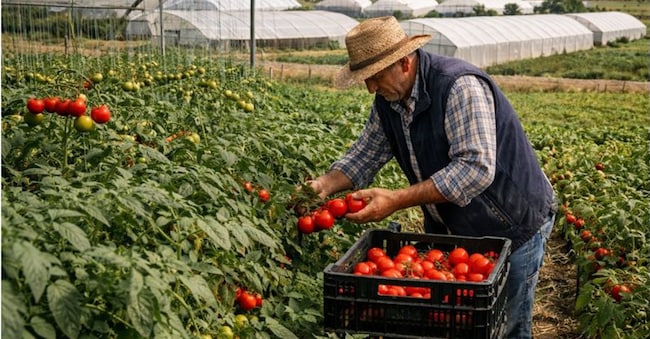
It continues to grow and invest but does not hide its anxieties. It is the fruit and vegetable district of south-eastern Sicily (Doses) based in Vittoria in the province of Ragusa. The 2025 Observatory paints a picture of a structured fruit and vegetable system, one of the largest in southern Italy, with more than 170 active companies, an aggregate turnover of more than 450 million and a production base covering more than 3,000 cultivated hectares, half of which are in greenhouse cultivation. Numbers that tell of economic solidity and resilience, confirmed by the fact that more than six out of ten companies have recorded an increase in turnover in the two-year period 2023-2024. "What emerges from the 2025 Observatory is confirmation that the district model continues to represent an indispensable tool for facing the complexity of the markets," says Antonino Di Paola, president of Doses. "The resilience and growth capacity recorded in the previous two-year period derives from the strength of a system that knows how to network, share resources and strategies. The challenge before us is twofold: to consolidate the supply chain integration that many companies are building, and to strengthen the control of foreign markets while maintaining roots in the domestic one. The South-East area has demonstrated dynamic and resilient entrepreneurship, but the future requires a quantum leap in terms of infrastructure and logistics'. The Doses district appears to be a system that has decisively taken the road to innovation, but now requires targeted policies and structural investments to transform caution into confidence and make the growth path lasting.
From primary production to integrated supply chain
Alongside the economic results, the transformation of the production model emerges strongly. The district is no longer just about primary production: an increasing number of companies have integrated packaging, marketing and, in some cases, processing, in an attempt to preside over several stages of the chain and defend added value. Horticulture remains the backbone of the system, but the most relevant fact is the qualitative evolution of agricultural practices. The adoption of renewable energies, precision irrigation, environmental sensors and traceability no longer represent a niche, while the reduction in the use of pesticides and the efficiency of water resources indicate an environmental transition already underway.
Labour and markets: still fragile growth
On the employment front, the district also shows a significant critical mass, with over 3,000 employees, even within a system that is still strongly marked by seasonality. The domestic market remains the main commercial outlet, but exports - especially to Germany and France - represent a strategic guideline that requires more solid logistical and organisational structures.
The crux of the future: between climate and uncertainty
It is precisely when looking at the future that the picture becomes more nuanced. The 'weighted average' of companies' answers returns a cautious sentiment: 51% express uncertainty, 45% maintain a positive outlook and only 4% look at the next ten years with pessimism. A figure that does not signal backwardness, but a widespread awareness of the challenges ahead. Climate change is perceived as the main transformation factor, followed by technological innovation, the progressive reduction of available plant protection products and the evolution of consumption. In the background remain unresolved structural issues: logistical infrastructure, water management, skilled labour and institutional support. For director Gianni Polizzi, uncertainty should not be read as a sign of weakness. "The Observatory photographs a sector in transition that is metabolising profound changes. Reducing the use of plant protection products, adopting sustainable practices, investing in renewable energy and precision agriculture are necessary responses to a rapidly changing context. Climate change is an everyday reality and businesses have understood this. The uncertainty about the future expressed by more than half of the companies is not resignation, but awareness that new tools are needed to manage unprecedented scenarios'.


