Silence in the auditorium: the lights go out and the show begins
Home theatre technology evolves with telescopic seats, touch sensors and soundbars with three-dimensional sound directivity. The prerequisite for contemporary design? Private accessibility to professional performance.

4' min read
4' min read
One autumn evening in 1959, at producer Angelo Rizzoli's house, a select group of insiders and friends attended the screening of an early version of La dolce vita, over four hours of footage. At the end, the Lombard entrepreneur, who had invested, together with the other producer, Peppino Amato, a multi-figure sum - which had risen in the course of the film's troubled production - did not hold back a worried comment: "But this is not a film, it's a marathon!". For once, Rizzoli's proverbial flair stumbles over the difficulty of grasping the visionary and subversive beauty of what, scaled down to 180 minutes, would become one of the most famous films in the history of cinema.
The tour of Fellini's masterpiece thus starts from a muffled room with velvet armchairs, where the beam of light from the projection booth creates on the screen the black and white images that would forever enter the collective imagination.
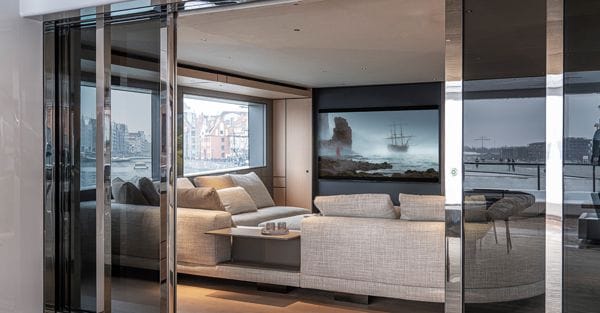
In those years, watching a film at home was a luxury reserved for a few. For everyone else, cinema was a frequent ritual, to be shared in the theatres. Distant times. Soon after, the pervasive presence of television would change the scenario of audiovisual enjoyment, an evolution accelerated in more recent years by streaming platforms and new lifestyles that entrust the cosy privacy of the home with an important role. It also changes that of the spectator, who becomes an active subject able to decide with the immediacy of the remote control what to watch or listen to, interacting with the sophisticated technologies of big screens and ultra-modern TVs. Today, the magic of a cinema or concert hall experience can be brought home with Bang&Olufsen's Beosound Theatre, a soundbar that brings together the performance of several dedicated home theatre devices. Three-dimensional sound directivity, for example, exploits the interaction of front, side and up-firing (upward-firing) speakers that reproduce sound with the most appropriate amplitudes and directions, expanding it into the space around the listener.
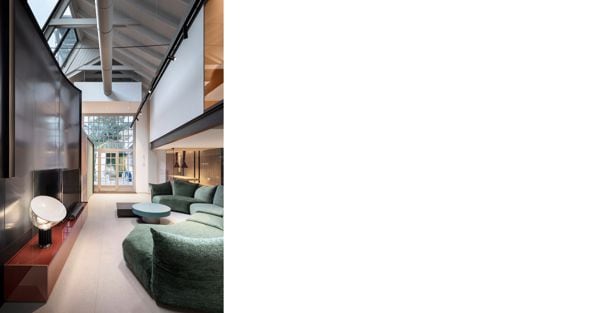
A space, that of the home theatre, which can become the heart of the living area and whose layout is the object of the utmost care. As in the Milanese loft born from the renovation of a factory, with a project signed by Contract District Group, which shows in filigree the heritage of an industrial past, but embraces contemporary elegance, adopting many glass partitions to divide the rooms. "The area around the large living screen shares this choice," explains architect Rudi Manfrin, the firm's art director. "The project focused on acoustic and seating comfort."
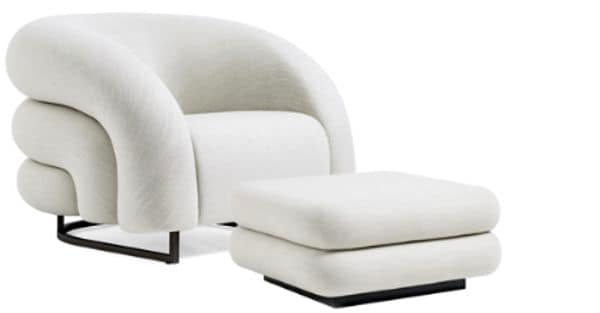
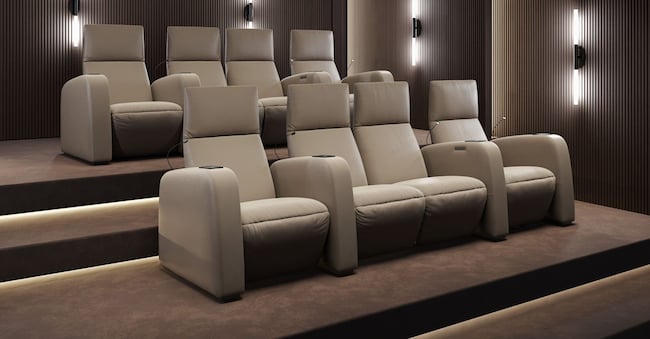
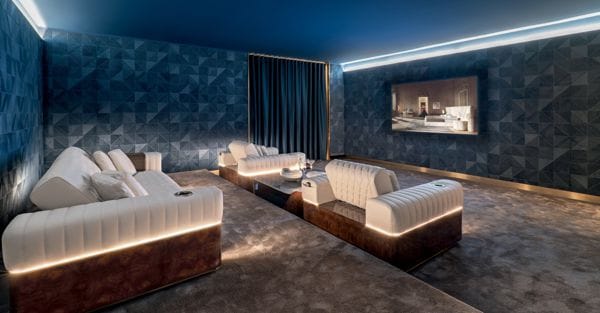
Specially designed armchairs and sofas are therefore an essential element in home theatre furniture. Visionnaire's Brubeck upholstered furniture interprets it as a space for shared entertainment and relaxation, and takes inspiration from the world of the experimental car. The finishes are custom-made: walnut-root outer shell, leather or fabric for the motorised seats that can be adjusted by remote control. The telescopic seat can be extended by 40 centimetres, the polyurethane foam and memory foam padding is of differentiated density, and an LED light with touch sensor integrated into the upholstery is mounted in the armrest.