
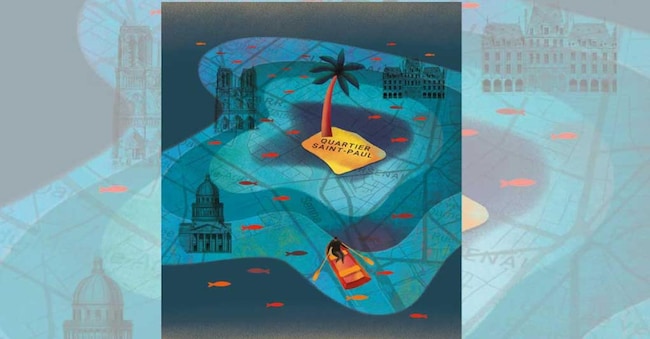
Island of silence in the teeming chaos of Paris
A very special oasis that juts out over the Seine, in the centre of the large and noisy Île-de-France, the ancient heart of the capital. A protected place, to be kept safe: better that the mass of tourists do not know and invade the arcane shelter

5' min read
5' min read
Intimidated by the curling volutes of four polished spirals in pierre de taille, a humble statuette of the Virgin of Lourdes, placed somewhat haphazardly, colours the niche of the rue Éginhard fountain in white and blue. She is an alienating little madonnina, disproportionate and petite, with a light touch: she catches the eye and permeates the air with nostalgic scents. Just below her, the basin is dry, the moss has rusted away, and the water appears a distant memory among the limestone encrustations. The baroque splendour of the église Saint-Paul-Saint-Louis is just a few steps away, and access to the passage leading to the Village Saint-Paul is through the sumptuous parish church, which towers over the noisy square of the same name, swarming with tourists who, from early morning, bivouac at the foot of the soaring façade, all too adorned with columns and Roman-style statues. Here, at the Saint-Paul metro stop (Le Marais), the hurried Parisians, with their typical pace - cadenced and studied, barely off the ground - meet. Their shaggy hair, always tired and bored, you can distinguish them restlessly waiting around the railings of the station entrance. It is useless to question them about how to get into the Village Saint-Paul: either they don't know, or they don't want to say. Because this place that juts out over the Seine, in the centre of the great and chaotic Île-de-France, the oldest heart of the capital, is an island of silence to be kept: better that the great mass of tourists not know and invade their arcane shelter. No. Not the Village!
Built amidst the gardens and the few remaining walls of what was once the palace of King Charles V, which badly survived the bombings of the war, the peaceful neighbourhood was resurrected in the early 1980s by architect Felix Gatier. Sandwiched between rue des Jardins-Saint-Paul, de l'Ave Maria and Charlemagne - names that give off the sweet ginger scent of early school years at the mere mention of them - the Village is in itself a world apart. "En dehors du contexte". I say an island, indeed! And rue Éginhard, so dark and oppressive, enclosed by the buildings that make it cramped, and overhung by the low ceiling that closes off its access, you find it just off the start, behind the Passage that leads straight to the transept, on the right side of the Jesuit mother church, with the fountain to close off the perspective. A turn to the left, then more tight and dark passages, under the live wooden beams, follow one another through the narrow alleys to finally open up into a play of courtyards that, in matryoshka fashion, contain one another. And here, as if by magic, when you have completely forgotten that you are at the centre of the dazzling metropolis, you suddenly find yourself just a little more resigned and restrained, the Paris of the flânerie more blasé, which here is dim, cloaked in slow whispers. Amongst the pavée courtyards, ground-floor shop windows house antique dealers, potters' and silversmiths' workshops, Japanese art galleries, a famous shop selling exquisite Persian carpets, old-fashioned hat milliners and, unfailingly, a few small restaurants, their menus written in chalk on blackboards in plain sight. Coming in last, more airy and bare, are the studios of architects and designers. As everywhere by now, an atrocious pimple on an Apollonian face, the ever-present real estate agent, with photos of flats for sale replaced by well-lit videos, is however always closed. Then, in the reassuring shade of a large elm tree, the queen of this prolonged salon is Venus sur Cour, a refined brocante of erotic antiques: resting on old étagère somewhat in disarray, deco statuettes of lascivious women fill the entranceway, bordered by flaming red, amid gilded dildos and mannequins of crested waitresses and guêpière. A daring dash of sensual frenzy in this bucolic buen retiro that smells of sweetish lichens and damp, while an unreal silence envelops the whole. At the doorstep of the tallest and sleekest apartment block, a majestic Russian Blue cat licks greedily at a paw and seeks shelter, huddling swiftly under a lilac tree with the bells of tiny flowers now all withered. The little bell he wears on his collar, a shiny pendant, barely chirps, illuminating the thick grey mantle with light echoes and golden glows. In one corner, interrupting the diffuse peace, hidden by jasmine and climbing roses, a memorial stone reminds us that entire families of Jews were torn from their homes here, later exterminated in the camps. All around, the well-defined but strangely unkempt flowerbeds have yellowish and purple wildflowers, and surround the ups and downs of overlapping planes that characterise the small squares onto which the windows of the buildings open, enclosing and towering over everything, laying siege to squares of sky, which the clouds obscure, while at the corners of the squares are the trees, with their trunks surrounded under their festive foliage by the colourful little houses that the residents thoughtfully prepare for the sparrows and rare robins.
Nothing seems left to chance among the exclusive entrances of these elegant residences with their ephemeral appearance of rigorous modesty, all announced by doors that are always the same, in ash lozenges, with brass handles and well-polished, lion-headed doors. The exclusivity of the neighbourhood manifests itself in the details, which here precisely nothing is overlooked. Shaded benches are everywhere and, books in hand - pages scrolling with studied nonchalance - Parisians recline on them with sinuous, aged elegance. The jaunty girls, rosy-lipped and furtive-eyed, cross their legs at the small tables of the few brasseries, and look on languidly, commenting on each arrival, their goblet gently clasped in the stem in their hand. They have colourful shirts and, sitting invariably side by side, turn their faces to the sun and passers-by. Tremendously chic ladies, hatted and groomed, tower over the clear pavement in an undulating hustle and bustle, superb anacondas, with light dogs in tow. The men leaf through Le Monde, with an eye to the Canard enchaîné barely in sight, and comment at length, muttering tasks and vainly, while the birds chirp. A perfect place. It certainly is! Were it not that the faces of the frequenters betray, at times, a spasmodic search for a tranquillity that, to the barely attentive eye, is far away. And if you look, they are anxiously searching for it, drowned as it is in the pleasant, misty rivulets of this calm so beautiful and artificial. The world, the world of the most controversial and ennuyant capital, is asked to wait outside.
I am reminded of Paul Valery's Hearing: 'Listen to that beautiful sound that is continuous and that is silence. Listen to what you hear when nothing is heard (...) Hiss again. A sinister hiss...'. This place is dear to me like few others. I set the novel Virginia in the drawer among these streets, and for one of life's many risks, I bought a pied-à-terre - or rather a studiò, as they call it here - a few streets away. I come here often. The old 'Marais Plan', with its blood-red cover, as my guide and only company. And today, once again, I am here!
My childhood friend, rich and haughty, handsome and lucky, killed himself yesterday. Just like that, without warning. Just a tightrope hanging, against time that flees relentlessly. Does it all make sense? Only one among others, with my nose to the sky, at the Village I seek respite. But it is nothingness. Hesitant, I too barely yearn for a niche, one that envelops me. Without frames. Because now I know: poignant and impossible, even the unreal silence of this island of placid, illusory courts, which I love and to which I abandon myself enraptured, deafens me with fear. And enclosed within these walls of the purest ochre, my distant world is depopulated by voices, only to be coloured by shadows.

