HTSI Reloaded

Simone Rocha: her menswear debut and life stories transformed into garments

A special guest at Pitti Uomo, presenting a collection that is both refined and understated, romantic and radical: the designer and her evocative creations in a continuous dialogue stretching from Hong Kong to Ireland, and from London to Florence.

by Lisa Corva

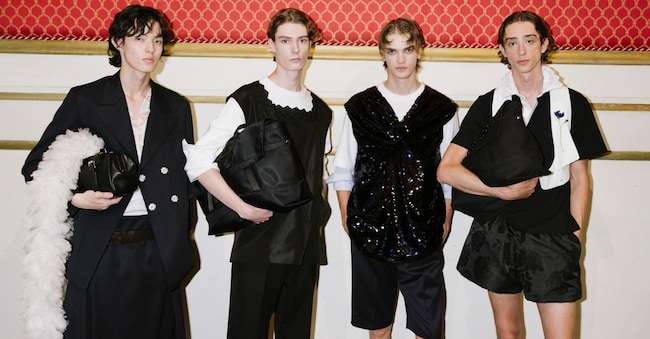
Il backstage della sfilata Simone Rocha al Teatro della Pergola a Firenze.

7' min read

Translated by AI
Versione italiana

7' min read

Translated by AI
Versione italiana

Simone Rocha’s menswear debut took place at the Teatro della Pergola in Florence, where she was a special guest at the 110th edition of Pitti Uomo. An imaginary journey from Ireland to Italia, featuring a collection that is at once romantic and radical, gentle and concrete, weaving together sartorial classics (suits, shirts, knitwear, Oxford shoes) with archive prints drawn from the designer’s early years. All the hallmarks of her aesthetic are present, reimagined for men. For this very reason, her menswear debut provides an opportunity to revisit, in a new light, the interview Simone Rocha gave to HTSI for ECHO. Wrapped in Memory.

Simone Rocha is dressed in black. It is a black that holds stories, reflections of water and whole worlds within it. These are the worlds she weaves into her designs: Hong Kong, where her father (John Rocha, a fashion designer who retired about ten years ago) was born; Dublin, where she grew up; and London, where she lives and works.

Loading...

Un ritratto di Simone Rocha. (© WILLIAM WATERWORTH)

The water is that of the islands: the island of Hong Kong, to which she is very closely attached, because for years she has regularly visited the many members of her family who live there, and sought inspiration; Dublin, with its darker hues, on the island of Ireland; and the water and creative currents of London, which is, after all, on another island, Great Britain. Let’s add the island of Taiwan, where she has just opened a shop in Taipei (following those in London and New York). Perhaps only those who grow up on an island – those who carry an island, or many islands, within them – are then able to blend so many worlds, so many horizons to navigate and explore. Simone Rocha does this with fabrics. And indeed, her black dress is soft with ruffles, flounces and pleats. As well as the dresses from her collection (which is shown in London; in Milan, for example, we can find them in Biffi boutiques), she showcases her world in an exhibition at MoMu, the Antwerp Fashion Museum.

It is entitled ECHO. Wrapped in Memory and her garments engage in a dialogue with textile works by Louise Bourgeois, in collaboration with choreographer Anne Teresa De Keersmaeker. “Wrapped in memory” – that is, enveloped in memories, in the memory. The perspective on the past, including that of the garments, is Simone’s. “Louise Bourgeois is an artist who speaks to me; she has always resonated with me,” she says. “Or rather, ever since the first time I saw her: it was at an exhibition at the Museum of Modern Art in Dublin, Stitches in Time.” Her early collections echo the French artist: the iconic spider’s webs, reinterpreted in lurex, became embroidery on dresses. That was in 2019. One of those dresses is currently on display in Antwerp. A unique exhibition that will explore memories of childhood and motherhood, ageing and nostalgia, the art of handcrafting, and the skills of repairing and mending. The physical and emotional memories evoked by the garments, through an unknown aspect of the MoMu Collection: the work of textile conservators. The museum in Antwerp – the city of the Antwerp Six, the fashion designers who graduated from the Antwerp Royal Academy of Fine Arts in the early 1980s, with Dries Van Noten being the most prominent among them –  houses a collection of over 38,000 garments and accessories, offering a glimpse into a myriad of personal stories and events. The smells, stains and tears in the garments, or the way in which some were altered and repaired in the past, are an inexhaustible source of information, say the curators, and tell the story of the passage of time. ECHO therefore presents a selection from the MoMu Collection in various stages of deterioration, with their flaws, discolouration and traces of damage, and with just as many emotions.

Stories, as we said. Simone’s stories are also family stories. A ‘close-knit’ family, as she describes it. Tight-knit and woven together, like a fabric. There’s her father, the fashion designer John Rocha, who has dressed, amongst others, the legendary Irish singer Sinéad O’Connor. He arrived in Dublin from Hong Kong, having studied at the Croydon School of Art in London. Then there’s her mother, Odette, who has always worked alongside her father and now looks after Simone. There’s her brother Max, who has opened a bistro in London, Café Cecilia (named after their grandmother), which has instantly become a hotspot for the fashion crowd. Simone designed the uniforms, whilst her father, John, collaborated on the interior design (incidentally, he also designed some of the furniture for his daughter’s restaurants). A tasty detail: one of the restaurant’s signature dishes is Guinness Bread, made with stout. ‘As for me, I know how to make Soda Bread, a traditional Irish bread,’ Simone tells me with a smile. Bread made with bicarbonate of soda instead of yeast: still much loved in Irish homes and in all restaurants.

Ireland has always been close to her heart. Simone was born in Dublin in 1986; she first studied in her home city, at the National College of Art and Design, and then fashion at a highly prestigious school, Central Saint Martins in London. ‘I grew up in my father’s studio; I breathed in and absorbed everything that interested him and my mother back then. Fabrics, embroidery, pearls. And art. If I had to name a favourite place in Dublin, I’d definitely say Francis Bacon’s studio.’ The incredible and unique chaos of the Irish painter’s studio was moved from London after his death and reconstructed, piece by piece, with all the canvases and paints, the torn newspapers and stained rags, inside the Hugh Lane Gallery, Dublin’s city art gallery.

Simone, who collects art, has three prints of Tryptich August 1972, created by Bacon following the suicide of his lover. She has incorporated them into her fashion sense: she hung them first in her London shop, she tells me, then in New York, and now they’ve come home – in the truest sense of the word – because they’re in her home. Ireland also features in her personal life: Simone is married to an Irishman, Eoin McLoughlin, who works in the film industry, and has two young daughters.

“Spending time together, working together, making things with our hands: that’s the legacy of my years in Dublin with my parents,” she explains. “That’s what I’ve tried to recreate in my London studio, with my team. I can sew, mend and crochet; everything that ends up on the catwalk – let’s say 90 per cent of it – was first created here, by hand.”

Here, in the atelier, they experiment with innovative designs, such as those in this year’s autumn-winter collection: a dress that looks as though it’s made of crumpled gold paper, delicate red and white bows (also used for an unusual make-up look). And then there are roses – but padded ones – pressed ribbons, and lace that seems almost trapped. For the collection’s name, Simone chose a Gaelic word: Lughnasadh, meaning ‘Lugh’s festival’ or ‘Lúg’s wedding’, an ancient festival that has remained on his island’s calendar. Usually celebrated on 1 August, halfway between the summer solstice and the autumn equinox, it is originally linked to the harvest: thus, the garments feature woven straw details.

A fascination with unusual fabrics and materials is, after all, a defining feature of Simone Rocha’s work. She loves to play with the unexpected, such as the large pearls on her jumpers – white on white – in a 2021 capsule collection for H&M. ‘In one of my first collections, from 2016, there was a pink dress, inspired by one I’d seen at my grandmothers’ house, but the contrasting fabric was neoprene. I like unexpected tactile sensations, playing with different elements and textures.’ Perhaps there’s an echo of Bourgeois in this too. ‘I’m interested in crossovers: of materials, of course, and of surprise embroidery, such as on men’s shirts. And the crossover within the collections: I design menswear pieces that I think girls might also choose, and vice versa.’ And indeed, her assistant, also dressed in black, is wearing a black embroidered lace shirt from the menswear collection. “I often reflect on the concept of femininity: for me, it’s fragility, sensitivity, but also strength. Being able to transform all this into a shield, a suit of armour,” she adds.

When I ask her which book she has just finished reading, she mentions Maggie O’Farrell, Portrait of a Marriage: The Duchess of Ferrara. O’Farrell is an Irish writer, but the novel, translated by Guanda, tells an Italian story – that of Lucrezia. The daughter of Cosimo de’ Medici, she was married off whilst still a child, in 1558, to Alfonso II d’Este: she was just 13 years old. She died at the age of 16: upon arriving in Ferrara, the city of which she had become duchess, she was perhaps poisoned. All that remains of her is a mesmerising portrait attributed to Bronzino, which lends its name to the novel. Her gaze is melancholic yet resolute; her skin is snow-white; she wears a black dress intricately embroidered, with antique pearls in her ears and woven into her hair alongside ribbons, as was the fashion of the time. A Renaissance opulence that is the very same as Simone’s. It may be a coincidence, but Simone Rocha, too, has a ribbon in her hair today: a white one. ‘I am fascinated by the Renaissance: the women of the fifteenth and sixteenth centuries, who had no voice, could nevertheless express themselves through their clothes. For example, through ceremonial gowns that commanded attention in a room: they were a way of conveying messages, even when one was forced to remain silent. A dress can be a statement. Not only that. I repeat: it can be a suit of armour.”

Another book that, as Simone tells me, has made a big impression on her recently is Le inseparabili by Simone de Beauvoir. It is a previously unpublished work, rediscovered and published worldwide (including in Italia, by Ponte alle Grazie) just three years ago: it is the fictionalised account of the close and passionate friendship between Simone de Beauvoir and Zaza (Elisabeth) Lacoin, from the time they met at school during the First World War right up to Zaza’s death in 1929. De Beauvoir wrote it in 1954 and, although she had decided not to publish it, she kept the manuscript. ‘I was struck by the account of this incredibly strong friendship, her determination to capture its intensity on paper and to preserve the memory of it for the rest of her life.’ An all-consuming friendship, as is often the case when one is just starting out in life. I wonder if Simone noticed the reference to the tulle dress and the Irish lace charlotte bonnet, with which the protagonist recounts her First Communion and, page after page, the stifling Catholic environment for the two girls. And who knows whether that lace will return, reworked and reinterpreted, in new collections. Because this is Simone Rocha: interwoven life stories that become dresses.

Copyright reserved ©
Loading...
Loading...

Newsletter

Notizie e approfondimenti sugli avvenimenti politici, economici e finanziari.

Iscriviti