
'Sinner effect' in growing clubs, starting with historical clubs
The Bonacossa in Milan and Ct Bari are growing. Parioli in Rome driven by home favourite Flavio Cobolli, protagonist of the latest Davis Cup triumph

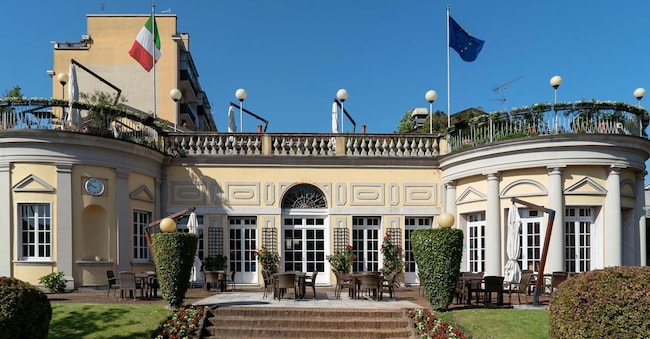
The golden moment of Italian tennis has led, in addition to record TV audiences and attendance in the stands, to a growth in clubs and the tennis planet in general that was unimaginable only a few years ago. In the most emblazoned and traditional clubs, then, there is a special air.
At the Bonacossa, the Milanese club of excellence designed by Giovanni Muzio, history meets the future on clay: if the Art Nouveau building and the pathways earned the protection of the Belle Arti in 2017, the effectiveness of the drainage system on the courts drew the attention of the Roland Garros technicians, who came to Milan for inspiration. This is recounted by the president, Elena Buffa di Perrero, who remembers how the flagship tournament, the Bonfiglio, brings the champions of tomorrow to the Bonacossa: 'All the greats have passed through here, even if they did not make it to the end. Alcaraz lost in the first round, even Federer didn't make it, Sinner stopped in the quarters, Tsitsipas won and so did Zverev. In 2025 the champion was Jacopo Vasamì', a familiar name to those who follow the sport, if only because he was chosen by Sinner as sparring. A tennis school of 600 pupils, 1,200 members with a perennial waiting list, the 16 courts always full: "If we had more we would fill them all, that's the Sinner effect. For the Vasamì final, the stadium was sold out, three thousand people, something that has never happened before... of course, the fact that we had an Italian player in the final was an accomplice. But there is a lot of enthusiasm in general. When there are virtuous models, even those who don't play become passionate and follow. It's an exceptional moment'.
In Rome, at the Parioli, one feels above all the 'Cobolli effect', the home favourite having a great season in 2025. Flavio is therefore following in the footsteps of predecessors who made history there: the unforgettable Nicola Pietrangeli and of course Adriano Panatta, son of the then caretaker Ascenzio. 'After winning the Davis Cup in Bologna, Cobolli was on his way back to Rome and called us from the motorway to say he would come by the club to say hello. Immediately we organised refreshments to celebrate him,' says Antonello Valentini, a long-standing member and manager (former general manager of the Federcalcio), adding that the Italian 'often appears on the courts and encourages the boys who see him as a myth'. Parioli has also grown further, with '57 new members in 2025, for a total of 1,120 members. We have 18 earth courts, two of which are covered, and three fast non-covered ones'. In agonistics, Parioli, directed by Claudio Panatta, is super competitive. "In 2025 we enrolled 11 youth teams from the under 18 to the under 10 and we won the men's under 14 Italian title," says Valentini, also recalling the club's choice of field for the year that has just begun: to invest all the resources in the nursery, rebuilding the teams without resorting to foreigners and external hires.
It is a bit like the philosophy of the Bari coach, founded in 1936 and today one of the most advanced in the South and beyond. The president herself is proof of this: Nicoletta Virgintino was Italy's number 5 in the 1980s (she played with Raffaella Reggi and the other strong Italian players of the time). She grew up in her club, before going to college in Latina and making her own way. Gianluca Pozzi, who was world number 40, is also a product of Ct Bari. Virgintino is the first woman to lead the club, which initially had 13 courts, 'today there are 18, we have 360 members in the tennis school, we make up the teams with boys who grew up with us and we have been promoted to A2,' she says proudly. Here, too, one can feel the Sinner effect, "I also notice it among the adults. The courts are always full, more than once. Certainly there has also been a social change: there are more families involved and more people play than before. Jasmine Paolini has also had no small impact. There is a different kind of attention. The enthusiasm for Jannik is such that it also generates sociality and collective cheering: "For the Finals we had to set up two TVs: it was full of children cheering wildly.


