Work

Hard-to-find skills: universities and businesses are seeking a new training model

In Bologna, the SUPER Foundation presented the white paper ‘Overcoming Boundaries’, a reflection on the future of vocational higher education and on the relationship between universities, businesses and the local community

3' min read

Translated by AI
Versione italiana

3' min read

Translated by AI
Versione italiana

69.8 per cent of Italian businesses are finding it difficult to recruit the professionals they need. This figure rises to 77.6 per cent amongst large companies. And between 2025 and 2029, the national labour demand is estimated to be between 3.3 and 3.7 million workers. These figures highlight the growing gap between the skills required by the economy and those available on the labour market.

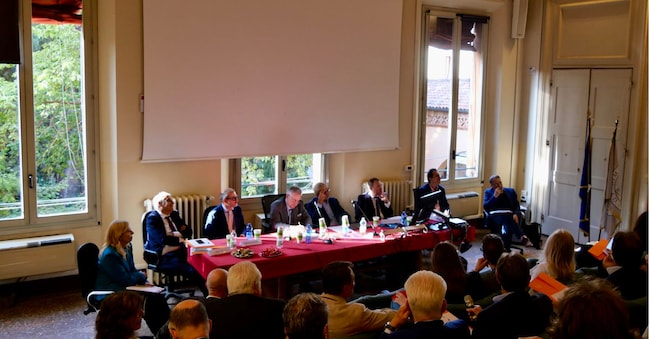
This is the starting point for the White Paper ‘Crossing Boundaries: The Present and Future of Vocational Tertiary Education’, presented in Bologna by the SUPER Foundation, with the aim of strengthening the links between universities, the ITS Academy, businesses, institutions and the professions.

Loading...

The survey carried out by the Foundation among 101 partner companies shows that demand for technical roles is concentrated primarily in the fields of mechanical engineering and energy efficiency, electrical and electronic engineering and automation, and IT.

Among the most sought-after roles are those in production, the technical department, planning, research and development, and project management. However, alongside specialist skills, there is an ever-increasing demand for soft skills: teamwork, problem-solving, flexibility, independence and reliability.

University life and corporate life

One of the key issues that emerged during the discussion concerns the different pace at which universities and the business sector operate. ‘To launch a degree programme in September 2026, the work has to begin at least a year and a half beforehand. In the business world, four years is an eternity,’ observed Gianantonio Battistuzzi, Vice-Rector and Head of Academic Affairs at the University of Modena and Reggio Emilia.

For this reason, the response to changing skills requirements cannot consist solely of launching new degree programmes. We also need the ability to update course content and programmes more quickly, through ongoing engagement with businesses.

“Companies are not in a position to provide training and do not claim to be able to do so. But they pick up on changes in the market much earlier – not least because, if they fail to do so, they will go out of business,” explained Maurizio Marchesini, chairman of the Marchesini Group and vice-president of Confindustria for Labour and Industrial Relations.

More than just technical skills

The point, however, is not to turn the university into a place of vocational training. ‘The university must educate, not merely train. Technologies change and will be different in a few years’ time: we must not only learn to use the tools, but also learn to think for ourselves, to be critical and to continue learning,’ emphasised Lorenzo Marconi, president of the SUPER Foundation.

This is a view shared by Marchesini: ‘The ability and the pleasure of solving problems is what I would like to see taught to young people.’

A significant part of the challenge lies precisely in striking a balance between technical skills and the ability to adapt. Companies are looking for candidates who can hit the ground running, but in a context where technologies, processes and professions are changing rapidly, the ability to learn continuously becomes crucial.

Loading...

Work placements, apprenticeships and bridging roles

The measures outlined in the White Paper include strengthening work placements, third-level apprenticeships, co-designing training programmes with businesses, greater integration between ITS Academies and universities, and the introduction of roles capable of acting as a link between the education system and the world of work.

“Work placements are essential,” emphasised Simone Baglioni, Vice-Rector for Teaching at the University of Parma, whilst also highlighting their role in fostering links between students and the local area.

According to Gabriele Marzano, head of the integration of employment policies and innovation initiatives for the Emilia-Romagna Region, there is still a need for a key player capable of establishing a structured dialogue between the various sectors: “What is mainly missing from this dialogue is a party that can contribute to the analysis and planning of skills.”

The challenge, therefore, is not to choose between theoretical and practical training, but to develop programmes that bring both together.

Copyright reserved ©
Loading...

Brand connect

Loading...

Newsletter

Notizie e approfondimenti sugli avvenimenti politici, economici e finanziari.

Iscriviti