
Small cannon fodder grows
Oscar-winning documentary chronicles the PM's propaganda to inculcate war in schools and prepare students to become soldiers

On 19 April 2026, Russia will celebrate the first Day of Remembrance of the Victims of the Genocide of the Soviet People, or the 'genocide perpetrated by the Nazis and their accomplices during the Great Patriotic War', which in the rest of the world is called World War II. It is not just a matter of words, but of a slow rewriting of history, put down on paper by a decree signed on 29 December by Vladimir Putin. Denazification is a term dear to the Russian president's heart to justify the aggression against Ukraine, and it is precisely in Volgograd, the former Stalingrad capital of the Resistance, that the first 'Museum of the Special Military Operation' will be inaugurated, i.e. the invasion of Kiev with a large monument dedicated to its fallen.
Putin's new narrative
Already in 2022, coinciding with the invasion of Ukraine, Pavel Talankin, a 30-year-old professor from Karabash, an obscure town in the province of Russia's southern Urals, becomes aware of the new course of the national epic. Obscure because renowned, even as a tourist attraction, for being one of the most polluted in the world. The centre, with a population of 10,000, is a grid of Soviet-style barracks amidst birch forests, copper foundry chimneys and snow-covered mounds of black soot. Here, the workers' children attend the same school where Pavel, known as Pasha, studied. He is the head and organiser of the events, as well as the school's video-maker, a figure who does not exist here, a legacy perhaps of the strong roots in Russia of cinema as a propaganda tool. The years pass and Pasha records and photographs the physical changes of the boys, parties and theatres, graduations, where the West is well chewed up. In Pasha's office one finds students dressed in grunge clothes, nose rings, retouched eyebrows, used to confide in each other under the poster of Hermione Granger and Severus Snape.
Love for the earth
Pasha also attends alumni parties, amidst affection and alcohol spread out on wooden planks. It's not the place for fairy tales, yet Pasha in front of his camera reveals: "I love it when it's freezing cold, when it's 45 degrees below zero and you have to rush from one side to the other, red-faced and ice on your moustache. I love the people. I love the labyrinth and the pipes of the copper factory. I love the stains on the walls of the buildings'.After announcing the war in Ukraine, Putin realises he cares about children, future soldiers and cannon fodder: there is no province or city that escapes his military lust. At Pasha's school, lessons are turned to patriotic rhetoric and the young teacher is forced to film them, as well as the marches of children who are at first astonished, but then increasingly accustomed to the normalisation of the conflict.
Prigozhin's Wagner Brigade at school
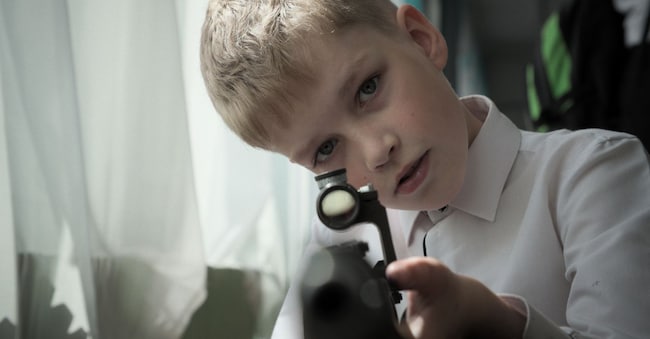
Militarised youth groups spring up and the Wagner Brigade from Prigozhin is welcomed into schools to let students experience the instruments of extermination, from butterfly mines to Kalashnikovs. Military dexterity contests are organised, complete with prizes, such as the one for throwing the grenade. Pasha does not want, nor can he believe that children are being trained to become martyrs, so he resigns from his post.
Contact with Denmark
But at the same time, he is contacted by David Borenstein, a Copenhagen-based filmmaker, who picks up his desperate web post. Suddenly Pasha withdraws his resignation: he realises that from his position he is able to record exceptional material to document the brainwashing of the new generation. Since he has been in charge of the project, his dissent becomes much more evident in words and gestures and, as a result, a furrow of mistrust opens up between the teacher, the citizens trying to make a living and the children who are increasingly wary of him. Thus was born Mr Nobody against Putin - now in cinemas, look for it on zalab.org - which just won the Oscar for best documentary. Comic, ironic, grotesque and despairing, it is directed by four hands, by David Borenstein and Pasha Pavel Talankin. Crucial to the birth of the film was Lucie Kon, head of content at the BBC and executive producer of the film, who oversaw the project and secured funding from the British network. Amidst hymns and cockades, flags and the award with a luxury flat to the most subservient teacher, the first casualties from the front among the former school children also arrive. The last glance is for the librarian mother, who with mutterings agrees with the regime, but with her eyes waves goodbye to her son who knows he is leaving never to return.


