
Smart glasses, Essilux-PoliMi lab grows in size
The multinational company and the university have built a multidisciplinary team of over 100 scientists, researchers and engineers from different countries in the Smart eyewear lab to create an international centre of excellence for research
by Cristina Casadei
 Aggiungi Il Sole 24 Ore
ai preferiti su Google
Key points
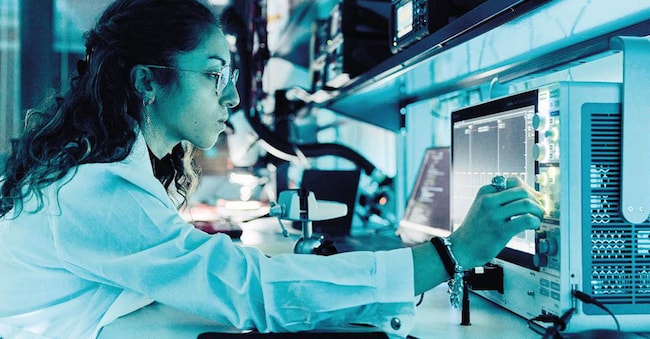
For the Smart Eyewear Lab, an international centre of excellence for research, the choice is made. The home is in Milan, at the Politecnico, which with EssilorLuxottica has created the Smart Eyewear Lab: a multidisciplinary team of more than 100 scientists, researchers and engineers from all over the world, who every day discover the new frontiers of technology. And where they prepare the new generations to design the smart wearable devices of the future, overcoming the boundaries of an overly specialised education to enter a more hybrid and integrated one in which the physicist works with the computer scientist, the engineer with the biomedical scientist, the designer with the materials scientist. With a project that is now also arriving in the classrooms of the Politecnico. Almost 800 students showed up at the starting blocks last September. And that was only the beginning. "The collaboration with the Milan Polytechnic started a long time ago, when Rector Ferruccio Resta was still rector. The current chancellor, Donatella Sciuto, who has always believed in the project and the vision that guides it," says Federico Buffa, head of research and development, product and marketing at EssilorLuxottica.
The Multidisciplinary Programme
The laboratory is working to create a technological platform where glasses are a gateway to new worlds where human and artificial intelligence meet to enrich the interaction between real and digital. And it becomes a laboratory within a laboratory with the birth of an interdisciplinary programme in smart wearable technologies built in collaboration between the university and the Group led by Francesco Milleri. For the Politecnico di Milano, "it is a project that is part of a strategic initiative called interdisciplinary pathways," explains Vice Rector for Education Stefano Ronchi, "with which we wanted to create discontinuity with respect to traditional degrees that lead to the creation of specialised profiles, but without real interdisciplinary integration. Technology, for example in AI, materials and photonics is evolving ever more rapidly in different directions that require skills that change over time and are very different. That is why it is difficult for a strong specialisation not to be updated a few years after graduation, and it is equally difficult for a graduate to cover the whole spectrum of necessary skills in depth'. This is how the professors of the Milanese university began to wonder how to avoid the dual risk of specialisations at risk of obsolescence and overly broad profiles. 'The path chosen was that of interdisciplinary courses,' continues Ronchi.
From the US to Italia
To tell the story, one has to go back about ten years and move to the very large triangle between Milan, Agordo and the Bay Area (San Francisco) where EssilorLuxottica was maturing deep thoughts on wearable technologies. It was a long journey that led the group to bring the story of smart glasses back to Europe and Italia. It was a journey born first of collaboration with Google and then Intel, which turned out to be a significant experience above all for the lessons learned from the mistakes of those first steps. In the beginning, we sought 'a collaboration with a technical university and focused on California to build academic partnerships,' says Buffa. 'Over time, we realised that it was almost always Italian researchers who were driving the most advanced part of the innovations we were interested in. Thanks to the contacts we made, we identified the most promising centres for us, certainly one is the ETH (the Federal Polytechnic, ed.) in Zurich, with which we have collaborations, the other the Politecnico di Milano, where we found the ecosystem we were looking for,' Buffa says. At this historic moment, above all, 'at the European level, there is a clear desire to build a technology ecosystem with its nerve centre in Europe. A number of large companies are also moving in this direction, increasingly oriented towards favouring and strengthening investment in Europe,' Buffa continues. 'It is a great responsibility that we feel very strongly at this time. Research has very high costs that are generally out of scale, no company can do it alone, the only way is to create an ecosystem between companies and universities'.
Electronics for the eyeglass
The second factor that gave a fundamental impetus to the project was the fact that 'among the many concepts that were maturing in the world of wearable technologies, glasses were only partially developed because the focus was mainly on telephony and other areas,' says Buffa. 'Our collaboration with Google, for example, on smart glasses and with Bose for the acoustic part was not enough for us to make the leap we wanted to make, we realised that we were limited by existing technologies. We had to build electronics, both hardware and software, specifically designed for the glasses. At the Politecnico di Milano, we found what we were looking for in the Joint Research Centre formula'.
Between Engineering and Design
The laboratory that has been built today is part of a much larger project that also includes the first interdisciplinary course in smart wearable technologies, 'a programme within the unique master's degree course in Italia, created at the intersection of engineering and design, to train professionals capable of designing the next generation of smart wearable devices,' says Ronchi. 'We could have thought of a new degree course, but for us it was not the right way. We wanted to go further because in the world of work it is increasingly important to be able to dialogue in multidisciplinary teams where people bring different skills. What we have created is precisely an interdisciplinary course where the physics engineer brings the best of photonics, the computer and electronics engineer the most advanced algorithms and hardware, the biomedical engineer the knowledge of how the human body interacts with devices, and the designer works on wearability and functionality. Thus the students tackle new problems in multidisciplinary teams. The interest was immediate and for the first course that started in September we received 799 applications from Design and Engineering schools. The second edition will start next September.

