
Smart ambulances on the horizon: they will be operational in 2027
The Bourelly Group’s CoriteL project was unveiled in Naples: a vehicle equipped with 5G and AI to speed up treatment in collaboration with hospitals

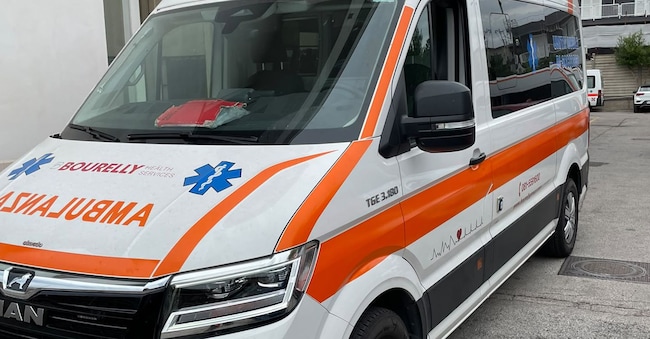
Smart ambulances with ultra-fast, ultra-low-latency connectivity via TIM’s 5G network: this is the project being developed by the Bourelly Group in partnership with CoRiTeL (Telecommunications Research Consortium) – in which Ericsson is a partner – and with TIM Enterprise. The launch of the first operational prototype of the Smart Ambulance is scheduled for December. This will mark the start of testing, validation and the subsequent path towards industrialisation and deployment on the roads.
The project, promoted by the Naples Industrialists’ Union, aims to turn the ambulance into the hospital’s first mobile ward, bringing specialists’ expertise directly to the scene of the emergency. State-of-the-art technology enables response times to be reduced and real-time teleconsultations to be carried out (with full HD video communication between the on-board team and the remote doctor, using an in-vehicle camera and bodycam to provide a close-up view of the scene); make a diagnosis even before arrival at hospital (ECG, vital signs and biomarkers measured on board, such as troponin, are immediately visible to specialists, supported by ongoing analyses, such as the FAST neurological screening for stroke and the fast bedside echocardiogram for rapid assessment of the heart, lungs and abdominal organs), and create an integrated medical record (patient information can, in fact, be accessed within the same digital environment as the data collected during the emergency response). Furthermore, whilst still on board the ambulance and therefore during the initial response phase, AI can be used to support the doctor: an AI-based avatar helps to review the data, summarise the context and draft the report, always under the supervision of the healthcare professional. Finally, a handover report is drawn up. At the end of the intervention, the system generates a summary which the doctor can review and amend before it is archived, ensuring continuity of information between the ambulance and the hospital.
“The ‘Smart Ambulance’ project aims to develop a digital healthcare ecosystem in which the ambulance, the operations centre, the doctor, hospitals and the local community are constantly connected,” says Guido Bourelly, sole director of Bourelly Health Service. “Through high-performance connectivity systems, it is possible to transmit clinical data and information in real time, such as ECGs, vital signs, diagnostic images, multi-parameter monitoring and high-definition video streams. From this perspective, the ambulance becomes a genuine mobile healthcare hub within the local network. The industrial aim is to integrate Italian healthcare and technological expertise with major telecommunications and innovation operators, developing a model that can also be exported to international markets. ‘Smart Ambulance’ clearly demonstrates the importance of working as a system. The integration of the operational expertise of a local company, the applied research of a consortium and the infrastructural capabilities of major technology partners – promoted by the Naples Industrialists’ Union – is the prerequisite for the creation of complex and competitive technological platforms.’
Bourelly Health Service is a company within the Bourelly Group, specialising in emergency and medical transport services, as well as the provision and management of healthcare services for public and private organisations. It currently operates in Campania, Lazio, Sicily, Calabria, Molise and Piedmont.
In a health emergency, time is often the decisive factor, as Nicolino Esposito, scientific director of Bourelly Health Service, pointed out. “In Italia, there are an estimated 18.27 million visits to A&E each year, 68 per cent of which are white and green codes. Total expenditure on A&E is estimated at around 3.5 billion euros, and the average cost per visit is around 192 euros, with an average waiting time for admission of around 31 hours.” Esposito added: “The 14th National Simeu Congress in Naples revealed that 9 out of 10 A&E departments are currently understaffed. In fact, only 11 per cent report having adequate staffing levels; 89 per cent have to resort to stopgap measures to cover shifts, including locum doctors, additional services and freelance contracts.”


