Products

Smartphones, prices on the rise but the recovery also depends on AI

Carlo Barlocco, Executive Director & General Manager of Motorola, speaking just a few hours after the Mobile World Congress in Barcelona, which reached 12% market share in the mobile market in Italia

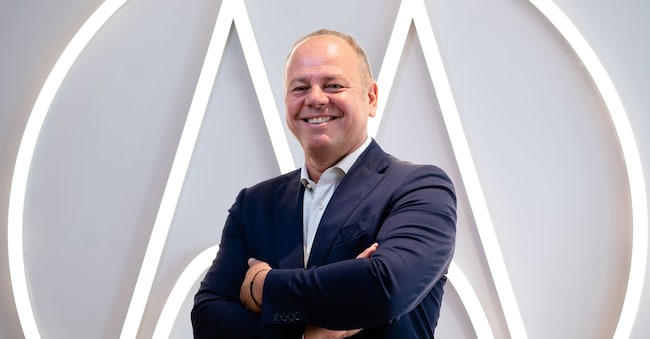
Carlo Barlocco, Executive Director & General Manager di Motorola

4' min read

Translated by AI
Versione italiana

4' min read

Translated by AI
Versione italiana

The last two years have been difficult for smartphone manufacturers. Not only for mobile phones but for all consumer electronics. Since Covid, something has changed in the minds of consumers. And the (slow) entry of artificial intelligence assistants into mobile devices has not yet had the wow effect that the market expects. With just a few days to go before the start of the Mobile World Congress in Barcelona, Carlo Barlocco, ex-Samsung and currently a leading figure at Motorola, is the right figure to understand what 2026 will be like and how 2025 went.

"The year ahead for the smartphone market promises to be complex, but what is certain is that, even in a challenging market environment, companies will continue to innovate. Against this backdrop, the balance of 2025 for Motorola was very positive and unique in the industry. Starting from a market share of zero in 2019, we are proud to have achieved a market share of 12.5% in volume and 5.2% in value on an annual basis (January-December 2025). This result attests to how our brand has not only won back the market, but more importantly, consumer trust.

Loading...

Today, we are the third largest smartphone brand in Italia by volume on a year-on-year basis and the second largest in the operator market, with a solid 19.9 per cent, thanks in part to a product mix increasingly oriented towards the mid-range. These figures, like the volume leadership in some months of 2025 with the razr family, demonstrate our ability to perform on several fronts".

How high is the memory price, when will we see the first price increases? And what consequences will this have in terms of model offerings?

The memory market is undergoing a major upheaval, a challenge that impacts the entire industry and all technology manufacturers. This dynamic is mainly driven by the accelerating adoption of AI across all sectors and the huge investments in this technology globally, which have generated a growing demand for advanced memory technologies.

This situation causes supply shortages, higher component costs and an overall contraction of supply. According to industry studies, these challenges will continue through 2026.

Since there has already been an increase in upstream prices, as soon as these new productions come onto the market, we will soon see a concomitant increase in public prices.

Where is the entry of Ai in smartphones? Has it become a reason to buy? When Nfc arrived on mobile phones, users switched smartphones en masse because there was a difference between those who had it and those who didn't. The question is: what does Ai need to know to be like Nfc?

AI represents a fundamental switch for the growth of the mobile market. It is set to be more disruptive than the Internet in the 1990s, or Nfc in the early 2000s. It is not just an add-on feature: it transforms the interaction with technology, making smartphones smarter, more personalised and more useful.

There are 3 types of AI: AI that enhances the actions we already take with the phone, such as photography; AI that helps us, such as Copilot, Gemini, which allow us to make specific requests and get articulate content; and predictive AI, which because it knows us intimately, proposes what to do and how to act. An evolution that will lead to the physical transformation of smartphones, requiring more powerful and optimised processors without compromising autonomy.

As soon as predictive AI arrives in smartphones and materialises in tangible applications that can help us in our daily lives and give us unique benefits, consumers who want to experience these things will decide to change their smartphones.

So this is just the beginning of AI, and I am convinced that the responsibility of us as manufacturers is not only to invest in its development, but also to educate consumers about the concrete benefits and changes it will bring to their daily work and private lives. This is crucial for the adoption and long-term success of AI.

As Motorola we are also developing predictive AI, capable of anticipating user needs based on context and interests, and it is this revolution that will put the smartphone back at the centre of digital habits.

Finally, the recent unveiling of Lenovo and Motorola Qira, a personal and multi-device ambient intelligence, integrated at the system level for proactive and contextual assistance, reinforces Motorola and Lenovo's leadership in the future of AI.

Finally, since they are going to Mobile World Congress, what has happened to electronics since Covid?

In recent years, the electronics market has been going through a complex phase. We have witnessed a shift in the priorities of consumers, who now value more goods and services that improve their quality of life: travel, health, leisure. Telephony, along with other segments such as televisions and screens, is shrinking slightly.

This trend is partly due to a slowdown in the pace of innovation. We have experienced a tremendous acceleration for years, but now the lack of device differentiation has lengthened the average lifespan of smartphones, reducing the frequency of purchase, precisely because we lack the 'leap' that motivates turnover.

In this scenario, innovation is no longer just a competitive factor, but becomes the essential lever to trigger a new cycle of growth and turnover. And this is where, as we have already discussed, Artificial Intelligence assumes a central role. It is the technology capable of going beyond the simple optimisation of existing functions, radically redefining the smartphone user experience and stimulating a new demand.

At the Mobile World Congress, these issues will be at the heart of the debate, and it is the perfect opportunity to show how Motorola, with its vision and investment in AI, is proactively responding to these market challenges, proposing solutions that return to generating value and true innovation.

Copyright reserved ©
  • Luca Tremolada

    Luca TremoladaGiornalista

    Luogo: Milano via Monte Rosa 91

    Lingue parlate: Inglese, Francese

    Argomenti: Tecnologia, scienza, finanza, startup, dati

    Premi: Premio Gabriele Lanfredini sull’informazione; Premio giornalistico State Street, categoria "Innovation"; DStars 2019, categoria journalism

Loading...

Brand connect

Loading...

Newsletter

Notizie e approfondimenti sugli avvenimenti politici, economici e finanziari.

Iscriviti