Quotate Italy

Venier: 'Snam network crucial for Europe ready to say goodbye to Russian gas'

by Celestina Dominelli

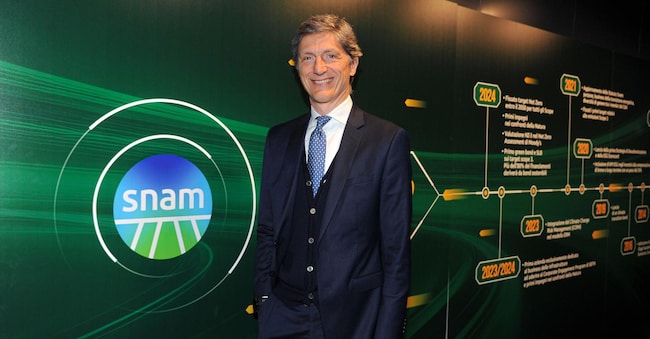
 Stefano Vernier, Amministratore Delegato SNAM Italy (foto IPP/Mario Romano)

4' min read

4' min read

"In the past few days we have completed the upgrading of the Malborghetto compressor station, which has made the reverse flow from Italy to Austria operational.As a result, as of 1 October, we can export up to 9 billion cubic metres of gas per year to Europe (compared to 6 billion previously). A step that, together with the completion of the further strengthening of the Poggio Renatico plant, as part of the RepowerEu funding, will represent an important assist for Eastern European countries that are still very dependent on Russian gas". Snam's CEO, Stefano Venier, starts from here, in this interview with Il Sole 24 Ore, to take stock of a year that has been 'particularly intense both for the construction of the priority steps linked to energy security and for the further evolution of the platform towards the green transition, which is consistent with and reinforces our path as a multi-molecule pan-European operator'. A path also reaffirmed in the road map to 2050 outlined in the first Transition Plan just presented by Snam, which celebrates its 83rd anniversary this year.

Why is the step you have just completed in Malborghetto so important?

Loading...

It is a fundamental junction in view of the expiry at the end of the year of the remaining contracts between Gazprom and Ukraine and should be considered synergic with the other vertical corridor that passes through the Balkans. Where, thanks to the start-up of the new floating regasifier in Alexandroupolis, in which our Greek affiliate Desfa is a shareholder, 5 billion cubic metres of gas are available for the Balkan countries and Austria, Slovakia and Hungary. These two corridors, together with the one passing between Germany and Austria, are crucial options to achieve the complete phase-out of Russian gas via pipeline in the coming months.

Strengthening infrastructure is one of the legs of energy security. The other is storage: where do we stand on this front?

European storages are now 95%. Today (yesterday for those reading, ed.) we will close at 98.5%, having abundantly exceeded 12 billion cubic metres of injected gas which, together with the strategic reserve, brings the bar to 16.5 billion, a slightly higher level than last year. If, to this, we then add the reserves of Edison Stoccaggio and Ital Gas Storage, we arrive at 14 billion cubic metres of working gas, a third of the consumption generally recorded in winter, between November and March.

Snam is also working on source diversification: in the next few days, new loads of liquefied natural gas are expected at the Piombino plant. How is that work progressing? .

By the end of the year, we will have reached 50 ships arriving at the Fsru in Piombino. Liquefied natural gas currently covers a quarter of our consumption and, so far, we have received 120 ships as Italy in the various infrastructures, mostly from the USA, Qatar, and Algeria, but we have also registered cargoes from Congo and Mozambique, to name but a few. This result confirms the effectiveness of our choice in terms of supply diversification.

Does the April deadline for commissioning the Ravenna regasifier remain in place?

Absolutely. We are in the process of completing the infrastructure works of the facility. As for the ship, it has completed its maintenance activities in Dubai and we expect to have it in Italian territorial waters by the end of the year.

When will you close the Adriatic Lng game, where you exercised the option to increase your shareholding from 9 per cent to 30 per cent?

We submitted the documentation to the European Antitrust Authority at the end of September, and we are confident that in the coming weeks we will get the green light so that we can reach the closing in December. And for Edison Stoccaggio we will present everything to the Italian Antitrust in the coming weeks in order to respect the first quarter of 2025 as the deadline for the closing of the deal..

You have recently expressed your interest in the deal whereby Eni aims to enhance the carbon capture and storage (CCS) business. How will you go about this?

We have already submitted a non-binding expression of interest to Eni and we are now in the due diligence phase. It is clear that this move ties in with the Ravenna development project in which we are both involved and where, since 4 August, we have started CO2 injections with very good results and a capture rate of 91%, which is extremely high. A sign that the technical performance is even better than we expected. A few days ago, we also submitted applications for 250 million in funding from the EU.

Will you also ask for access to EU funds for the SouthH2Corridor project, the hydrogen corridor that should connect Africa and Europe?

We have filed an application to access some 20 million euro of EU resources for the project part.

How much is the total investment?

For phase 1, which concerns the construction of the backbone in Italy, we are talking about some 4 billion investments on a horizon of 2032-2033: 60% of this is the modernisation of existing networks.

On Wednesday, the Gse published the ranking list for the latest biomethane auction. How many of your projects are eligible for incentives?

With the outcome of the last call for tenders, we have arrived at 9 authorised projects: 8 of these are under construction, with 2 already completed and starting up this month. While, on the connections front, to date we have received 319 requests: 153 have been accepted and we are already working on the authorisation and implementation front.

Copyright reserved ©
Loading...

Brand connect

Loading...

Newsletter

Notizie e approfondimenti sugli avvenimenti politici, economici e finanziari.

Iscriviti