Government in trouble

Sanchez’s housing plan rejected. Spain heading for snap elections

The Socialist Prime Minister attacks the opposition: ‘History will judge you very soon.’ The vote could take place on 29 November. Street protests against high rents continue

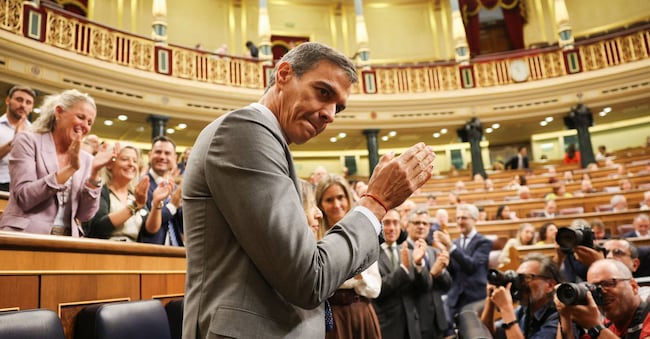
Il premier socialista Pedro Sanchez alla Camera prima del voto che ha bocciato il piano del governo per la casa REUTERS

3' min read

Translated by AI
Versione italiana

3' min read

Translated by AI
Versione italiana

The Spanish Parliament has rejected Pedro Sánchez’s plan to tackle the housing crisis: a major blow for the Socialist Prime Minister, who is now considering whether to challenge the right by calling a snap election. Sánchez has gathered his most trusted advisers at the Moncloa and is expected to make a decision over the weekend on a vote that would once again bring the parliamentary term to an end: ‘What has happened is very serious and must be analysed carefully,’ sources within the government explained. Meanwhile, protests have resumed in the streets over rising rents and the lack of housing for the poorest sections of the population.

The left-wing minority government led by Sánchez failed to secure the necessary votes in Parliament: the lower house of Parliament rejected the measures drawn up in recent days to tackle the housing crisis. The right-wing parties voted against the measures, alongside the People’s Party and the xenophobic Vox party. However, the decisive factor in the rejection was the ‘no’ vote from Junts, the Catalan pro-independence party – which is conservative in orientation and whose votes helped bring Sánchez back to power in 2023 – explained that the Socialist initiative would ultimately reduce the supply of rental properties and cause prices to rise even further.

Loading...

The two housing measures were rejected by 178 votes against (and 172 in favour) and 184 votes against (and only 166 in favour) respectively: the main measures proposed by the government included a ban on evictions for vulnerable tenants until 2030; the automatic renewal of existing tenancy agreements; restrictions on short-term lettings; and very strict limits on the purchase of residential property by investors whom the government has described as ‘vulture funds’.

Not even Sanchez’s surprise address to the chamber before the vote managed to convince the Catalans and the opposition: ‘Do the right thing, otherwise history will judge you sooner than you think and more harshly than you can imagine,’ said the Prime Minister.

Sánchez’s defeat came as protests against rising rents and the housing crisis continued: the events in Madrid and many other Spanish cities were sparked by the case of an elderly woman, Maricarmen Abascal, aged 87, who was evicted last week because she could no longer afford the rent for the flat in the capital where she had lived for years.

A crowd of demonstrators gathered yesterday outside the Congress, and the Tenants’ Union, which is organising the protests, has stated that it will continue to organise further mass demonstrations as early as today. The camps at Puerta del Sol, in the centre of Madrid – the very spot where the Indignados protested in 2011, at the height of the country’s economic and financial crisis – will also remain in place. “The camp will continue and will keep spreading to other neighbourhoods. We are aiming for a general strike,” said Alicia del Rio, spokesperson for the Tenants’ Union.

The leader of the People’s Party, Alberto Núñez Feijóo, has accused Sánchez of exploiting the housing crisis for his own electoral gain and has called for Parliament to be dissolved and for a snap election. “All of Sánchez’s moves are designed not in the interests of the public, but – he said – with the polls in mind.”

Support for the Sánchez government has fallen in recent weeks due to the migrant crisis in Ceuta. According to the latest analysis by the CIS, the Socialists remain the leading party with 31 per cent of the vote, but an alliance between them, Sumar and Podemos would only reach just over 40 per cent of the vote, falling short even of the coalition of right-wing parties.

Pablo Simon, a professor of Political Science at Carlos III University in Madrid, is inclined to believe that Sánchez will once again decide to call a snap election: ‘He must call an election within nine months in any case. So the question is: will he have a better opportunity than this in three or six months’ time? That is the question he will ask himself. And the answer is probably no.” According to sources at Moncloa, Sánchez could make a decision as early as Monday and call a general election for 29 November.

Copyright reserved ©
Loading...

Brand connect

Loading...

Newsletter

Notizie e approfondimenti sugli avvenimenti politici, economici e finanziari.

Iscriviti