
How artificial intelligence changes air travel (with the challenge of the single pilot on board)
Companies are exploring the use of AI to reduce costs and improve air traffic management
by Mara Monti
4' min read
4' min read
Artificial intelligence will soon be on board aircraft and some airlines and aircraft manufacturers are already exploring the possibility of reducing the number of pilots in the cockpit through the use of artificial intelligence and automation. Reducing costs and improving flight safety by reducing human error are the arguments for this new development, which still has many challenges and limitations to overcome. Starting with the assessment by aviation regulators who have to approve the use of AI in different programmes.
Digital assistant and single pilot on board
.The digital assistant that the American aviation group Collins is working on with the Jarvis project under the European Sesar programme promises to help the pilot manage communications with the control tower, prevent possible errors and correct them quickly, and even support operations in the case of single-pilot flights. "Systems using AI will not replace, but support pilots on board aircraft in processing large amounts of information to make complex decisions in a short time. The same is true on the ground in flight controller communications,' explains Michela Terenzi, head of human factors applied at Deep Blue, an Italian SME specialising in research and consultancy in the aviation sector that presented the Jarvis project at the Paris air show together with Collins.
European programmes for the digitisation of air traffic
.Europe is investing in sophisticated programmes for the digitalisation and optimisation of air traffic that are interesting, but destined not to see the light of day any time soon: as in the case of the European Sesar Joint Undertaking programme, which aims to 'improve safety by integrating technologies and procedures for air traffic management in increasingly complex operational environments and by integrating services for different types of aircraft, with or without crew,' reads a draft. All the main operators in the sector (in Italy Aeroporti di Roma, Sea Aeroporti di Milano, Leonardo, Cira, Enav) and international operators are taking part in the programme, and it has a budget of 1.6 billion euros financed not only by industry but also by Eurocontrol and Horizon Europe.
A complex evolution that currently sees 78 projects already operational, on which EUR 650 million have been invested. Those that integrate artificial intelligence systems will face the complex challenge of certification, which requires the definition of requirements aligned with the demands of Easa and the AI Act.
A Google map in the aircraft cockpit to choose alternative airports
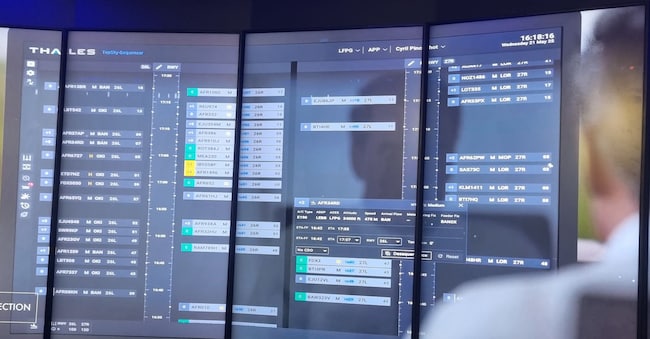
.From the cockpit to the digital assistant dedicated to air traffic controllers designed to quickly process complex databases and lighten their often stressful work, to the digital assistant supporting airports to increase runway safety and avoid collision risks. Thales, the French aeronautics giant, exhibited its cockpit of the future, FlyTX, at the Paris show, with the application of artificial intelligence that the manufacturer plans to certify by 2028: in the event of a distruption, such as the recent case of London's Heathrow airport being closed for hours due to a short circuit, the pilot will have at his disposal alternative routes and stopovers where to land, a kind of colour google map with a touch screen to make the choice quickly and without wasting fuel, as well as useful information for passengers forced to land at a different airport from the one planned, such as nearby hotels and train times.


