
So the mountains live on thanks to the multiplier effect of winter tourism
An Anef-Pwc study reveals the territorial impact of skiers' spending

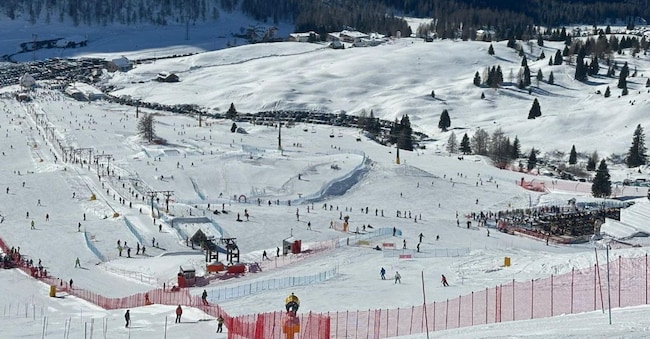
One for eight. This is the multiplier effect that emerges from the study "Mountain Economy. Impacts and challenges of the mountain system in Italia commissioned by ANEF (Associazione Nazionale Esercenti Funiviari adhering to Confindustria) to PwC Italia. For every euro spent on the purchase of tickets and tourist services in ski lifts, an effect of more than eight times the stimulated local turnover, understood as production value, is generated. If, on the other hand, only the impact on tourism expenditure is considered, the multiplier effect is more than 5 times. The analysis measures the socio-economic impact of mountain tourism linked to ski lifts for Valle D'Aosta, Lombardy, Veneto and the provinces of Trento and Bolzano.
The data show that in the territories analysed, against 1,111 million euros of tourism expenditure destined for ski-lift facilities for the purchase of ski passes and other services provided by the operators, overall local tourism expenditure reached 5,576 million excluding VAT, activating 8,941 million in turnover and more than 75 thousand direct and indirect local jobs. All this produced a tax revenue of 548 million euros for the Regions, Provinces and Municipalities of the mountain areas of the territories analysed. To understand how mountain tourism is capable of generating a significant fiscal impact at the local level, it is enough to consider that for each day of skiing recorded on the ski lifts, the average tax revenue per skier is 15.5 euros.
On the investment front, on the basis of the 2024 budget data, the last year available, of the operators in the geographical areas analysed, it can be seen that the amount of financial resources earmarked for the construction or renovation of existing infrastructures, i.e. plants, snowmaking, vehicles, machinery, equipment and buildings, and other cubava 291 million euros, distributed as follows: 30% in the province of Bolzano, 27% in the province of Trento, 21% in Lombardy, 13% in Valle D'Aosta, 9% in Veneto. In other words, this is 94% of the national total of infrastructure investments in 2024. Here too, the multiplier effect is considerable: for every million of production value generated by the management companies of the territories analysed, 250,000 euros were spent on investments.
From an environmental point of view, ski lifts emit only 6% of the CO2 tonnes attributable to mountain tourism. New technologies, such as Ecodrive systems for chairlifts and high-efficiency generators for snowmaking, allow energy savings of up to 20%, while the use of electricity from renewable sources is growing. Looking at the mountain system in Italy as a whole, Italy has a total of 2,500 mountain municipalities that occupy about 35% of the national territory and are inhabited by more than 7 million inhabitants, more than 12% of the Italian population. 51% of mountain municipalities have an economy strongly focused on tourism with an average of 17 tourist presences per inhabitant, more than double the national average. There are more than 552,000 local business units operating in the mountain system, of which 171,000 are craft businesses, employing a total of 1.8 million people.

