
This is how NATO is demonstrating its unity following Trump’s barbs
Everyone is praising the atmosphere of harmony, from Secretary Rutte to the US President himself, who, however, did not hold back on his attacks on allies again yesterday, starting with Spain, with whom he wants to sever trade ties
from our correspondent Beda Romano
 Aggiungi Il Sole 24 Ore
ai preferiti su Google
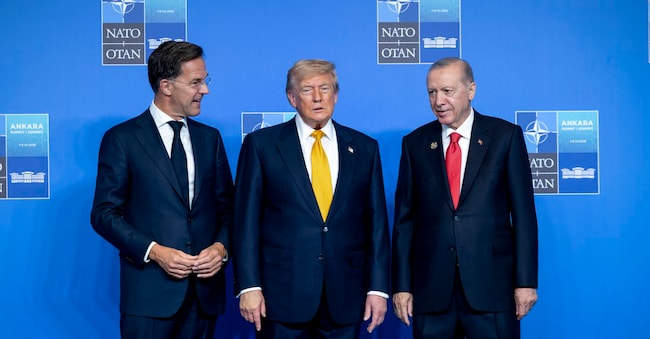
ANKARA – Amidst criticism and praise, rebukes and accolades, President Donald Trump has, as expected, left his mark on the NATO summit that concluded yesterday here in Ankara. Behind the façade of unity that the allies sought to project, doubts and tensions persist. On the other hand, how could it be otherwise when the White House is constantly blowing hot and cold? Among the decisions taken, it is worth noting the US decision to grant Kiev licences to produce Patriot missiles.
In the Atlantic Council chamber, “there was a strong sense of unity”, said NATO Secretary-General Mark Rutte. After commending the increase in military spending across European countries, the former Dutch prime minister went on to say: ‘We are laying the foundations for a stronger, more balanced and more capable NATO.’ President Trump himself added: ‘There was so much love, so much unity in that room.’ As expected, the communiqué emphasises the ‘unwavering commitment’ to collective defence.
Also yesterday, the United States announced its intention to grant Ukraine a licence to produce Patriot missiles, which are effective in missile defence. This decision is likely to give Kyiv an extra edge in its now long-running war against Russia. “I believe they are capable of producing them fairly quickly,” said President Trump at a press conference with President Volodymyr Zelensky. “They have a great capacity to produce weapons.”
This sudden decision may be driven by the White House’s ambition to jump on the bandwagon at a time when Ukraine appears to be gaining the upper hand, at least in technological terms, over Russia. Other observers believe the decision is also driven by a desire to counter European competition, in particular the Franco-Italian SAMP/T missiles. Meanwhile, Kyiv has secured confirmation of Western aid totalling 140 billion euros for 2026–2027.
All in all, the NATO summit ended on a better note than it had begun. Before the summit, the US president had criticised Spain: it was a ‘terrible’ ally in terms of military spending, he had said, ordering a halt to trade relations; he had reproached certain countries, including Italia, for not having taken part in the war against Iran; he had reiterated his desire to annex Greenland; and he had even threatened to withdraw all US troops from the European continent.


