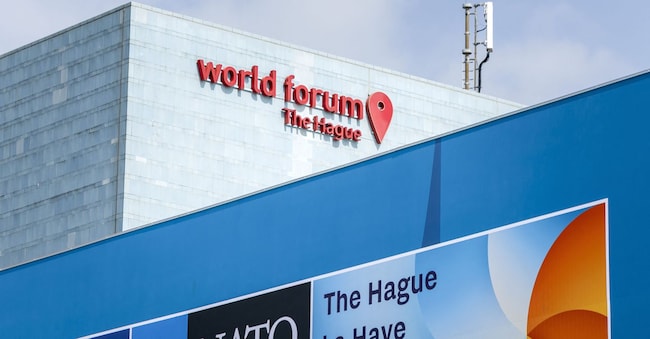
Towards the Hague Summit

How Nato prepares for the 5% challenge in partnership with start-ups

The Diana programme, launched two years ago, facilitates the cooperation of member countries with the private sector. The aim is to exploit the new investments in defence, which are now set to increase, to facilitate innovation in the field of dual-use products, civil and military, and to multiply the spin-offs, including economic ones

from our correspondent Beda Romano

L’area che ospiterà il vertice Nato dell’Aja della settimana prossima

4' min read

4' min read

BRUSSELS - How high will Nato countries' military spending go? To 5.0% of gross domestic product, as is rumoured? And in what way? The decision will come at next week's summit in The Hague. In the meantime, for the past two years, the military organisation has launched a programme of cooperation with industry. The aim is to exploit new investments in defence to facilitate innovation in the field of dual-use products, civil and military, and multiply the economic spin-offs.

The DIANA programme (the acronym stands for Defence Innovation Accelerator for the North Atlantic) was officially announced in 2023 at an Atlantic Alliance summit in Madrid. In fact, the attempt is to sharpen the technological edge of the military organisation by facilitating cooperation between the private sector and member states. Among other things, a 15-year fund with EUR 1 billion from governments has seen the light of day.

Loading...

The Innovation Fund is investing in start-ups specialising in emerging technologies that are increasingly a priority in the eyes of the Atlantic Alliance (data processing, quantum technologies, biotechnology). Technology is proving to play a crucial role in today's conflicts. Artificial intelligence, for instance, made it possible in the war in Ukraine to reduce the use of 155 millimetre bullets by 40 per cent and to cut decision-making times by 90 per cent.

NATO's Deputy Secretary General for Innovation, Jean Charles Ellermann-Kingombe, explained at a seminar a few days ago: 'Many high-tech companies do not belong to the defence sector. They develop products in a different way and are not used to participating in our tenders. They belong to a different ecosystem (...) Our task is to bring them closer to the big defence sector, especially as they develop useful technology to fill our gaps'.

Returning to the DIANA programme, the aim is to open up the defence sector to smaller companies, but also to channel research and development in such a way that products initially intended for civil use can also be used in the military sphere. DIANA therefore has three offices (London, Tallinn, and Halifax), 20 sites (called accelerator sites in English), dedicated to promoting the technologies in which the selected start-ups specialise, and 180 test centres (19 of which are in Italy).

Analyst at the Istituto Affari Internazionali in Rome, Alessandro Marrone is cautious: 'The DIANA project has to reckon with the fragmentation among NATO member states, an organisation that moreover does not make technological industrial policy. It is therefore difficult for the programme to turn out to be a paradigm shift (...) Of course it is an opportunity for small companies that can access the various test centres, including the National Underwater Dimension Centre in La Spezia'.

The rigmarole to fully enjoy DIANA involves a series of stages. According to the military organisation, currently 10 companies have just completed the second stage. In all, 74 companies are part of the class of 2025. Two Italian companies have so far been selected: Orbital Recharge in Space (ORIS), a company specialising in energy transmission via laser technology; and Fluid Wire Robotics, an enterprise born from a rib of the Scuola Superiore Sant'Anna in Pisa and active in robotics.

Domenico Sfasciamuro, one of the founders of ORIS, a company set up in 2024 and which has already received 100,000 euro in subsidies from the DIANA programme, explains from Turin: 'Our company is dedicated to space. For us, participating in the Nato initiative was useful to understand a world, the military world, in which information is difficult to find. Our goal is to understand whether our work can be used beyond the space sphere and in the military field as well'.

Asked how much money has been invested so far, a NATO spokeswoman replied: 'We do not disclose this amount. We can say that we are on track with investments and have made more than 10 direct investments'. Beyond the more technological aspects, for Nato it is also a matter of helping smaller companies to participate in tenders. Tom McSorley, an advisor to the DIANA programme, recently pointed out that lawyers are just as important as engineers at this juncture.

Let us leave aside for a moment the moral and political aspects of rearmament, which divide NATO member states so much. Historically, increased defence spending intersects with industrial issues, even before economic ones. It is well known that military research has given birth to the Internet, and other inventions that are now part of our daily lives (satellite navigation, the microwave oven, adhesive tape, nylon and other artificial fabrics, the tea bag, concentrated juices).

According to the SIPRI institute in Stockholm, military spending has increased to USD 2,718 billion in 2024, an increase of 9.4 per cent in real terms compared to 2023. In an article published in February by the Kiel Economic Institute, Ethan Ilzetzki, professor at the London School of Economics, reminded us that a phase of rearmament also has economic consequences. He looked back to the German choices of the 1930s, which enabled the country to overcome the Great Depression.

SPESA PER LA DIFESA E CRESCITA NELLA UE E NEGLI USA

Loading...

In Europe, an increase in military spending from 2 to 3.5 per cent of GDP would contribute 0.9 to 1.5 per cent to GDP growth. "GDP growth," the author warns, however, "will be lower, possibly negative, if the increases are financed by tax increases rather than by borrowing. Once again the example of Germany comes to mind: the Merz government has made rearmament the driver of economic recovery, announcing billions in investments, including in infrastructure.

Copyright reserved ©
Loading...

Brand connect

Loading...

Newsletter

Notizie e approfondimenti sugli avvenimenti politici, economici e finanziari.

Iscriviti