
So at Palazzo Lascaris the future is built on the footsteps of the past
The restyling of the Regional Council is bringing to light ancient stuccoes and frescoes that will be preserved alongside the new architectural elements

3' min read
3' min read
On the one hand, the rediscovery of the past, thanks to restoration work aimed at dismantling the "superstructures" inserted over time to mould the space to the needs of use that had concealed decorations and even frescoes. On the other, the grafting of contemporary architectural elements with a profound reinterpretation of the rooms and the inclusion of innovations both in terms of building structure and technology integration.
This is the summary of the double intervention in Turin that is transforming the block of the Piedmont Regional Council, between Via Alfieri, Via Arsenale and Via Dellala, with the complete restoration of the historic Palazzo Lascaris (in which the body has had its headquarters since 1979) and the parallel transformation of the neighbouring building of the former Banco di Sicilia, acquired in 2011 to house a library as well as a new area for events and conferences, independent (also in terms of hours of use) of the political-administrative activity. The expected completion date is December 2025. The construction site has been underway for months and the new Council, installed in the summer under the leadership of Davide Nicco, has yet to meet in the former and future underground hall, which will be completely redesigned. The double maxi-operation, carried out in synergy with the Superintendency, is financed by the Council itself for a respective amount of about 12 and 6 million. "An intervention," explains the president, "aimed at preserving and securing an asset that is part of the city's heritage.
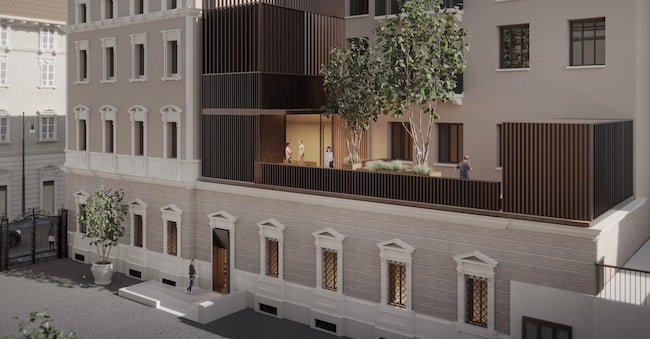
The intervention of the former Banco di Sicilia will be the most visible from the outside. "The entrance from Via Alfieri," say Elena Sacco and Paolo Danelli of the Milanese studio Dap, in charge of the architectural and interior design project together with Professor Paolo Gasparoli, a leading name in restoration work, and a team of other experts, "will be duplicated with the opening of a new front on the courtyard side. This façade, which has never been exploited and incorporates a low building, once a mere service room, will become the privileged access route to the conference space. In particular, the insertion of new steel elements with a bronze finish, marked by visible ribbing, on the roof of the low building will make the transformation immediately visible to citizens, becoming the occasion for the opening of a terrace for use by the library".
Inside, the large hall punctuated by columns on the ground floor, home to the former bank, will be cleared of the plaster false ceilings that clashed with the building's original history (built in the second half of the 19th century by the then Banca Tiberina to a design by engineer Luigi Beria and rebuilt after the damage of the Second World War) and will become a large events space, furnished with modules designed to be reconfigured according to needs. "In the basement," the planners continue, "the bank's vaults and safety deposit boxes will be preserved in a museum space, as a reminder of the past. In addition to representing a heritage for regional culture and storing historical and rare volumes, the library will also serve the Council's legislative activities.
"At Palazzo Lascaris," explains Francesco Leccese, technical and safety manager, "the renovation combines structural consolidation and energy efficiency of the building. The renovation covers the entire envelope: from the roof to all the primary frames (replaced and reinforced), from the replacement of all the windows and doors with thermal break to the replacement of the boiler systems, with the integration of geothermal and the new installation of the internal heat distribution systems, to the elimination of all architectural barriers.

