
That’s how SpaceX burned through a trillion in a month
The share price has hit an all-time low, partly due to the failed launch of Starship, but analysts remain optimistic

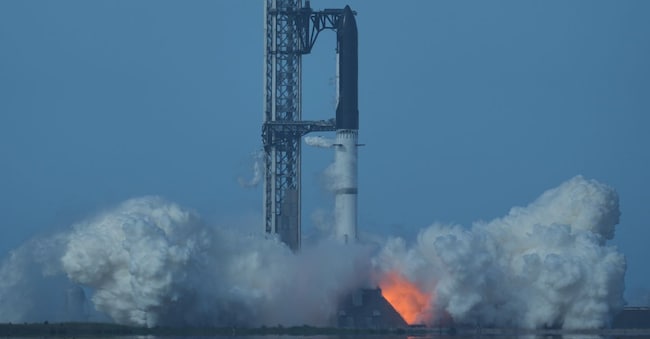
A black day for SpaceX, whose share price has hit its lowest level since going public. Shares in Elon Musk’s company fell by as much as 6.9 per cent in early trading, hitting $122.12 per share (below the IPO price of $135), before recovering some of the ground lost. As a result of this slump, its market capitalisation has fallen to around $1,600 billion. This is a significant drop, considering that on 16 June – three days after its listing – the aerospace giant was valued at 2,640 billion. In other words, SpaceX has lost over one thousand billion in market value.
Weighing on the market, in addition to a difficult day for the entire tech sector, was the failed launch of Starship. On Thursday, the rocket was set to lift off from Starbase, the company’s launch site in south Texas, for its thirteenth mission. Lift-off was scheduled for 17:45 local time. However, at the scheduled time, whilst plumes of smoke rose from the launch tower, the rocket remained on the ground. Some of the engines failed to ignite. Musk explained that the fault triggered the automatic abort sequence and that the company proceeded to vent the propellant. “We’ll analyse everything with the teams, figure out what happened and decide when the next attempt will be,” said Dan Huot, SpaceX’s head of communications. A new launch is expected within a few days.
In the history of rocketry, a launch failure is not an uncommon occurrence. But timing is everything. Thursday’s launch was supposed to be Starship’s first test since its IPO in June – the largest in history, which raised around 86 billion dollars. And Starship is the vehicle on which much of Musk’s ambition rests: taking data centres into space, expanding the Starlink network, and sending humans to the Moon and Mars. The rocket’s development, which has cost over $15 billion to date, has been marked by explosions, malfunctions and delays. And it is worth remembering that SpaceX designed it to be fully reusable – a milestone that no other manufacturer has ever achieved.
Then there is the NASA chapter. SpaceX has secured contracts worth $4 billion to land astronauts on the Moon as early as 2028. To achieve this, it will have to refuel the vehicle in orbit, launch it a dozen times in a row and certify it for human flight. A daunting list of tasks for a rocket that has not yet completed an orbital mission.
Of course, yesterday’s slump certainly extends beyond SpaceX. The company joined the Nasdaq-100 at the start of the month and analysts remain largely optimistic, with an average 12-month price target of $235.34. But the fall threatens the boom in AI-related IPOs. AI was at the heart of the narrative with which Musk’s space company presented itself to the market, with data centres in space seen as the key to securing a dominant share of a potential market estimated at $26,500 billion. A hugely lucrative prospect, but one that, for the moment, remains merely on paper.


