Global warming

So the US again turns its back on the Paris Agreement on climate change

Leaving the 2015 treaty is a huge blow to multilateral cooperation already in deep crisis

by Gianluca Di Donfrancesco

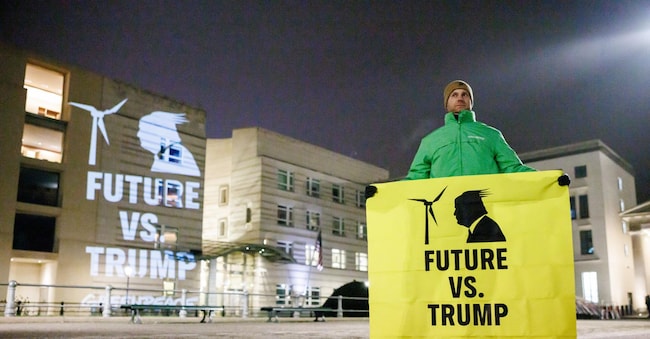
Il futuro versus Trump: una pala eolica che scombina il ciuffo del presidente americano. L’immagine è stata proiettata sulla facciata dell’ambasciata americana di Berlino, in Germania, da Greenpeace per protestare contro l’uscita degli Stati Uniti dall’Accordo di Parigi sul clima  EPA/CLEMENS BILAN

7' min read

7' min read

With the executive order signed on the day he returned to the White House, Donald Trump has taken the United States out of the Paris Agreement against climate change. Again. He had already done this during his first term: his position on the climate crisis has always oscillated between extreme scepticism and denialism. Even during the election campaign for the presidency, Trump used the term 'hoax' in reference to the Paris Agreement and the effects of global warming, and called those who in his opinion are prophets of doom 'climate hoaxsters'. On other occasions, he spoke of extreme exaggerations of the effects and risks, of the inevitability of global warming, of conspiracies and hoaxes about clean energy and other solutions to counter it. He did not mince his words against the scientific community, which he said 'does not know what is going on'.

In reality, the peer-reviewed scientific literature is virtually unanimous on the direct link between rising greenhouse gas emissions, generated by human activities, and rising global temperatures. Both set new records in 2024.

Loading...

The United States is the second largest emitter of greenhouse gases. They are responsible for about 13% of carbon dioxide emissions, compared to over 31% for China and less than 7% for the European Union (7.5% if the UK is added). The United States, however, ranks first in cumulative emissions between 1750 and 2023.

The Paris Agreement, which Trump brands as 'unfair and one-sided', is the treaty adopted in December 2015 by the more than 190 member nations of the Unfccc, the United Nations Framework Convention on Climate Change, the cornerstone on which the global diplomacy of the fight against global warming is based, through the macro-directives of mitigation (cutting greenhouse gases), adaptation (investment in prevention and resilience) and climate finance (aid to developing countries).

Acknowledging the recommendations of science, the Paris Agreement sets the goal of limiting the rise in global temperatures at the end of the century to as close as possible to 1.5 degrees, compared to pre-industrial levels, and in any case well below 2 degrees.

Entitled 'Putting America first in international environmental agreements', the executive order by which Trump gets rid of the treaty was signed on 20 January 2025 and started the process of the US withdrawing from any agreement, pact, convention or similar commitment made under the UNFCCC.

The withdrawal becomes effective one year after the notification to the UN Secretary General, which has already been executed by the White House: as confirmed by the UN, it will take effect on 27 January 2026. At that point, the United States will join the small group of states that are out of the agreement: Iran, Libya and Yemen.

In the twelve months between notification of the exit and its entry into force, it is up to Trump to decide whether to send delegations to climate meetings or to attend summits related to the agreement. Already the announcement of the intention to leave the treaty on the eve of Cop29, which took place last November in Baku, Azerbaijan, heavily influenced the conduct and outcome of the negotiations, which resulted in an almost complete failure, barely covered by an understanding that at best saves the diplomatic mechanism of the annual climate conferences. Joe Biden's envoy, John Podesta, found himself de facto delegitimised by the president-elect.

Trump has not (yet) announced withdrawal from the UNFCCC treaty either, which was ratified by the US Senate and provided the framework for negotiating and signing the Paris Agreement. In any case, the executive order indicates that the administration will severely limit participation, including funding, and may not send delegations to Conference of the Parties (COP) meetings. Once the withdrawal from the Paris Agreement takes effect, the US Administration may be allowed to attend UNFCCC meetings (and participate in any votes), but not the Paris Agreement meetings: on these occasions, the US will only be allowed to participate as observers, without voting rights.

Cutting off aid

.

The executive order of 20 January also aims to cut interventions in favour of poor and developing countries, to help them support spending on mitigation works (reduction of carbon dioxide emissions) and adaptation to climate change (works and infrastructure to prevent and cushion the impact of increasingly frequent and severe extreme climate events), including through technology transfer.

The UNFCCC, the Paris Agreement and the previous international agreement known as the Kyoto Protocol impose funding obligations on countries that are Annex I Parties to the Framework Convention. The United States is one of them. However, there are no penalties for those who fail to meet these obligations. In any case, Trump's America "shall immediately cease or revoke any purported financial commitment made by the United States under the United Nations Framework Convention on Climate Change."

So does the International Climate Finance Plan, established by former President Biden to coordinate multilateral and bilateral institutions in assisting developing countries.

What happens to the US Ndc

.

On the other hand, the Nationally Determined Contribution (NDC) of the Paris Agreement is not explicitly mentioned: this is the set of measures taken at the individual nation level that make up the strategy to achieve mitigation and adaptation (but also climate finance) targets consistent with the global goal of halting the rise in global temperatures within the 1.5° ceiling at the end of the century (already at risk), compared to pre-industrial levels.

Each country must communicate its MoU to the UN and is obliged to update it periodically. This is an obligation for those who adhere to the Paris Agreement. It is an obligation that falls upon leaving the treaty and in any case is not accompanied by sanctions: the content, implementation and achievement of the MoU are not legally binding.

In the weeks leading up to Trump's inauguration, the outgoing administration, led by Biden, had formally presented new plans to achieve lower emissions targets. The US was to reduce greenhouse gases by between 61% and 66% by 2035, compared to 2005 levels. The US also pledged to achieve neutrality (zero net emissions) by 2050.

However, other executive orders of 20 January and other measures planned by the federal government could limit the US's ability to meet these targets. Among other things, the Interagency Working Group on the Social Cost of Greenhouse Gases is being terminated, the federal government's use of the social cost of greenhouse gases in permitting is being revised, and the Environmental Protection Agency's 2009 opinion that greenhouse gases threaten the public health and welfare of current and future generations is being revised.

Furthermore, Trump has abolished many of the limits and incentives to reduce the use of fossil fuels and has clearly indicated that he intends to push as hard as possible on oil extraction (drill, baby, drill).

The US is the world's largest gas exporter and oil production has risen to record levels under Biden. These factors could counteract the progress made with renewable energy across the country in recent years, thanks in part to Biden's Inflation Reduction Act. According to the think tank Energy Transitions Commission, the Trump energy agenda could add about 0.3°C to global warming and push other countries to scale back their efforts to cut greenhouse gas emissions.

The previous

.

It is not yet clear what concrete consequences, beyond political ones, the withdrawal of the United States from the Paris Agreement will have on climate negotiations and the implementation of international climate change commitments. Washington had initialled its entry into the treaty on 22 April 2016.

The exit decided during Trump's first term had limited impact. Although the president announced the withdrawal shortly after being sworn in, in 2017, the decision did not come into effect until 4 November 2020, due to complicated UN regulations. This time, it will be quicker, as the Administration will not be bound by the same initial, treaty constraints. The US was thus only left out for a few, since on 19 February 2021, Biden had brought them back in.

Moreover, when the first Trump administration decided to leave, governments of states like California continued to implement their own regulatory programmes to reduce greenhouse gas emissions. In all, thirty states and many American cities have committed to the goals of the Paris Agreement. A phenomenon that will be repeated in this second flight from the climate treaty.

In a letter sent to Simon Stiell, Executive Secretary of the UNFCCC, New York Governor Kathy Hochul and New Mexico Governor Michelle Lujan Grisham, co-chairs of the US Climate Alliance, assured that 'our states and territories continue to have broad authority under the United States Constitution to protect our progress and advance the climate solutions we need in order to meet the goals of the Paris Agreement and reduce climate pollution. This does not change with a new federal administration." The Climate Alliance is a bipartisan coalition of over twenty governors, representing about 60 per cent of the economy and 55 per cent of the population of the United States.

For Laurence Tubiana, CEO of the European Climate Foundation and 'architect' of the Paris Agreement, 'the withdrawal of the United States is unfortunate, but multilateral climate action has proved resilient and is stronger than the policies of any individual country. Europe, together with other partners, now has the responsibility and the opportunity to step up and lead the way. By pursuing a fair and balanced transition, it can demonstrate that ambitious climate action protects people, strengthens economies and builds resilience'. The climate crisis, Tubiana added, 'cannot be tackled by any country alone: it requires a multilateral response. But this moment should serve as a wake-up call to reform the system, ensuring that those most affected, communities and individuals on the frontline, are at the centre of our collective governance'.

As happened four years ago, re-entry into the Paris Agreement by a future president would be very simple and become official after a 30-day period. The United States, under President Trump, remains the only nation out of more than 190 signatories to exit the treaty.

Copyright reserved ©
Loading...

Brand connect

Loading...

Newsletter

Notizie e approfondimenti sugli avvenimenti politici, economici e finanziari.

Iscriviti